
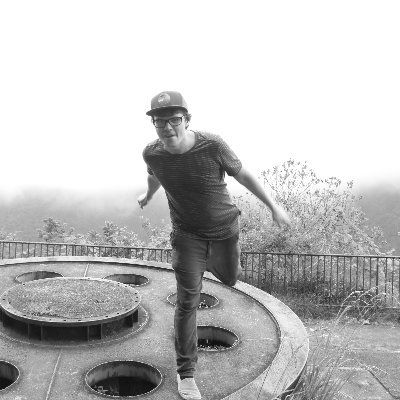
Marco Preußner
@pre_mRCO
Followers
73
Following
122
Media
1
Statuses
49
Joined January 2020

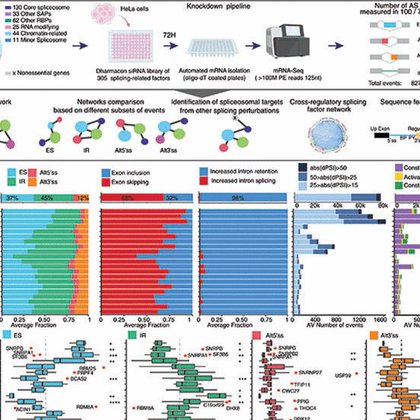
🎉Excited to announce that our paper on the blueprint of the human spliceosome is now out in @ScienceMagazine ! A decade of work with Juan Valcárcel and the incredible team at @CRGenomica to uncover the intricate roles of this essential RNA machinery. https://t.co/azZ4aSlD3s
science.org
The spliceosome is the complex molecular machinery that sequentially assembles on eukaryotic messenger RNA precursors to remove introns (pre-mRNA splicing), a physiologically regulated process...
10
46
225

Please check out our new review on commonalities between vesicular and nonvesicular transport via intrinsically disordered proteins! Hope you will like it!

New #review alert! Read on how intrinsically disordered proteins orchestrate #vesicular and nonvesicular #transport and #neuronal activity. #intrinsicdisorder #IDP @VolkerHaucke @LeibnizFMP Stephan Sigrist @FU_Berlin ➡️ https://t.co/Xy0IyHC6Xy
1
22
109
📯 Our work on a new core splicing factor is out in @MolecularCell! FUBP1 is important for splicing of long introns. Multivalent interactions support spliceosome assembly and intron bridging. Great collab with @Sattler_lab & Luck_lab. Check it out here: https://t.co/eb8TBuRZbr
2
32
170

Gene therapy approach to boost 'cold shock protein' in the brain without cooling protects mice against neurodegenerative disease
0
2
1
Hypothermia in a syringe: Manipulation of RBM3 alternative splicing using antisense RNA therapeutics prevents neurodegeneration at normal temperature. Check our article with @MallucciLab and @OmiqaBio in @EmboMolMed Link: https://t.co/hXvxQfcNqS
0
4
32
Now in @ScienceAdvances: Alternative splicing occurs after step 1 of splicing! Also reveals trans-acting factors for NAGNAG splicing. Thanks to Reinhard and his team, my phantastic students @FUBiochemistry @FU_Berlin and help from @OmiqaBio DOI: 10.1126/sciadv.adf1785
0
0
11

Our next RNA club meeting today at 5 pm will feature the research of @pre_mRCO from Heyd lab @FUBiochemistry and Vanessa Loiacono from Bock lab @MPIMP_Potsdam. Join us in person or via zoom!
1
3
4

GGGOOOAAALLL we made the cover! huge thanks to the team @NatureSMB @sarakosman for highlighting our work! https://t.co/t1nJBDIQnD 🤩😍🥰😊🥲 feelin' all the feels 🥲😊🥰😍🤩
9
11
90

Ever wonder what happens to our brains at lower temperatures? Looks like our neurons enjoy a cool bath – thanks to increased expression of a cold-shock protein, RBM3. Check out our preprint sharing some secrets behind RBM3 cold induction. https://t.co/Z4WvbOkZHy
3
42
176
For further mechanistic insights also check another preprint from @JulieQLin, @DeepakKhuperkar, @MallucciLab, @RueppLab and @ule_lab. https://t.co/PT13hnEC6T

biorxiv.org
Enhanced expression of the cold-shock protein RNA binding motif 3 (RBM3) is highly neuroprotective both in vitro and in vivo . Whilst upstream signalling pathways leading to RBM3 expression have been...
0
0
2
Can we target alternative splicing to treat neurodegenerative diseases? With @MallucciLab and @OmiqaBio we find that a poison exon is responsible for cold induced RBM3 expression. Targeting this exon by ASO-therapy results in neuroprotection in vivo.
1
2
14
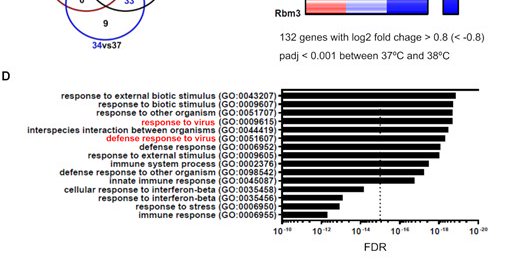
Now online @NAR_Open: How a 1°C increase in temperature induces antiviral genes and promotes an immune response! Great work from @_brunalos! https://t.co/gqCx0KJrBn
academic.oup.com
Abstract. Antiviral innate immunity represents the first defense against invading viruses and is key to control viral infections, including SARS-CoV-2. Bod
0
7
33
Here comes the second one from @AlexandraBergf1 . This time also including the great support from Marco (@pre_mRCO) from the lab of Florian Heyd @FUBiochemistry . Happy to be part of this work 🥳 https://t.co/kDL2ca3Y2p
0
7
25

Are stress granules the RNA analogs of misfolded protein aggregates? Both RNA and proteins can form promiscuous interactions. Similar to the protein chaperones, the RNA chaperones limit self-assembly. #RNASpecialIssue #condensates ➡️ https://t.co/3Wt1HPOoVy
0
26
61

The popularity of selected methods for differential #splicing identification. #bioinformatics #methodsmatter
3
18
56

For the first time, researchers have revealed the atomic structure of the human minor spliceosome, according to a new study in Science. The findings provide a framework for a mechanistic understanding of the function of this ribonucleoprotein complex. ($) https://t.co/pwkedGHz4M
1
16
92

Curious about how reovirus can survive in a low-pH environment? Find out more about it in my latest publication on @biorxivpreprint. Thanks to @MRuwolt and all AG Neu for making this possible!

An unusual aspartic acid cluster in the reovirus attachment fiber σ1 mediates stability at low pH https://t.co/YsWRVDQrHQ
#bioRxiv
0
6
11

Have you noticed it’s getting chilly in the air? How are plants coping with this? Happy to share the remarkable work of David Guillaume-Schöpfer, who did his PhD in the group, and our amazing collaborators @alexwebblab @lab_costa @Fabrizio_Doc
@Jaegerlab
https://t.co/Vy0bo3VBHB

biorxiv.org
Cold temperatures are a threat to temperate plants, and Arabidopsis thaliana has acquired an adaptive gene expression network controlled by CBF transcription factors. The CBFs are sufficient to...
5
35
109

Now online @emboreports : More insights into the importance of body temperature cycles: How alternative splicing coupled to decay (#NMD) can generate rhythmic gene expression (#circadian)! Thanks to our collaborators from #sfb973 and #Omiqa
https://t.co/kPfBbFhpCV
link.springer.com
EMBO Reports - Mammalian body temperature oscillates with the time of the day and is altered in diverse pathological conditions. We recently identified a body temperature‐sensitive...
0
0
10