

Brendan Sargent
@_brendan95
Followers
453
Following
3K
Media
8
Statuses
660
Clinical Neuroscience @uniofoxford • Former AFP @livuni • Undergad @edinunimedicine • Interests in neuro, psych, imaging • Love music more than most things
Oxford/Liverpool
Joined May 2013

Our new paper on immune activation in the brain following SC2 infection in mice is out in Frontiers in Immunology. Thanks to: @LivUni_IVES @The_MRC @NIHRresearch @InfectNeuroLab @BenedictNeuro and all our collaborators @LivUni and beyond! https://t.co/xIUQzVRYMA
0
14
25

On #WorldMentalHeathDay we would like to extend a huge thank you to all patients, families, clinicians and others who give their time to research ⭐️🧠 this is hugely important in improving our understanding of mental health - thank you!
0
2
5

Did a little podcast on research into Parkinson’s disease and the importance of science communication & public engagement 🧠 🗣️ Go on… give it a listen, promise it’s super interesting Even roped @Pollage in to be the naive voice of reason 👓
@bettyonthebrain highlights the need for more research on Parkinson's Disease and her incredible work with @BrainImagingLiv Youtube: https://t.co/n54TurX7zQ Spotify: https://t.co/26ANbbVdWm Website: https://t.co/66EM5SCjNq
#research #podcast #parkinsons
0
4
11

Out today! We report results from a PK11195 PET and DCE-MRI study investigating neuroinflammation and blood-brain barrier breakdown in acute, clinical intracerebral hemorrhage. @LauraMParkes @adrianpj1 @GJBrainResearch
journals.sagepub.com
Neuroinflammation is a promising therapeutic target in intracerebral hemorrhage (ICH), characterized in the brain by microglial activation and blood-brain barri...
3
9
18

How are cortical changes in temporal lobe epilepsy related to the hippocampus, and what does this mean for treatment? Our study in @JAMANeuro shows that white matter changes, cortical atrophy, and successful neurostimulation map to brain networks connected to the hippocampus!
2
48
155
2 minute summary of our work published in @NatureMedicine this week: 1 year after hospitalisation with COVID-19 we found cognitive deficits equivalent to 20 years of ageing associated with raised brain injury proteins and reduced grey matter volume https://t.co/vY0ielNZrJ
12
330
674

https://t.co/Ba48m5zeZL Link to paper- for me the most interesting finding was cognitive deficits were largely driven by depression- also raises ? Is acute covid depressogenic
nature.com
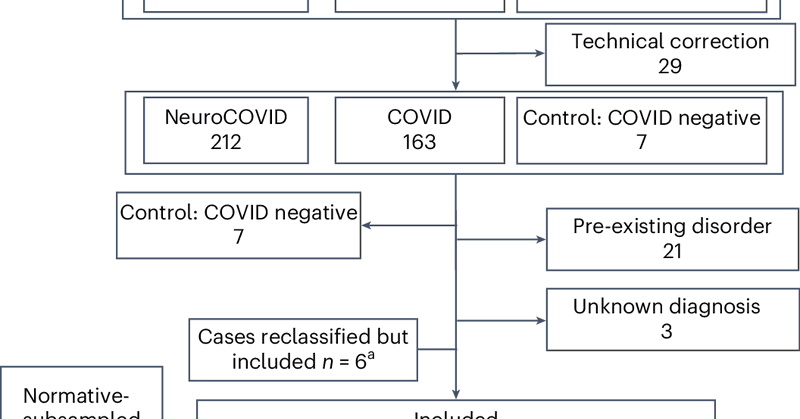
Nature Medicine - A national prospective study of patients requiring hospitalization for COVID-19 demonstrates global cognitive deficits at 1 year, associated with elevated brain injury...

#Covid cognitive deficits even 12-18months AFTER hospitalisation associated with reduced #brain volume on MRI and #brain-injury biomarkers in blood. OUT TODAY in @NatureMedicine
1
6
16

A new study published in @NatureMedicine, which used #BioResource volunteer data, has linked #COVID19 hospitalisations to significant cognitive decline & brain structure changes, even after a year post-recovery. Discover more here: https://t.co/RW9HiBwdv1
0
10
13
Important study. Great work Greta, Brendon,and team.🤯
The brain injury 1 year post-Covid hospitalization, systematically assessed with MRI (reduced grey matter), biomarkers, and cognitive deficits "equivalent in magnitude to aging from 50 to 70 years of age." https://t.co/ZJAShcRvOb
@NatureMedicine @gkwood3 @BenedictNeuro
1
1
5
The brain injury 1 year post-Covid hospitalization, systematically assessed with MRI (reduced grey matter), biomarkers, and cognitive deficits "equivalent in magnitude to aging from 50 to 70 years of age." https://t.co/ZJAShcRvOb
@NatureMedicine @gkwood3 @BenedictNeuro
49
1K
3K
#Covid cognitive deficits even 12-18months AFTER hospitalisation associated with reduced #brain volume on MRI and #brain-injury biomarkers in blood. OUT TODAY in @NatureMedicine
3
32
60

Cognitive, imaging and brain injury biomarker evidence for significant long-term brain consequences for COVID-19 infection. Great work from @gkwood3 @BenedictNeuro and many others out today in @NatureMedicine

Does COVID-19 impact the brain? Newly published @NatureMedicine One year after hospitalisation with COVID-19, we tested cognition, scanned brains and took blood samples, here's what we found: 1/n https://t.co/vY0ielNZrJ
0
6
21
@gkwood3 @BenedictNeuro @BrainImagingLiv @bettyonthebrain @Frosty_Immunity @rai_bethlehem @edbullmore @Menon_Cambridge @Tim_R_Nicholson @psychgenomics @ProfHampshire @AlanCarson15 @ProfTonyDavid @tompollak @valegiunca @Frankongho @covidcns Please also see these articles about the publication! @CIDRAP University of Minnesota Center for Infectious Disease Research and Policy: https://t.co/XItAeu0cJQ
@LivUni University of Liverpool: https://t.co/zrPuHLtiNB
@UniofOxford @KingsCollegeLon @Cambridge_Uni Bonus/Bonus
news.liverpool.ac.uk
Latest insights into after effects of severe COVID-19 on the brain
0
9
10
@gkwood3 @BenedictNeuro @BrainImagingLiv @bettyonthebrain @Frosty_Immunity @rai_bethlehem @edbullmore Many thanks also to colleagues across the U.K for brilliant work and great support throughout! @Menon_Cambridge, @Tim_R_Nicholson, @psychgenomics, @ProfHampshire, @AlanCarson15, @ProfTonyDavid, @tompollak, @valegiunca, @Frankongho amongst many others @covidcns 9/9
1
6
8
A huge thank you especially to @gkwood3, @BenedictNeuro, @BrainImagingLiv, @bettyonthebrain, @Frosty_Immunity, @rai_bethlehem, @edbullmore for the support during my AFP in Liverpool, for tireless work on this project, and for being brilliant mentors and colleagues 8/9
1
4
7
These results should be interpreted in context, as highlighted in the manuscript; analyses were pre-specified given the multimodal nature of the study, and all patients were hospitalised. Watch this space for more exciting COVID-CNS work coming from amazing colleagues 🧠 7/9
1
0
6
Future COVID-CNS work will look in more detail at whole-brain and multi-modal neuroimaging. Additionally, further work is needed to support and tease apart the potential associations between symptoms of depression, cognitive deficits, and brain injury seen in this study 🧠 6/9
1
0
6
In terms of pre-specified structural neuroimaging analysis, cognitive deficits were associated with reduced grey matter volume, particularly in the anterior cingulate cortex, which is associated with cognition, attention and emotional processing 5/9
1
6
11
Serum brain injury biomarkers were raised, on average one year after patients' hospitalisation, even in those who did not have a neurological complication associated with their COVID-19 illness 4/9
1
5
9
This cognitive impairment appears to be global, rather than domain-specific; seen across all tested cognitive domains in terms of both accuracy and response time 3/9
1
5
8