

Matt Panichello
@MattPanichello
Followers
309
Following
382
Media
0
Statuses
101
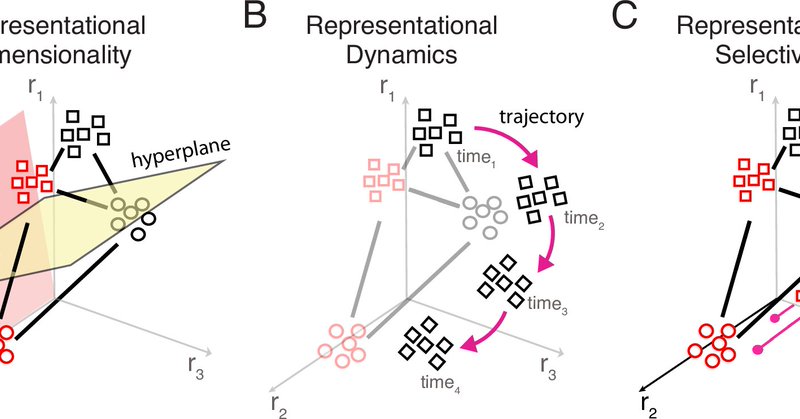
The paper is out! We show that practice fosters abstraction and enables faster access to neural states that tessellate task contingencies!

academic.oup.com
Abstract. Extensive practice makes task performance more efficient and precise, leading to automaticity. However, theories of automaticity differ on which

We have a new preprint with @kazuhi_s_ , Takahiro Nishio, and @BadreLab! “Practice Reshapes the Geometry and Dynamics of Task-tailored Representations.”
0
5
21

New theory: Categorization is Baked Into the Brain It is not at the end of sensory processing but a core computation that begins at the earliest stages, occurring throughout the cortex as predictive feedback shapes feedforward processing. https://t.co/tqfrKiS4ZR
#neuroscience

osf.io
Categorization, the grouping of similar objects, actions, or events, is fundamental to adaptive behavior. Traditionally, neuroscience assumes it begins with feature detection following to, as a final...
11
41
186

Out today in @Nature: we show that individual neurons have diverse tuning to a decision variable computed by the entire population, revealing a unifying geometric principle for the encoding of sensory and dynamic cognitive variables. https://t.co/sqNl4v8CgR
7
93
387

PhD students: Remember to apply for the Google PhD fellowship. It will make your PhD super smooth. Application opens on 10th April 2025 Deadline: 15th May 2025
6
83
816
Our new paper with @chrismlangdon is just out in @NatNeuro! We show that high-dimensional RNNs use low-dimensional circuit mechanisms for cognitive tasks and identify a latent inhibitory mechanism for context-dependent decisions in PFC data. https://t.co/ld0CQm7o3F

nature.com
Nature Neuroscience - The latent circuit model identifies low-dimensional mechanisms of task execution from heterogenous neural responses. This approach reveals a latent inhibitory mechanism for...

Excited to share my work with @EngelTatiana, out now in @NatNeuro! We show that RNNs use low-dimensional latent circuit mechanisms for cognitive tasks. We find that context-dependent decisions in both RNNs and PFC arise from latent inhibitory mechanisms.
0
23
99

Summer research opportunities in psychology and neuroscience for URM/low-income/first-gen undergrads at U. Wisconsin–Madison. Details and application portal at
psych.wisc.edu
Application Opens: November 1, 2018 Application Deadline: February 15, 2018 Admission Notification: Ongoing After Application deadline Application Link: https://srop-uwmadison.fluidreview.com *Note...
0
14
17
Thanks to @erinLrich, @EelkeSpaak, and an anonymous third reviewer for their thoughtful comments
1
0
1
A new, improved version of this paper is now published at https://t.co/im3pIpuqpb !

nature.com
Nature - By recording large populations of neurons in behaving monkeys using newly developed silicon probes, we show that intermittent periods of memorandum-specific spiking coexist with synaptic...
New paper with Donatas Jonikaitis, Jin Oh, Shude Zhu, @EthanTrepka, & Tirin Moore. We used high-density recordings (neuropixels) and single-trial analyses to understand how spiking and activity-silent mechanisms support working memory.
3
10
32

Selective attention guides behavior through target enhancement and distractor suppression. Using human ECoG, we uncovered the complementary neural mechanisms enabling this gating process. https://t.co/XANg4SYZUN Work with Sabine Kastner, Bob Knight, @OleJensenOHBA, @FiebelkornIan
1
7
24
Now out in Nature Communications!
nature.com
Nature Communications - People can choose the correct actions to perform in a context-dependent way. Here, the authors show that this ability requires reaching a target brain state just prior to...
Excited to share a new preprint with @apaxon, @kazuhi_s_ & @BadreLab : “A Transient High-dimensional Geometry Affords Stable Conjunctive Subspaces for Efficient Action Selection”
1
14
39

We live with the limitations of our memory, but don’t really know where they come from. Our new paper ( https://t.co/DYiL0IfxvF) studies "swap errors", which we argue arise during memory manipulation – see thread for more! @timbuschman, @MattPanichello, @wjeffjohnston
1
28
78

New project: https://t.co/qIdc6tvcbw Engineers, ML researchers, mech interp community: Reach out if you're interested in getting involved
22
84
649
TigerBrain applications due next week! Postdocs from *all* fields of neuroscience encouraged to apply. More details 👇

Are you a postdoc about to go on the faculty job market? If so, we encourage neuroscientists from all areas (cognitive, systems, molecular, etc) to apply to TigerBrain: the annual PNI Postdoc Scholars symposium, happening October 17. Apply by Aug 15: https://t.co/Qy7pwnGVOl
0
2
6

1/5 Excited to finally share our new paper (led by @lndriscoll, now a group leader at the Allen!) in @NatureNeuro on modular computation in neural networks! We've explored how artificial recurrent networks handle multiple tasks, offering insights into flexible computation.
8
85
300
Nishal is brilliant and super nice, you should work with him

Super excited to start my lab @RiceNeuro and @RiceECE in January 2025 !🎆 We aim to understand the human brain using intracortical BCIs and enable new translational applications with high-dimensional read-out and write-in. Looking for awesome postdocs + grad students:
0
0
2
A revised version of our preprint on precisely replicating neural activity through a dynamic, cellular-resolution electrical stimulation sequence using temporal dithering and spatial multiplexing. New experimental validation led by AJ Phillips. https://t.co/Z2MEJWN1Tz

biorxiv.org
Neural implants have the potential to restore lost sensory function by electrically evoking the complex naturalistic activity patterns of neural populations. However, it can be difficult to predict...
1
3
15

Happy to see my thesis work out today in @Nature! https://t.co/7PC0MLkW8I Josh Merel @jessedmarshall @lhq20 @yuvaltassa Ugne Klibaite @amandajgellis Greg Wayne @mattbotvinick @BOlveczky @GoogleDeepMind Video credit to the talented @KJHerr23
21
155
630

Our paper, Crows ‘count’ the number of self-generated vocalizations, is out! With this amazing team (@KatharinaBrecht, @lena_veit, A_Nieder), we uncovered that crows are able to control the number of vocalizations produced. https://t.co/b9zpgV3qhC

science.org
Producing a specific number of vocalizations with purpose requires a sophisticated combination of numerical abilities and vocal control. Whether this capacity exists in animals other than humans is...
2
46
111

In 2019 I went to Cambridge to debate @lengyel_m on the usefulness of Marr's Three Levels of Analysis. We've finally published a pair of "CrossTalk" articles in @JPhysiol laying out our positions. My piece: https://t.co/0RWNM9Hk54
#MarrNoMore #DownWithThe3Levels
4
43
203

We're also hiring! We are looking for at least one full-time RA/lab manager to join the newly located @ShenhavLab this summer. Please RT and pass this along to your best candidates!
1
35
42