

Saffron Huang
@saffronhuang
Followers
7K
Following
4K
Media
91
Statuses
1K
how shall we live together? societal impacts researcher @AnthropicAI • @collect_intel co-founder • ex @AISecurityInst @GoogleDeepMind⋅ views mine
sf
Joined April 2013
Really proud and excited to release this work on empirically measuring AI values “in the wild” — understanding, analyzing and taxonomizing what values guide model outputs in real interactions with real users. There is a lot of work on training models to follow particular

New Anthropic research: AI values in the wild. We want AI models to have well-aligned values. But how do we know what values they’re expressing in real-life conversations? We studied hundreds of thousands of anonymized conversations to find out.
10
24
266
I’m so proud to have led this work, and really excited that it’s out now. We decided to study how Anthropic engineers/researchers’ jobs are changing because we thought: ok, AI is being used a lot in people’s jobs, and there’s a lot of speculation of what that might mean, but not
How is AI changing work inside Anthropic? And what might this tell us about the effects on the wider labor force to come? We surveyed 132 of our engineers, conducted 53 in-depth interviews, and analyzed 200K internal Claude Code sessions to find out. https://t.co/YLLjs9W9e5
5
15
364

Last night, with @GiveDirectly, we hosted what we expect to be one of many conversations to come about AI & UBI — ft. @NickAllardice & Caitlin Tulloch from GD & @saffronhuang from Anthropic, moderated by @KelseyTuoc We'll publish the full conversation on our website soon!
1
2
12
this is a really cool role!!! if you're a full stack SWE who cares about HCI / human agency / education APPLY!!!!!! https://t.co/6hcvsmPlbK

job-boards.greenhouse.io
San Francisco, CA
4
25
230
“We continued to litigate strategies for evaluating AI, never answering the question: If we have never designed a test for the human mind that captures what it aspires to, why do we believe we can meaningfully measure AI systems, which are far more alien?” https://t.co/AKZdHiyzGE

thepointmag.com
AI measurement is a new field, and everything is still under contention—not just how we test but what we should be testing for.
0
1
2
My new piece out in The Point today -- on what we cannot know about or measure in LLMs, and why

New online, @saffronhuang on what it means to measure intelligence—in large language models and in us: https://t.co/AKZdHiyzGE
1
4
24

@saffronhuang and I will be at #COLM2025 to talk about this work!
New Anthropic research: AI values in the wild. We want AI models to have well-aligned values. But how do we know what values they’re expressing in real-life conversations? We studied hundreds of thousands of anonymized conversations to find out.
1
3
22

BREAKING: Governor @GavinNewsom just signed our groundbreaking AI bill, SB 53, to promote AI innovation (creating a public cloud called CalCompute), require transparency around AI lab safety practices & protect whistleblowers at AI labs who report risk of catastrophic harm. 🧵
74
50
302
this is incredible stuff. so cool to see @AnthropicAI release more valuable data on AI usage across the economy

The Anthropic Economic Index now covers geographic and 1P API data. We’re releasing new research, open source datasets, and an interactive website to explore AI usage across the world.
1
1
13
New from the Anthropic Economic Index: the first comprehensive analysis of how AI is used in every US state and country we serve. We've produced a detailed report, and you can explore our data yourself on our new interactive website.
90
310
2K

Today we're launching new ways to learn in Claude Code and the Claude app. First up: Claude Code now lets you customize communication styles with /output-style
171
574
6K

@divyasiddarth and @audreyt joined @reidhoffman and @AriaIrene, hosts of the Possible Podcast, to talk about one of the most important topics today: how democracy and AI can bring out the best of each other.
1
12
67

My team at @AISecurityInst is hiring! This is an awesome opportunity to get involved with cutting-edge scientific research inside government on frontier AI models. I genuinely love my job and the team 🤗 Link: https://t.co/poiWqKlmgt More Info: ⬇️
3
24
111
Highly recommend applying if you have ideas for understanding AI's economic impacts or policy proposals!
Announcing the Anthropic Economic Futures Program—our latest commitment to understanding AI's impacts on work and the economy. The program will support new research and actionable policy solutions to address the workforce impact of AI.
3
9
51
Announcing the Anthropic Economic Futures Program—our latest commitment to understanding AI's impacts on work and the economy. The program will support new research and actionable policy solutions to address the workforce impact of AI.
66
188
2K
it’s really important to know both Claude’s “EQ” not just “IQ” (for lack of better terminology) — take a look at the findings below
New Anthropic Research: How people use Claude for emotional support. From millions of anonymized conversations, we studied how adults use AI for emotional and personal needs—from navigating loneliness and relationships to asking existential questions.
0
6
71
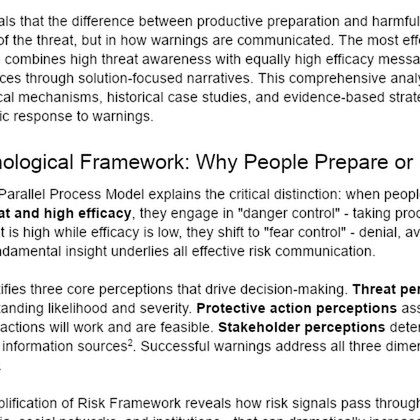
Bonus: When are warnings actually effective? I used Claude to create a deep research report on "When do warnings about the future become a self fulfilling prophecy vs. actually preventing the situation?" Based on research & past case studies, the key difference is not in the
docs.google.com
When Warnings Work: The Psychology of Preparation versus Panic Research reveals that the difference between productive preparation and harmful panic lies not in the severity of the threat, but in how...
1
0
5
Full conversation:

joinreboot.org
Listen now (60 mins) | Saffron Huang on human agency in AI forecasting
1
0
2
What if we mapped causal chains and leverage points instead, to show people what can actually be done, instead of making a super-smooth, neat narrative? (Apparently the AI 2027 folks are working on this, which is great)
1
0
3
I see narratives that underrate coordination and consideration of institutions as particularly dangerous, because it underrates human agency
1
0
2
If your uncertainty is so high, why anchor us to this specific line?
2
0
2