

Tosif Ahamed
@_mlechha
Followers
418
Following
2K
Media
68
Statuses
1K
Trying to understand the world in my own way, one mistake at a time. Theory Fellow @HHMIJanelia https://t.co/aRy6hlrxyY
Toronto, Ontario, Canada
Joined June 2016
1/ Excited to announce that my Ph.D. work with @greg_stephens and @antoniocbscosta on the dynamics of C. elegans locomotor behavior is out now in Nature Physics! Here's a tweet thread about our primary contributions.

Capturing the continuous complexity of behaviour in Caenorhabditis elegans
7
39
142

1/ Our paper appeared in @Nature today! https://t.co/bsdYF8k6G6
@FieteGroup @KhonaMikail. Explains emergence of multiple grid cell modules, w/ excellent match to data! Novel mechanism for applying across vast systems from development to ecosystems. 🧵👇
2
47
194

We’re excited to collaborate with @NCBS_Bangalore to launch the PRISM Fellowship (Promoting Research and Inclusion in STEM). It offers an unparalleled opportunity for students from disadvantaged backgrounds to gain research experience, academic skills & mentorship at NCBS.
4
72
127

Super excited to start my lab @NCBS_Bangalore in March 2025! The lab will primarily be powered by chemistry, and we will build chemical tools for biology with a strong focus on fluorescence imaging. We will collaborate widely and are open to any relevant areas of biology.
53
36
666

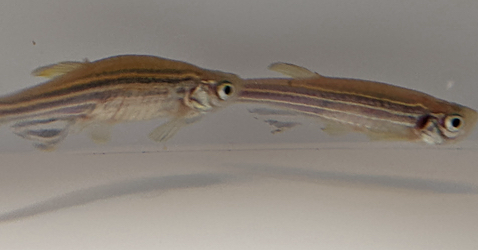
Delighted to see the main paper from my Phd, our work on the Dynamics of Dominance in 3D #ZebraFish fights, published today in PRX Life! Also check out the great Physics Magazine Focus story from Philip Ball
physics.aps.org
By observing two fighting fish, researchers have decoded the repertoire of trajectories and body postures used in the interaction—and identified the winner.

A new 3D tracking system captured the movements of two male #ZebraFish as they fought for dominance, showing how the fish chased each other through a tank using “attack” and “circle” maneuvers until a winner and loser emerged. 🐟 Read the paper: https://t.co/8HXFOBmuoA
3
9
42
🐛Janelia Theory Fellow Tosif Ahamed (@_mlechha) is part of a team that developed an AI model that simulates complex animal movements with exceptional accuracy. Read about this new work, led by @greg_stephens @OISTedu & @antoniocbscosta @InstitutCerveau ➡️ https://t.co/shBZ0qnONY
0
26
179

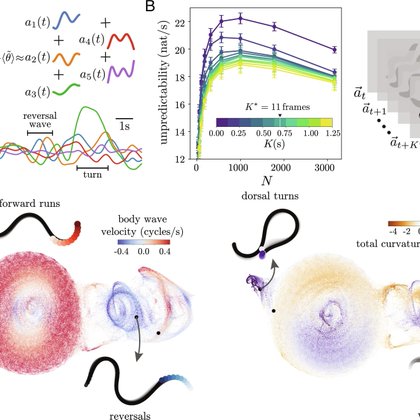
When @willryu first shared his beautiful movies of a wiggling worm, I was blown away! But how can we both accurately and with interpretability capture the posture dynamics of an animal’s behavior?
1
6
13
Thus we’re pleased to share our @antoniocbscosta @_mlechha answer to this challenge using the nematode C. elegans @PNASnews
pnas.org
How do we capture the breadth of behavior in animal movement, from rapid body twitches to aging? Using high-resolution videos of the nematode worm ...
2
4
11
📢NEW!! We are excited to announce our expansion into a new and exciting form of science communication: Theatre! 🎭 This dynamic medium has incredible potential to make a lasting impact. If you are in Bengaluru on Sunday, 4th Aug Sign up here:
docs.google.com
Anchehalli is a pretty little village nestled between forest, farm land and grazing pastures. Manju, the naughty little kid of Anchehalli is not his usual jolly self. What happened to him? Something...

Anchehalli, a quaint village surrounded by forests and farms, faces a mystery. Manju, usually full of mischief, isn't his jolly self. What happened to him? Join the villagers as they tackle this mystery. Sign up here: https://t.co/URSara4vuL
#science_theatre #play #scicomm
1
3
15
Anchehalli, a quaint village surrounded by forests and farms, faces a mystery. Manju, usually full of mischief, isn't his jolly self. What happened to him? Join the villagers as they tackle this mystery. Sign up here: https://t.co/URSara4vuL
#science_theatre #play #scicomm
0
5
22

🚨Preprint‼️ 1/ Predicting neural activity is notoriously difficult and requires complicated models. Here we develop simple “minimodels” which explain 70% of neural variance in V1! 🐭🐒 #neuroai @computingnature @marius10p @NunezKant Paper: https://t.co/Cr5ppTrAZX Recording 🔬 :
3
47
170
How do bacteria grow and move in large groups where cells appear adhered to each other but can move freely? Using capillary forces from thin layers of water! Check out our new preprint with Matt Black, Chenyi Fei, @RicardAlert and Ned Wingreen: https://t.co/DN1SUQh9xb
1
19
109
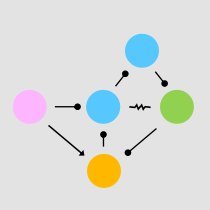
A long journey by @JunMeng_elegans, @_mlechha and Wesley; a pleasure with the Shangbang and Thomas' groups; gratitude to the helpful inputs and warm support from Quan and Aravi https://t.co/zQWiQ2Emlt
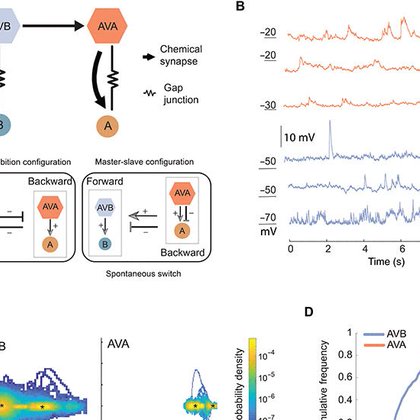
science.org
Mutually exclusive motor states are governed by a single neuron acting at two timescales in C. elegans.
1
1
5
Positions for remote work available to help us with #suite2p, #kilosort2 or #cellpose. Start date flexible.
5
83
142
The Kilosort4 paper is now published @naturemethods. We put a lot of work into building and properly documenting all things Kilosort (including for older versions). w/ @computingnature #kilosort paper: https://t.co/db36Z7T7Ke code: https://t.co/ULZKyF8uy9
6
50
236

Spike sorting with #Kilosort in #python w/ #pytorch + @pyqtgraph ! >>> pip install kilosort[gui] To learn more, check out the docs ( https://t.co/7xz5DoB1sS by Jacob Pennington), or watch the talk ( https://t.co/hpoCdrqYbr by @marius10p )

The Kilosort4 paper is now published @naturemethods. We put a lot of work into building and properly documenting all things Kilosort (including for older versions). w/ @computingnature #kilosort paper: https://t.co/db36Z7T7Ke code: https://t.co/ULZKyF8uy9
2
17
78
Beautiful work by @antoniocbscosta & colleagues on a biological basis for power laws in behavior. Slowly changing transition rates seems enough. The work is also a nice example of the power of integrating experiments, theory and theoretically motivated data analysis in biology.

Why are power laws and heavy-tailed distributions so widespread in animal behavior? We show how behavioral plasticity might be the minimal necessary ingredient w/ M Vergassola @LP_ENS_, Gautam Sridhar @wyartlab @ClaireWyart
https://t.co/NKe2SsboPV (thread below) 1/12
1
1
8
Why are power laws and heavy-tailed distributions so widespread in animal behavior? We show how behavioral plasticity might be the minimal necessary ingredient w/ M Vergassola @LP_ENS_, Gautam Sridhar @wyartlab @ClaireWyart
https://t.co/NKe2SsboPV (thread below) 1/12
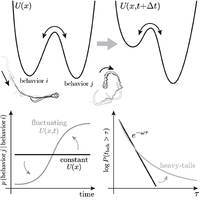
journals.aps.org
In this study, non-ergodic models accounting for slow behavioral adaptive changes explain universal long-term patterns observed in the motions of animals, such as larval zebrafish and C. elegans.
As animals shift priorities, their decisions impact how they move. Using a time-varying #model, scientists show how slowly adjusting strategy due to external cues or internal needs explains long-term locomotion behavior seen in C. elegans and zebrafish. https://t.co/eUf1TeOwUR
3
26
69
We invite students & postdocs in #neurotheory to apply for this “by the students, for the students” workshop to discuss theoretical #neuroscience techniques, participate in detailed discussions, & network with peers ✈️Hotel, meals & travel fully covered Learn more & apply by
1
10
19
As animals shift priorities, their decisions impact how they move. Using a time-varying #model, scientists show how slowly adjusting strategy due to external cues or internal needs explains long-term locomotion behavior seen in C. elegans and zebrafish. https://t.co/eUf1TeOwUR
1
11
36

Excited to share @EliasScheer's thesis work from my lab, in a paper that explores how animal decision-making is coupled to behavioral state changes over minute-long and second-long timescales. https://t.co/KMas4B7uyL
2
24
79