
Nature Methods
@naturemethods
Followers
152K
Following
2K
Media
2K
Statuses
6K
Nature Methods publishes cutting-edge methods, tools, analyses, resources, reviews, news and commentary, supporting life sciences research. Tweets by editors.
New York
Joined March 2011
The wait is over!! We are thrilled to announce that we have chosen Spatial Proteomics as 2024’s Method of the Year! 🥳 For more on Spatial Proteomics and a road map to this special issue, please see this month’s Editorial or read on in this thread. https://t.co/phXooJzJda
11
299
876
Nature Methods is hiring! We are looking for candidates with expertise in genetics, genomics and/or molecular biology to join our editorial team in the US (NYC/Jersey City) or China (Shanghai/Beijing). Apply by December 12! https://t.co/zxh4dyT0NZ
0
4
27
Confocal Airy beam integrated with single-photon oblique light-sheet tomography is a high-throughput imaging approach for brain-wide mapping of neurons. https://t.co/0tHi9tmyCq
0
2
10
Stimulus-modulated approach to steady state (SASS): an acquisition scheme for event-related fMRI that generates data interspaced with acquisition-free periods for stimulus presentation or response reporting. @walkbkrenil
https://t.co/L95EqOLgdv
0
1
4
Also check out the News & Views on the work here: https://t.co/0Me13VAnY4
0
0
0
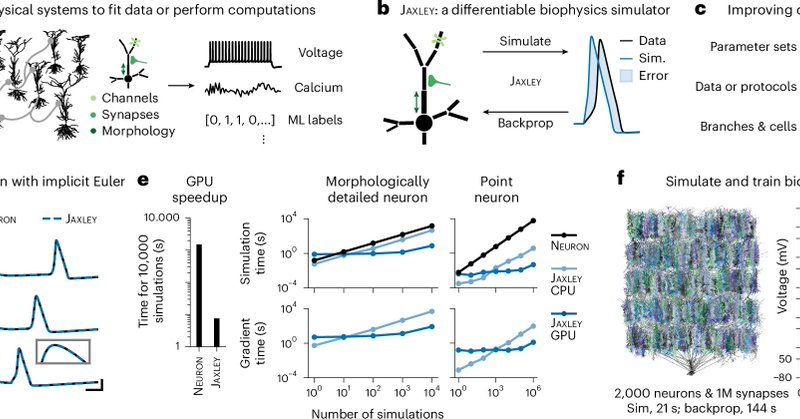
Jaxley: a platform for simulating biophysical models in neuroscience. @deismic_ @jakhmack @uni_tue
https://t.co/JRiX33mT5e
nature.com
Nature Methods - Jaxley is a versatile platform for biophysical modeling in neuroscience. It allows efficiently simulating large-scale biophysical models on CPUs, GPUs and TPUs. Model parameters...
1
4
33
By developing a strategy of metagenomic coassembly and prioritizing divergent marker gene sequences, Bin Chicken efficiently recovers more than 77,000 microbial genomes with high novel diversity which expands the tree of life. https://t.co/1efn0WAjUS
0
2
10
MISO: a micro isolation method for single-particle cryo-EM grid preparation for extremely small sample amounts. https://t.co/Tewzj6KIaU
1
8
24
Read this powerful piece from a computational neuroscientist who experienced a turning point in her research upon witnessing human brain surgery. https://t.co/0j08zmbFe8
1
0
2
Nature Methods is hiring! We are looking for candidates with expertise in genetics, genomics and/or molecular biology to join our editorial team in the US (NYC/Jersey City) or China (Shanghai/Beijing). Apply by December 12! https://t.co/zxh4dyT0NZ
0
4
27
In our November issue we feature several papers on the theme of tools for cell segmentation and tracking. For a roadmap to the issue, read our Editorial. https://t.co/Fusdt0Z2oB
0
3
15
Our November issue is now live! 🎉 https://t.co/PBA3WcH2Wh On the cover, cell tracking in a developing zebrafish embryo visualized using Ultrack. Cover by Alexandre Dizieux, Jordão Bragantini, Loic Royer, Merlin Lange, CZ Biohub. Paper here: https://t.co/SuOLwJUfl7
0
20
111
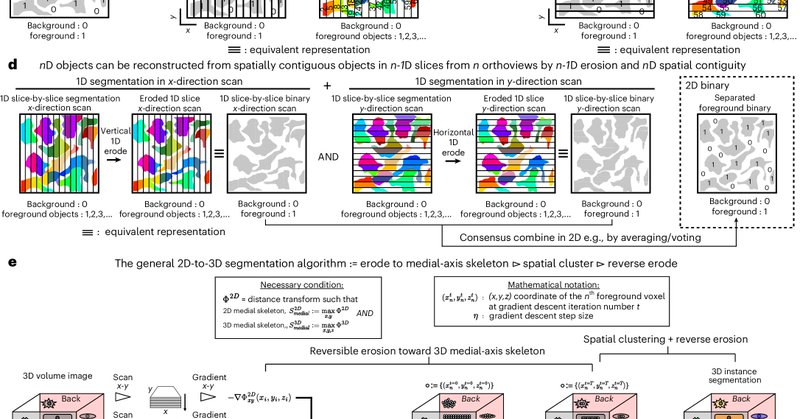
u-Segment3D: a universal framework for 2D to 3D cell segmentation that generalizes across cell types and imaging modalities. https://t.co/cH4mypXkze
nature.com
Nature Methods - u-Segment3D is a universal framework that translates and enhances 2D instance segmentations to a 3D consensus instance segmentation without training data. It performs well across...
0
26
90
For a quick summary, read the Research Briefing on this work, here: https://t.co/xuiIRpGBLe
By learning a differentiation potential using an optimal transport-based approach, STORIES models and infers cell fate trajectories using spatiotemporal omics data. @gjhuizing @JulesSamaran @gabrielpeyre @cantinilab
https://t.co/dG7HBQ09j8
0
1
5
nELISA: a miniaturized sandwich immunoassay that serves as a massively scalable platform for quantitative proteomics. https://t.co/FlLah55HUn
0
23
124
Monod fits biophysically motivated models to single-cell transcriptomics data, providing insights into gene expression dynamics. @goringennady @lpachter @mariacarilli @johnjvastola
https://t.co/zx27cbPvZS
0
15
63
Read the Research Briefing on this work, here: https://t.co/NNLo8jZSGz
0
0
0
CABLE: a method that uses information about cell or nuclear shape to infer fiber tracts in the brain. https://t.co/ujAdJll8mt
1
2
13
Read the Research Briefing on this work, here: https://t.co/NNLo8jZSGz
0
0
1
CABLE: a method that uses information about cell or nuclear shape to infer fiber tracts in the brain. https://t.co/ujAdJlkAwV
1
0
3
Read the Research Briefing on this work, here: https://t.co/NNLo8jZSGz
0
0
0