
Nafsika Forte
@NafsikaForte
Followers
139
Following
1K
Media
0
Statuses
56
Chemical Biologist. Postdoc from the @DanNomura group @UCBerkeley. PhD in Chemical Biology from @UCL.
San Francisco, CA
Joined October 2017

Happy to present our latest paper with @pottslab & @Amgen in @J_A_C_S by co-first authors @C_M_Zammit & Cory Nadel on the discovery of a direct-acting covalent destabilizing degrader of AR and the undruggable truncation variant of AR, AR-V7, in androgen-independent prostate
1
21
122
Excited to highlight our latest @biorxivpreprint by graduate student @L__Orreo on the discovery of a covalent degradative handle that acts through two unique cysteines C173 and C178, on the frequent-hitting E3 ligase DCAF16 that can be used to modularly design monovalent and
2
13
98
New @biorxivpreprint from our lab, Maimone lab, & @NovartisScience on a covalent destabilizing degrader of myc that acts through stereoselective targeting of an IDR C203 in MYC! Congrats to Hannah Rosen & Kelvin Li! https://t.co/LIyTB5jOod
biorxiv.org
While MYC is a significant oncogenic transcription factor driver of cancer, directly targeting MYC has remained challenging due to its intrinsic disorder and poorly defined structure, deeming it...
1
11
51
Excited to post our latest @biorxivpreprint by @C_M_Zammit, Cory Nadel, @pottslab and our group on a covalent destabilizing degrader of AR and AR-V7 in androgen-resistant prostate cancer cells! Great collaboration with @Amgen.
biorxiv.org
Androgen-independent prostate cancers, correlated with heightened aggressiveness and poor prognosis, are caused by mutations or deletions in the androgen receptor (AR) or expression of truncated...
5
10
65

Happy to share that we have a new @AstraZeneca-linked PhD opportunity available (with @BakerGroupUCL) in the area of C-terminal cysteine modification to create novel antibody-drug conjugates (ADCs)! Link to apply below, deadline: 28/01/25, @UCLChemistry
https://t.co/q7DsQVasHZ
0
9
19
Excited to present our newest paper in @J_A_C_S by @Qian37774492 on using a novel covalent molecular glue of 14-3-3 and ER/YAP/TAZ as a 14-3-3 recruiter for targeted protein localization of nuclear neo-substrates into the cytosol as a new induced proximity approach.
3
26
178
Excited to have this paper published! Congrats to @florAliciaflor and @NafsikaForte on their @J_A_C_S paper on a direct-acting covalent destabilizing degrader against the challenging oncogenic transcription factor beta-catenin! We go from an initial nonspecific and nonpotent hit
9
32
185
Congrats to @melissalim00 & @ThangDoCong on their @ACSCentSci paper on the discovery of a minimal degradative covalent handle that targets DCAF16 for rational design of monovalent degraders! Thanks @NovartisScience @TheMarkFdn! @UCB_Chemistry @berkeleyMCB

pubs.acs.org
Targeted protein degradation with monovalent molecular glue degraders is a powerful therapeutic modality for eliminating disease causing proteins. However, rational design of molecular glue degraders...
3
18
95
Congrats to our former grad student and now postdoc @floraliciaflor on her paper on investigating proteome-wide targets and anti-cancer mechanisms of the natural product Ophiobolin A in collaboration with #TomMaimone! @UCB_Chemistry

pubs.acs.org
Ophiobolin A (OPA) is a sesterterpenoid fungal natural product with broad anticancer activity. While OPA possesses multiple electrophilic moieties that can covalently react with nucleophilic amino...
2
10
76
Congrats to @FrontierMeds!!!! So proud of this accomplishment!! Frontier Medicines Announces Oversubscribed $80 Million Series C Financing to Support Progress of Clinical-Stage Pipeline | Frontier Medicine
frontiermeds.com
4
3
51
Congrats to chembio grad student @melissalim00 and postdoc @thangdocong91 on their @biorxivpreprint on the discovery of a minimal covalent DCAF16 degradative handle for rational design of linker-less monovalent degraders against not only BRD4 but also several other targets!
2
29
162
Congrats to our postdocs Seong Ho (Johnny) Hong & @adivkrn on the discovery of a covalent recruiter against the CUL1 substrate adaptor protein SKP1 that targets a SKP1/substrate receptor interfacing C160 to enable PROTAC applications! @UCB_Chemistry @berkeleyMCB @TheMarkFdn
6
13
92

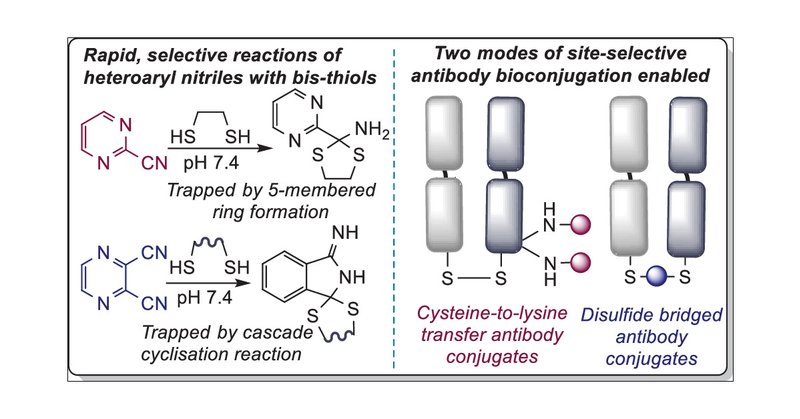
The Nitrile Bis-Thiol Bioconjugation Reaction | Journal of the American Chemical Society @vijaychudasama_ @UCLChemistry #Thiol #Nitrile #Bioconjugation
pubs.acs.org
Electron-poor aryl nitriles are promising reagents for bioconjugation due to their high electrophilicity and selectivity for reaction with thiols, albeit generally in a reversible manner. A transient...
1
9
59
New @biorxivpreprint from our lab by @Qian37774492 on a covalent 14-3-3 molecular glue with the transcription factors YAP and TAZ and using this glue as a 14-3-3 recruiter to sequester nuclear neo-substrates into the cytosol! Thanks to #AppleTreePartners & @themarkfdn
2
29
122
Excited to showcase our new @biorxivpreprint frm postdocs @floraliciaflor & @NafsikaForte on the discovery of covalent degraders of oncogenic transcription factor b-catenin (CTNNB1) via destabilization! @UCB_Chemistry @berkeleyMCB @TheMarkFdn
https://t.co/eAznEL1ikr

biorxiv.org
β-catenin (CTNNB1) is an oncogenic transcription factor that is important in cell-cell adhesion and transcription of cell proliferation and survival genes that drives the pathogenesis of many...
4
25
130
New paper from our lab by postdoc Seong Ho (Johnny ) Hong on the discovery of a covalent recruiter against the Cullin adapter protein SKP1 for targeted protein degradation applications!
biorxiv.org
Targeted protein degradation with Proteolysis Targeting Chimeras (PROTACs) is a powerful therapeutic modality for eliminating disease-causing proteins through targeted ubiquitination and proteasome...
3
19
99

Excited to share this work from @tineisadora! Precise control over protein subcellular localization could have massive implications for gain-of-function therapeutic strategies. We showcase targeted relocalization activating molecules (TRAMs) for rewiring interactomes. (1/n)

Targeted Protein Relocalization via Protein Transport Coupling https://t.co/FiHfEUeYck
#bioRxiv
4
42
159
New @biorxivpreprint from our lab and @UCB_Chemistry grad student Margot Meyers on the discovery of a covalent recruiter for the CUL4A adaptor protein DDB1 for PROTAC applications!
biorxiv.org
Targeted protein degradation has arisen as a powerful therapeutic modality for eliminating proteins. Thus far, most heterobifunctional Proteolysis Targeting Chimeras (PROTACs) have utilized recruit...
1
13
92

It has been four years since this journey started, but (this chapter at least) has come to an end! Our work on "Chemical generation of checkpoint inhibitory T cell engagers for the treatment of cancer" is now online in @NatureChemistry! https://t.co/jUd5EFBswL 1/9
6
19
37