
Alistair Evans
@DrTeethAl
Followers
1K
Following
1K
Media
46
Statuses
877
Biologist and palaeontologist | Evolutionary morphology, evo-devo, cool things that teeth do, 3D imaging. Head of @EvansEvoMorph Lab, Professor at @MonashBiol.
Melbourne, Australia
Joined August 2012
Introducing a new rule of nature: the power cascade! Revealing how pointed structures grow across the tree of life. Teeth, claws, horns, beaks and thorns. Follow our thread below. #OpenAccess @BMCBiology @EvansEvoMorph
https://t.co/8s0rqjHEat
9
78
218

A new study shows how different snake species have evolved very different strategies to deliver their deadly bites. @DrTeethAl @MonashUni

theconversation.com
A new study shows how different snake species have evolved very different strategies to deliver their deadly bites.
0
1
0
How do we capture fast and furious snake bites? High-speed video with 3D reconstruction, all at 1000 frames per second! @MonashBiol @J_Exp_Biol @SilkeCleuren
0
0
1
Full speed snake strikes - faster than the blink of an eye! From our new paper in @J_Exp_Biol @SilkeCleuren
0
0
0
Speedy snakes! Our new study on high-speed kinematics of strikes in venomous snakes https://t.co/2sBqujilXl
#MonashBiol @SilkeCleuren
journals.biologists.com
Editors' choice: Comparison of prey strikes of 36 venomous snake species using high-speed 3D kinematical analysis shows vipers are often faster than elapid snakes, with highest strike velocities in...
0
0
1

One fossilised log from southern Australia has spilled the dirt on termites' very cold and very ancient past. @Ichnologist @DrTeethAl @MonashUni

theconversation.com
One fossilised log from southern Australia has spilled the dirt on termites’ very cold and very ancient past.
0
2
3

Five fossils of world's oldest known mega raptors have been found in Australia and detailed in a new @JVP_vertpaleo study. @Dinoman_Jake et al. say the discovery gives an insight into the group's evolutionary history and ancient ecosystem🦖 https://t.co/pVHTettIPw
#FossilFriday
0
3
5
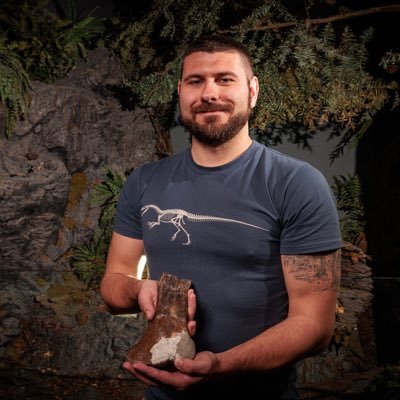
They’ve only waited 120Ma. A new glimpse into theropod diversity from Early Cretaceous Australia: megaraptorids, an unenlagiine, and for the first time, carcharodontosaurians. Published in @JVP_vertpaleo , read it here: https://t.co/XpRd3eUAB8 Artwork by Jonathan Metzger. 1/10
5
89
395
@museumsvictoria @PPaleoartist @Inxcetus @Joseph_Bevitt @DrTeethAl Finally, if you’d like an alternative runthrough of this research, check out are article at The Conversation here: https://t.co/6rCV2mjo8W 10/10

theconversation.com
Some of the new finds are the first evidence of these types of dinosaurs from Australia.
2
10
31
The long, sharp, blade-like canines found in many extinct predators evolved at least five times throughout history. @TIPollock @MonashUni

theconversation.com
The long, sharp, blade-like canines found in many extinct predators evolved at least five times throughout history.
2
2
7

New paper about the functioning of saber teeth led by the amazing @TIPollock 🥳 combining 3DGM with biomechanical testing we identified functional optimality as a key driver underpinning the repeated evolution of extreme saber-tooth morphologies 🔪🦁 https://t.co/FmZYXaMwdM
1
73
248
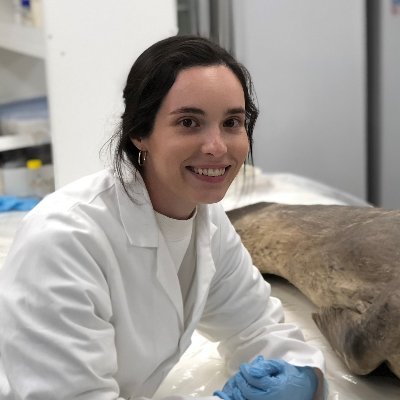
Thanks to all my coauthors, @digitalpalaeo @NarimaneChatar Pablo Milla Carmona @DSRovinsky Olga Panagiotopoulou @WMGParker Justin Adams @DPHocking @glpcjd @jemilyr @DrTeethAl 🐯
0
1
10
Out today in Current Biology: https://t.co/mOdnpe5mQI Thank you to @GraphicsSci for the fab graphical abstract

cell.com
Saber teeth are a classic example of convergence, having evolved repeatedly throughout mammalian history. Using 3D morphometrics, biomechanical testing, and a Pareto optimality analysis, Pollock...
1
1
16
Sabre teeth are a classic example of convergence. Our new study, integrating 3D shape, biomechanics, and optimality modelling, helps explain why: revealing that functional optimality was a key driver behind the repeated evolution of extreme sabre-tooth morphologies🔪🦷 Link⬇️
1
26
79
Heeeeey #SVP2024 attendees, do not miss the Carnivora & Co session tomorrow morning if you're still in town 🦁🐺🦦🐻🦝🦡🦨
2
6
31
Congrats @Scincomancer ! Excellent study on the insides of the not-so-limbed.

How do lizard skeletons adapt to the evolutionary reduction of limbs? https://t.co/Dx2hK05mkf
#ProcB #OpenAccess @Scincomancer @chapple_lab @DrTeethAl @EvoMorphoLab_KU
0
2
13
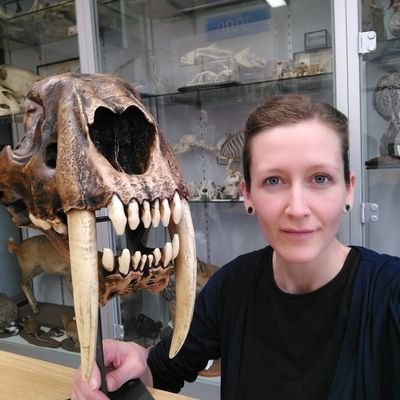
New Paper! Juvenile Jurassic mammaliaform from the Isle of Skye shows mammals grew more slowly in the time of dinosaurs. Our study in Nature uses synchrotron imaging of teeth to look at life history and growth. Thread 🧵 ...

nature.com
Nature - Juvenile and adult skeletons of Middle Jurassic Krusatodon from the Isle of Skye, Scotland, show that this mouse-sized mammaliaform had longer development and lifespan than modern mammals...
9
85
241


Kangaroo teeth grow forever – and keep a record of their owner’s age and sex. @WMGParker tells us all about it! https://t.co/iwUfVRZvJW via @ConversationEDU

theconversation.com
Yearly growth lines and a conveyor belt of molars show how marsupial teeth carry a surprising amount of information.
0
2
12

We are seeking a permanent part-time (4 days/week) Editorial Assistant to support @NHM_Science journals, the Journal of Systematic Palaeontology and Systematics and Biodiversity. This role is suitable for remote or hybrid working. Deadline of 1st July.

jobs.nhm.ac.uk
0
58
72