WeVent
@we_vent
Followers
349
Following
14
Media
52
Statuses
82
Mechanical Ventilator Education on the go!
Joined August 2019

We recently released Essentials of Mechanical Ventilation, a free online resource for clinicians and students working with COVID-10 patients. Learn more about this resource today!
0
16
32
The answer: Early cycling it is! How do you deal with it? #VentRounds @CCF_PCCM @CleClinicRespir #FOAMed #SoMe4MV

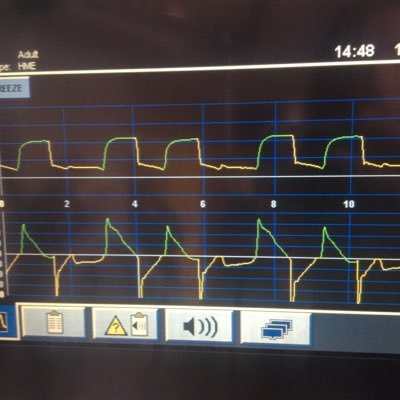
You walk by the ICU, you glance at a ventilator. This is what you see going on. No alarms. Patient looks comfortable. #VentRounds @CCF_PCCM #some4mv #FOAMed @CleClinicRespir
8
31
88
So important to recognize the nuances of managing #ventilators in all patients, including those with #COVID19. You cannot safely just “set it and forget it”. See below for a breakdown of patient-vent discordance illustrated by @emireles_c @CleClinicRespir #ModesWithLimitations
Here is the answer! Work shifting indeed. Great job @krveshi @msiuba @siddharth_dugar @SGBraunthal @Thind888 #VentRounds #MedTwitter A deeper explanation at https://t.co/YUtHrVCfIB
1
4
4
Can plateau pressure be higher than peak pressure? Read 👇 #WeVentWednesdays @some4mv
Can we measure Plateau pressure during pressure support? And what does it indicate?
0
2
0
5/Good for patients with significant asynchrony and/or chronic respiratory failure. Not used for short term ventilation, HD instability or heavily sedated. In COPD patient in PSV, increased pressure--> more intrinsic peep & increased difficulty triggering --> resultant decr RR
1
3
4
4/ PRO/CONS: Does not require addition hardware (like NAVA) Not available on all vents Invasive and noninvasive ventilation Patients > 20kg Does not resolve intrinsic peep Improves synchrony
1
2
2
3/ Support increases in proportion to patent effort in PAV Change in PAV setting make changes in the slope of PAV curve Triggering: need to generate sufficient flow or pressure change to trigger breath. Does not resolve autopeep. More rapid shallow breathing pattern
1
2
2
2/ PAV: Proportion of work of breathing unloaded by the ventilator. Designed to improve synchrony but allowing ventilatory pattern to be controlled by patient. No flow or pressure limit. Flow and pressure parallel patient effort.
1
2
3
1/ Lesson#9: Proportional Assist Ventilation (PAV) #WeVentWednesdays #WaveformsMatter
@CritCareMed @some4mv
#FOAMed References: https://t.co/pbuM9XzsQH
https://t.co/KyroKMkhDj
https://t.co/hsB64aJ7VA
1
5
10

Wolbrink et al : GamER Study-residents had superior knowledge acquisition with virtual ventilation simulator before PICU rotation. Link: https://t.co/Jjrn3PNmKS
@sccm #CritCareMed #MedEd Fig : Change in test scores throughout the study by arms
0
8
15
7/Waveform analysis with NAVA (upper panel) & PS (lower panel). Note dyssynchrony in lower panel with ineffective triggering & pressure and flow waveform not matched to neural EAdi waveform Further reading: https://t.co/iq3XUOEmWf
https://t.co/5haTrhIJqS
https://t.co/FPIlARXtOP
0
0
1
6/Goal of setting NAVA level: unload the increased effort of resp muscles Techniques: 1) stepwise uptitration to achieve inflection point on curve below – Brander et al OR 2) set @ 60% of highest EAdi during SBT w/ 7cmH20 in PSV & retest daily until extubation – Roze et al
1
0
1
5/ EAdi is the sum of the diaphragm electrical activity in µV. Transesophageal catheter w microelectrodes positioned near cural diaphragm Reliability of EAdi is dependent on intact neurologic circuit. Can be disrupted by sedation, muscle relaxants, CNS or PNS injury.
1
0
0
4/Overlaping PC waveform with EAdi demonstrates dyssynchrony. Breath 1&3: flow dyssynchrony Breath 2: ineffective triggering Arrows demonstrate neuro-mechanical uncoupling in PC.
1
0
0
3/ Matches inspiration to neural activity & improves patient-ventilator synchrony by optimizing neuro-ventilatory coupling Advanced COPD on conventional ventilator: timing asynchrony between neural expiration & opening of the ventilators expiratory valve (mechanical expiration)
1
0
0
2/NAVA on Maquet SERVO-i Ventilator. PC-CSVr – Spontaneous ventilatory mode, triggered & cycled by diaphragmatic electrical activity (EAdi). Pressure delivered in proportion (Gain) to patient inspiratory effort as a measure of Eadi. #WeVentWednesdays
@some4mv @PulmCCM
1
0
0
1/Happy New Year WeVenters! Looking forward to an educational & productive 2020! Lesson#8:Let’s start off with a lesson on Neurally Adjusted Ventilatory Assist (NAVA) References for this lesson: https://t.co/XBuzPGTRiS
https://t.co/HyJMMkUcnI
1
2
4
Additional resources: https://t.co/IpJ7Q3Ullc
https://t.co/D3uP856wLQ
https://t.co/OvXMEDLgl8
https://t.co/p9IXFGya2s Check out this video! https://t.co/L7mja5ES6M

pmc.ncbi.nlm.nih.gov
Experimental animal models of acute respiratory distress syndrome (ARDS) have shown that the updated airway pressure release ventilation (APRV) methodologies may significantly improve oxygenation,...
0
1
2