Time Series Features
@compTimeSeries
Followers
766
Following
266
Media
99
Statuses
489
Tweets by @bendfulcher about time-series analysis.
Sydney, New South Wales
Joined July 2015
After years of development, am excited to announce the launch of our new self-organizing drag-and-drop library for sharing and exploring diverse time-series data! Have a play! 🤓 https://t.co/1RM0LfA45g
2
31
103
And there's an open python repo with really clear and easy to read and code implementing the key methods: https://t.co/njU2129n7f Take a look?! 👀
github.com
Time-series dimension reduction (TSDR). Contribute to KieranOwens/tsdr development by creating an account on GitHub.
0
0
2
@kieran_s_owens (i) explains how all the methods can be understood through these conceptual groupings, (ii) derives new relationships between existing methods, and (iii) provides some case-study demonstrations/comparisons of how (insanely) well they can work on data
1
0
2
These powerful methods are underappreciated: A recent review included *0* methods designed for time-series data, instead focusing on generic dimension reduction methods. Here we assemble >60 scientific methods for the first time, and unify them across 7 categories.
1
0
2
New preprint! (by @kieran_s_owens) Of interest to anyone who analyzes time-series data!: "Time-series dimension reduction: a comprehensive review and conceptual unification of algorithms" https://t.co/mdoiHLBjPC
#timeseries #dimensionreduction #complexsystems
1
16
43
New preprint!: "Using matrix-product states for time-series machine learning". https://t.co/aZ6WMdICAc Quick summary below 👇
2
20
67

Better believe it, there are now TWO #timeseries feature sets available in #julialang. The new CatchaMouse16.jl package joins Catch22.jl, bringing 16 more features tailored to (mouse) fMRI data: https://t.co/wAEY4ORspP Check out the CatchaMouse16 paper below

github.com
Evaluate catchaMouse16 features in Julia. Contribute to brendanjohnharris/CatchaMouse16.jl development by creating an account on GitHub.

New preprint w/ Imran Alam, Patrick Cahill @Valerio_Zerbi @m_markicevic @brendanjohnh @olivercliff "Canonical time-series features for characterizing biologically informative dynamical patterns in fMRI" https://t.co/eEGK6ZGKPv Code: https://t.co/DgSPHqKGqM Short summary 👇
0
2
9
A new method of detecting criticality from time-series data outperforms conventional metrics in the presence of variable noise levels for both simulated systems and real neural recordings. Read https://t.co/E8DVA3w19i
#PRXjustpublished #PRXopenaccess #PRXComplexSystems
0
25
128
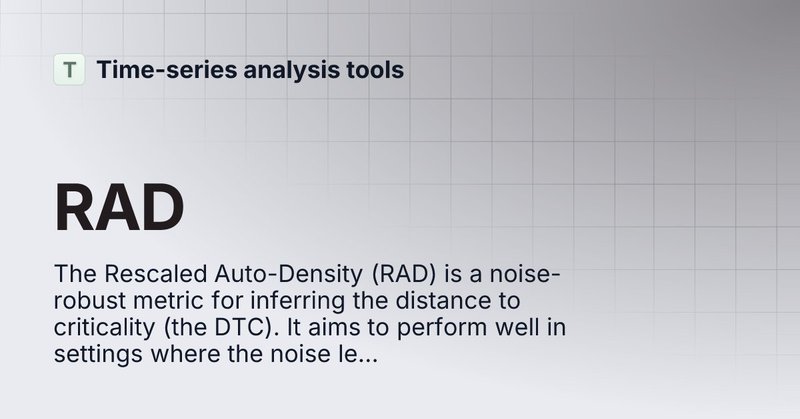
Our work by @brendanjohnh (w Leo Gollo) on tracking the distance to criticality in noisy systems is now out in @PhysRevX 🙂 (includes an application tracking criticality across the mouse visual hierarchy) https://t.co/dDKA1h3WWE Code details:
time-series-features.gitbook.io
The Rescaled Auto-Density (RAD) is a noise-robust metric for inferring the distance to criticality (the DTC). It aims to perform well in settings where the noise level varies between time series.

A new method of detecting criticality from time-series data outperforms conventional metrics in the presence of variable noise levels for both simulated systems and real neural recordings. Read https://t.co/E8DVA3w19i
#PRXjustpublished #PRXopenaccess #PRXComplexSystems
2
31
104
New preprint by Rishi Maran @eli_j_muller "Analyzing the Brain's Dynamic Response to Targeted Stimulation using Generative Modeling" A review/perspective on why new mechanisms may be found by modeling brain stimulation dynamics 🧠⚡️ https://t.co/XTbti5wm1X Quick summary 👇

Analyzing the Brain's Dynamic Response to Targeted Stimulation using Generative Modeling.
3
48
159
New preprint w/ Imran Alam, Patrick Cahill @Valerio_Zerbi @m_markicevic @brendanjohnh @olivercliff "Canonical time-series features for characterizing biologically informative dynamical patterns in fMRI" https://t.co/eEGK6ZGKPv Code: https://t.co/DgSPHqKGqM Short summary 👇
1
19
48
Latest preprint: "Parameter Inference from a Non-stationary Unknown Process" (PINUP) We're really interested in the problem of inferring sources of non-stationary variation directly from measured time-series data. https://t.co/7KI02eTFpO Quick summary 👇
2
48
188
If you're at OHBM this year, check out @AnnieGBryant's great work developing a systematic method to extract interpretable dynamical patterns from fMRI time series!
0
5
28
Curious about scientific papers that have used hctsa for time-series feature extraction? I maintain a log of this here, categorized across Biology, Cellular Neuroscience, Neuroimaging, Medicine, Pathology, Engineering, Geoscience: https://t.co/oAFboRdGKH
1
23
98
"Extensive MEG time-series phenotyping unveils neural markers predictive of age" Using the hctsa time-series feature set, finding age-predictive patterns of autocorrelation within the visual and temporal cortex. https://t.co/RC4cv0iedW
0
2
2

@misicbata @olivercliff @bendfulcher @compTimeSeries Amazing work using the great pyspi package! We also used it in our recent work and examined the sensitivity of (only) 20 representative FC metrics regarding neural decline induced by age and malignant brain tumors https://t.co/2ou0NNHYkz!
0
1
4

Benchmarking methods for mapping functional connectivity in the brain | https://t.co/C9kCKmmNOY What is the best FC metric? Led by @liuzhenqi0303 avec @loopyluppi @JustineYHansen @yetianmed @AndrewZalesky @bttyeo @bendfulcher ⤵️
7
108
288
catch22 documentation for efficient time-series feature extraction is now live on @GitBookIO, with docs for #RStats #Python #Julia and #Matlab and full descriptions of all time-series features https://t.co/ckKSjrymRD
0
4
18

#Satellite ComplexTime explores temporal dynamics in complex systems across various domains. They invite submissions on topics related to temporal data handling, methods, and tools. Learn more at: https://t.co/hG0FHICsYS
1
10
25
Beyond oscillations - A novel feature space for characterizing brain states https://t.co/bLgHM6pdPT
0
7
16
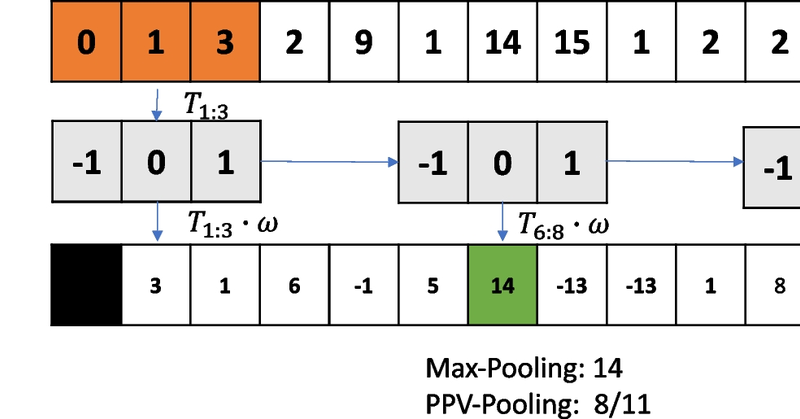
bake off redux is online first, it reviews and compares recent algorithms for time series classification using the @aeon_toolkit for the vast majority of experiments
link.springer.com
Data Mining and Knowledge Discovery - In 2017, a research paper (Bagnall et al. Data Mining and Knowledge Discovery 31(3):606-660. 2017) compared 18 Time Series Classification (TSC)...
0
8
11