
Brendan Harris
@brendanjohnh
Followers
88
Following
64
Media
9
Statuses
42
Postgrad student in complex systems @sydney_physics
Joined July 2021
New paper! We introduce an efficient set of statistical features for fMRI time series (calibrated on mouse manipulation experiments and tested on mouse and human data): catchaMouse16. Paper: https://t.co/6yZNHIu49A Code: https://t.co/DgSPHqK8Be

Alam et al. develop a canonical time-series feature set for characterizing biologically informative dynamical patterns in fMRI: https://t.co/vPmaoY3Lsp
@bendfulcher @fMRI_today @mallarchkrvrty1 @OHBM
0
16
54

x-less Chris Whyte and I introduce a novel data-driven framework to evaluate >200 connectivity-based neural correlates of consciousness! Results are used to quantitatively compare outputs from neurodynamical models tailored to theoretic predictions. https://t.co/cwQqXtdbGh
1
16
41
Can't wait for #cosyne2025, starting tomorrow! Our paper (with Leonardo Gollo and @bendfulcher) will be on display at poster [1-117] Stop by 8pm to 11pm tomorrow and hear about our new method for detecting criticality in noisy systems like the brain!
0
4
10
Going to #cosyne2025? Wondering whether higher cortical regions are closer to a critical point? Stop by poster [1-117] on the 27th March to chat about detecting #criticality in noisy systems like the #brain! Poster and related links are up now at:
github.com
Poster file for Cosyne 2025. Contribute to brendanjohnharris/Cosyne_2025 development by creating an account on GitHub.
0
2
10
Excited to share work co-led with @aditi_jh developing a data-driven selection technique for overlapping community detection algorithms, applied to the human structural connectome! https://t.co/g97ZqbX082
1
23
53

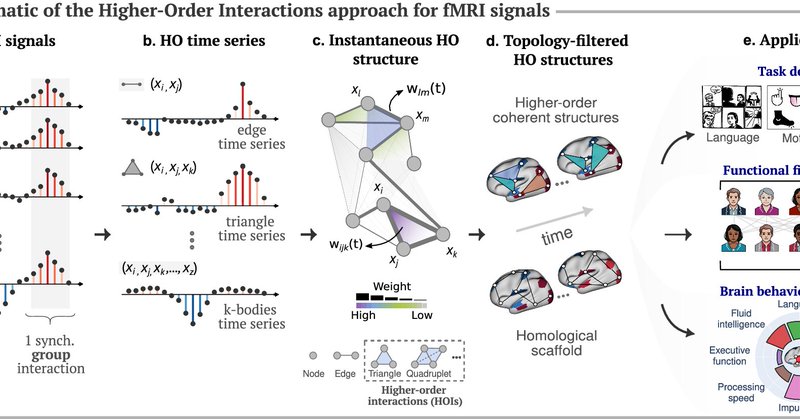
Very happy to see that our paper on "Higher order connectomics of human brain function" is now out in @NatureComms . Lots of fun! Last one by the great @andreasantor0 , with @lordgrilo @fede7j @maximelca
nature.com
Nature Communications - Here, the authors perform a higher-order analysis of fMRI data, revealing that accounting for group interactions greatly enhances task decoding, brain fingerprinting, and...
7
50
202
Our review/perspective on tracking non-stationarity of an unknown process is now published in Chaos 🦋 Congratulations @kieran_s_owens ! Stay tuned for some follow-up work coming soon 👀 https://t.co/dXYvTOo5cC
pubs.aip.org
Non-stationary systems are found throughout the world, from climate patterns under the influence of variation in carbon dioxide concentration to brain dynamics

Latest preprint: "Parameter Inference from a Non-stationary Unknown Process" (PINUP) We're really interested in the problem of inferring sources of non-stationary variation directly from measured time-series data. https://t.co/7KI02eTFpO Quick summary 👇
2
26
104

So excited for this work to be finally out. Thanks to all the co-authors for putting up with me and letting me talk about tennis 🎾!

New paper in Imaging Neuroscience by Joshua B. Tan, James M. Shine, et al: The engagement of the cerebellum and basal ganglia enhances expertise in a sensorimotor adaptation task https://t.co/oqXZXyqUo9
2
8
25
Better believe it, there are now TWO #timeseries feature sets available in #julialang. The new CatchaMouse16.jl package joins Catch22.jl, bringing 16 more features tailored to (mouse) fMRI data: https://t.co/wAEY4ORspP Check out the CatchaMouse16 paper below

github.com
Evaluate catchaMouse16 features in Julia. Contribute to brendanjohnharris/CatchaMouse16.jl development by creating an account on GitHub.
New preprint w/ Imran Alam, Patrick Cahill @Valerio_Zerbi @m_markicevic @brendanjohnh @olivercliff "Canonical time-series features for characterizing biologically informative dynamical patterns in fMRI" https://t.co/eEGK6ZGKPv Code: https://t.co/DgSPHqKGqM Short summary 👇
0
2
9
Our work by @brendanjohnh (w Leo Gollo) on tracking the distance to criticality in noisy systems is now out in @PhysRevX 🙂 (includes an application tracking criticality across the mouse visual hierarchy) https://t.co/dDKA1h3WWE Code details:
time-series-features.gitbook.io
The Rescaled Auto-Density (RAD) is a noise-robust metric for inferring the distance to criticality (the DTC). It aims to perform well in settings where the noise level varies between time series.

A new method of detecting criticality from time-series data outperforms conventional metrics in the presence of variable noise levels for both simulated systems and real neural recordings. Read https://t.co/E8DVA3w19i
#PRXjustpublished #PRXopenaccess #PRXComplexSystems
2
31
104

Direct your gaze at this or put it into your periphery, really depends if you are walking. We found that the oscillation of visual detection ability during walking has phasic difference between centre and periphery. See our preprint at:
1
2
4
New results now live! Most exciting is @brendanjohnh mouse #neuropixels application. We find that brain areas higher in the visual hierarchy are closer to #criticality (in a way that cannot be detected with existing #timeseries measures) 😄🐭⬇️ https://t.co/DVQz3jmjdU
New #ComplexSystems preprint: "Tracking the distance to criticality in systems with unknown noise" By @brendanjohnh w/ Leonardo Gollo 😀 https://t.co/DVQz3jmjdU A summary in the thread below 👇
2
28
78
New pre-print by @aria_mt_nguyen w @jlizier: "A feature-based information-theoretic approach for detecting interpretable, long-timescale pairwise interactions from time series" Introduces a new method: uses features to infer time-series interactions https://t.co/k7AU7agbTh
4
27
78
New #ComplexSystems preprint: "Tracking the distance to criticality in systems with unknown noise" By @brendanjohnh w/ Leonardo Gollo 😀 https://t.co/DVQz3jmjdU A summary in the thread below 👇
2
19
61
All inspired by the normalizations in @bendfulcher's MATLAB time-series analysis toolbox 𝘩𝘤𝘵𝘴𝘢: https://t.co/iM3dzRKdWn ( https://t.co/aenzP5258w)
0
0
1
Outlier-robust versions of each normalization that use the median and interquartile range, as well as mixed normalizations that are robust unless the IQR is 0
1
0
0
Five base normalization methods (more to come, open to suggestions)
1
0
1
Even simpler syntax for reversing/inverting a normalization!
1
0
0
Simple syntax for normalizing any-dimensional slices of an array!
1
0
0