
Mattia Cordioli
@bordinki
Followers
176
Following
4K
Media
9
Statuses
94
PhD | Data science, genetics, metabolomics
Helsinki
Joined April 2013
RT @Jakob_German: Thrilled to share our latest preprint!📜 A major project I’ve led during my PhD, examining how genetic factors influence….
0
12
0


another great work from the lab - huge congrats @feiyi_wang !!.

T1D and other autoimmune diseases (AIDs) co-occur in families. How parental AIDs impact T1D risk in offspring and how much of the familial risk is explained by HLA and non-HLA variants? 👩🏻🦱🧔🏻♂️👶🏻.Find out more from this thread 🧵 and our new preprint ⬇️!
1
0
5


RT @ZhiyuHas0Memory: Is the genetic of disease susceptibility and progression shared?. We look at this question within a global biobank col….
0
44
0
A huge THANK YOU to everyone who's been guiding and helping me in this work, which wouldn’t have been possible without: @_corbettandrea_ @HannaKariis @DrSakari @pecsi_max @i_am_dr_doom @matteoferro98 @lehto_kelli @ProfNiemi @samrip @MilaniLili and my supervisor @andganna (14/14).
0
0
9
Take-home message 2:. The robust associations with some of the socio-demographic factors considered suggest that socio-economically disadvantaged groups would benefit from targeted interventions to improve the dispensing and uptake of pharmacological treatments. (13/n).
1
1
2
Take-home message 1:. Our results suggest a very limited role of genetics, including established pharmacogenes, on persistence and adherence. (12/n).
1
2
5
Moreover, we tested whether the GWAS results from FinnGen could be used to build a polygenic score for statin adherence and found this was significantly associated with observed adherence. (11/n).
1
1
2
We finally replicated the results for statins in Estonian Biobank, which have similar drug purchase and genetic data, and observed consistent effects for health and socio-economic factors present in both studies. (10/n).
1
0
1
We also wondered how ploygenic scores for the traits above would predict persistence and adherence. Effect sizes were overall smaller than those for the health and socio-demographic factors at the beginning, and could explain a lower fraction of variance in adherence. (9/n).
1
0
1
Interestingly, adherence to statins and BP medications were positively correlated with participating in one or more of the optional questionnaires of UK Biobank. (8/n)

1
0
3
We ran a GWAS of persistence and adherence to each medication. We didn’t find significant associations with either phenotype but could use the results to explore the genetic overlap between persistence, adherence and other health and behavioral traits. (7/n).
1
0
3
None of the pharmacogenes we tested showed an effect on adherence. (6/n)

1
0
2
We then turned to genetics, the first suspect being relevant and well established pharmacogenes. CYP2C9 intermediate met. (⬆️ risk of fluvastatins side effects) associated with lower odds of persistence. Similar for tamoxifen and CYP2D6 poor met. ( ⬇️drug response). (5/n).
1
0
3
We first considered the effect 8 health and sociodemographic factors. Non-Finnish/Swedish mother tongue (proxy for recent immigration) and receiving social assistance benefits (lower socio-economic status) showed the biggest effects on both phenotypes, across all meds. (4/n)

1
0
3
We looked at these phenotypes across 5 relevant med classes, including up to N=1 814 591. We explored health and socio-demographic factors in the nation-wide Finregistry data, and genetics for the subset of ppl from FinnGen. We replicated our results in Estonian Biobank. (3/n)

1
0
5
Based on data from all prescription drug purchases made in Finland from 1998 to 2020, we defined two drug taking behaviors: continuing the treatment for at least one year vs early discontinuing it (persistence), and following the prescribed therapeutic regimen (adherence) (2/n).
1
0
2
Really excited to share a new preprint📜, the main project I have been working on during my PhD!. Why are people not adherent to their💊💊? How much do social vs genetic factors impact that? What about relevant pharmacogenes?. Here’s what we found! (1/n) .

medrxiv.org
Low drug adherence is a major obstacle to the benefits of pharmacotherapies, and it is therefore important to identify factors associated with discontinuing or being poorly adherent to a prescribed...
2
23
91
RT @andganna: The last paper from @covid19_hgi is out in @Nature . Thanks again to all the contributor, for making this initiative a succes….
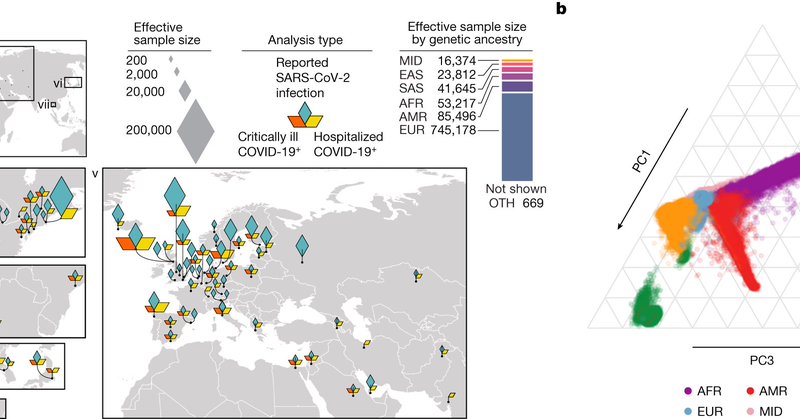
nature.com
Nature - A second update on mapping the human genetic architecture of COVID-19
0
30
0