
Alec Nielsen
@alectricity
Followers
4K
Following
22K
Media
26
Statuses
1K
Multicellular in Boston, Co-founder & CEO @AsimovBio
Boston, MA
Joined April 2009
biotech needs its own david sacks in reflecting on this past year, one thing has become increasingly obvious to me: biotech desperately needs a public champion. someone who can translate scientific progress into policy, coordinate the industry’s scattered voices into a coherent
49
39
363
It makes you wonder how big the deductive overhang on any topic truly is. With the right insight, someone can make a discovery that rightly belong centuries in the future.

It's almost unbelievable how clever the ancients were
43
92
2K
Arabidopsis thaliana, plant biology's ubiquitous model organism, came from the Harz Mountains of northern Germany. It was discovered in 1542 by Johannes Thal and, over the next 500 years, spread through labs around the world. @AlexandraBalwit tells the story in a new essay.🔻
2
4
34
The discovery of penicillin wasn't what we were taught. This essay reads like a scientific whodunit: unreliable firsthand accounts, scientific detective work, and multiple theories on what really happened in Fleming's lab in 1928 Highly recommend this fascinating piece from

Alexander Fleming's discovery of penicillin is unlikely to have happened in the way he described. It's almost certainly a myth. For decades, scientists and historians have puzzled over inconsistencies in Fleming’s story. The window to Fleming’s lab was rarely (if ever) left
0
0
6
Here are 30 great essays about biology. I consider these to be my "personal canon," and think that they are all basically perfect in their own ways, despite being different in form and style. All have shaped my own writing considerably. I'm not including links here, but you can
22
137
827
You have heard of AI slop in the context of short video creation. But the same principle applies when it comes to improving drug discovery: we absolutely do not need a deluge of new hypotheses; we need better predictive validity (as per @JackScannell13). https://t.co/kdEEQ38qbP
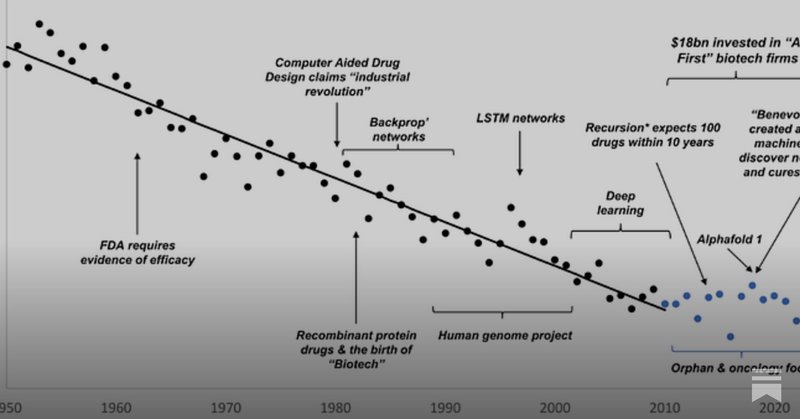
writingruxandrabio.com
Some thoughts on avoiding self delusion.
29
114
683

Ruxandra has an excellent new post about how the real bottleneck to new medicines is human PoC. Much of the discourse about AI + biology (not Ruxandras post) takes as axiomatic that there nothing to be done to accelerate trials. In fact there is plenty to be done. See China.

This post is also an argument for why AI won't bail us out of regulatory reform to make in-human testing easier. In fact, in-human data from trials would be the best complement to AI and one way to avoid the "slop trap" by training it on meaningful results.
8
12
87
Many great discoveries in biology came about because of LIMIT THINKING. Rather than focus on small tweaks to improve a system, it's sometimes better to make them abstract to find that system's theoretical limits. Carnot did this with engines. Shannon did this with information.
3
33
122

Today, we’re announcing Kosmos, our newest AI Scientist, available to use now. Users estimate Kosmos does 6 months of work in a single day. One run can read 1,500 papers and write 42,000 lines of code. At least 79% of its findings are reproducible. Kosmos has made 7 discoveries
277
659
4K

Agents are finally starting to work in biology. We’ve partnered with Anthropic and major biotech vendors - Vizgen, AtlasXOmics, Takara, 10x Genomics - to build a tool that allows scientists to steer their own analysis with natural language. Raw spatial data to publication
27
104
575

The best sci-fi doesn't predict the future, but helps make it by inspiring the right generation to get it done.

Foundation series by Isaac Asimov: **technologist uses science to predict the future and categorize knowledge, then sends it to other planets to continue civilizational progress in case of collapse Elon: **uses xAI to predict tokens, also builds grokipedia to categorize
2
3
28
I learned many interesting things from this essay, but my favorite is that a Parisian high society seamstress taught her delicate technique to organ transplant surgeons Our world is rich with characters and ideas

I think this is one of the finest essays we've ever published at @AsimovPress. It tells the entire story of a liver transplant, without sparing any detail. Every cut, every incision...the race to the next hospital... I learned a ton. Highly recommend Donna Vatnick's article.
0
3
19
I think this is one of the finest essays we've ever published at @AsimovPress. It tells the entire story of a liver transplant, without sparing any detail. Every cut, every incision...the race to the next hospital... I learned a ton. Highly recommend Donna Vatnick's article.
Writer Donna Vatnick spent dozens of hours observing a liver transplant. She watched as surgeons extracted an organ from a dead donor, placed it on ice, flew it to another hospital, and transplanted it into the recipient. The full story, told in intricate detail, is out now:
3
10
97

At the Asilomar conference in 1975, biologists chose to be pro-active about calling their own work risky 50 years later, you can’t ask AI for a PCR recipe without getting shut down like a bioterrorist My fellow biologists: this is our fault. We built this regulatory culture
26
8
110

Welcome to the age of generative genome design! In 1977, Sanger et al. sequenced the first genome—of phage ΦX174. Today, led by @samuelhking, we report the first AI-generated genomes. Using ΦX174 as a template, we made novel, high-fitness phages with genome language models. 🧵
34
213
1K
Biologists to CS people discovering LLMs are inscrutable:
In computer science, they teach to separate the data from the compute. It's very basic stuff. This is why LLMs slap you in the face as a software engineer. They go ahead and violate this principle maximally egregiously. An LLM isn't data—you can't query it like a database or
0
11
69
STARBURST, a new construct for autobioluminescence, is now available from Addgene.
6
81
493

I've written up some thoughts on publishing for machines. 10M research papers are published per year and there are 227M total - machines will be primary producers and readers of publications going forward. It's time to revise the scientific paper.
16
40
242
While making the second @AsimovPress book, we asked CATALOG (a DNA computing company in Boston) if they could write it in DNA. And they said yes! But the encoding steps, or how the book was converted to nucleotides, wasn't obvious. Now a new paper explains it all in detail.
6
40
219
Brb making a $100B unsolicited longshot offer to buy deepmind

Exclusive: AI startup Perplexity makes an unsolicited longshot offer to buy Google’s Chrome browser for $34.5 billion
0
0
13