Weizhe Hong
@TheHongLab
Followers
4K
Following
1K
Media
4
Statuses
336
Neuroscientist, Professor @UCLA — studying the neural basis of social behavior
Los Angeles, CA
Joined February 2019
We are excited to share our latest work in @ScienceMagazine studying cooperative behavior in both biological and artificial intelligence systems — fantastic work by @JanineJiang22, Linfan Gu, and wonderful collaboration with @JonathanCKao! https://t.co/nVxe3E3fGA
13
57
213
We extended our findings to artificial intelligence systems by training artificial agents in a similar cooperation task using multi-agent reinforcement learning (MARL). The agents developed behavioral strategies and neural representations reminiscent of those observed in the
1
0
5
We identified key social behavioral strategies and decision-making processes in mice that facilitate successful cooperation. We found that these processes are represented at both single-cell and population levels in the anterior cingulate cortex (ACC) and demonstrated a causal
1
0
4
Cooperation, the process through which individuals work together to achieve common goals, is fundamental to human and animal societies and increasingly critical in artificial intelligence. However, the complex behavioral dynamics and neural mechanisms underlying this process
1
0
3
Our findings suggest that shared neural dynamics represent a fundamental and generalizable feature of interacting neural systems present in both biological and artificial agents and highlight the functional significance of shared neural dynamics in driving social interactions.
4
1
3
We extended this framework to artificial intelligence agents and observed that, as social interactions emerged, so too did shared neural dynamics between interacting agents. Importantly, selectively disrupting the neural components that contribute to shared neural dynamics
2
0
3
By measuring activities of molecularly defined neurons in the dorsomedial prefrontal cortex of socially interacting mice, we find that the multi-dimensional neural space within each individual can be partitioned into two distinct subspaces—a shared neural subspace that represents
1
0
0
Social interaction can be viewed as a dynamic feedback loop between interacting individuals as they act and react to one another. To understand the neural basis of these interactions, we investigated inter-brain neural dynamics across individuals in both biological brains and
1
0
3
Thrilled to share our latest work in @Nature studying inter-brain neural dynamics in both biological and artificial intelligence systems — amazing work by @xzh_brain, Nguyen Phi, and fantastic collaboration with @JonathanCKao! Read the full article here: https://t.co/oCSg8JIWxQ
13
75
358

Please join us in Lisbon for the 2025 S4SN (@S4SNeuro) meeting this year. We have a wonderful set of speakers and symposium sessions!! 👇👇👇
0
5
27

Check out our (@TheHongLab) new review discussing the concepts and neural mechanisms of prosocial helping behavior! 😁
0
5
10
Thanks to William Sheeran and Zoe Donaldson for their insightful perspective piece highlighting our work.

science.org
In mice, two brain regions drive the impulse to revive an unconscious companion
0
1
5
Congratulations to @Fangmiao4 and Emily Wu! A special shoutout to Li Zhang at USC for their converging and complementary findings!
1
0
5
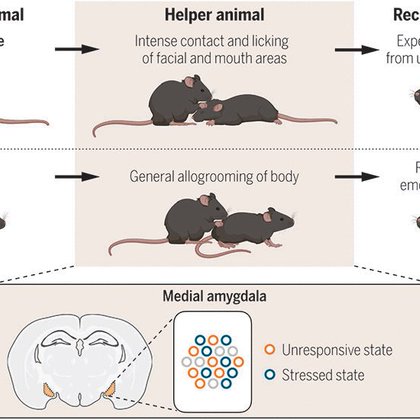
We identified the medial amygdala (MeA) as a key region that encodes the unresponsive state of others and drives this head-directed physical contact. Notably, the behavioral responses toward unresponsive conspecifics differed from those directed at awake, stressed individuals,
1
0
4
In this study, we demonstrated that mice exhibit rescue-like social behaviors toward unresponsive conspecifics, characterized by intense physical contact and grooming directed at the recipient’s facial and mouth areas, which expedite their recovery from unresponsiveness.
1
0
2
Humans often take actions to assist others experiencing unresponsiveness, such as transient loss of consciousness. How other animals react to unresponsive conspecifics—and the neural mechanisms driving such behaviors—remain largely unexplored.
2
0
3
We are excited to share our latest work showing that mice display rescue-like prosocial behavior toward unresponsive partners. @ScienceMagazine
https://t.co/Jzwna46rFy
science.org
Humans often take actions to assist others experiencing unresponsiveness, such as transient loss of consciousness. How other animals react to unresponsive conspecifics—and the neural mechanisms...
26
75
260

The BRAIN Initiative has been an engine of innovation but is now fighting for its survival. Here we discuss why BRAIN is special and why we must all fight for it now https://t.co/1SECiT2G7m
@TheHongLab @DrZoePhD @bjmarlin @doristsao @moriel_z @HongkuiZeng XiaokeChen ZivWilliams

nature.com
Nature Neuroscience - Launched in 2013, the BRAIN Initiative (BRAIN) in the United States aimed to unlock the mysteries of the brain and develop new treatments for neurological and neuropsychiatric...
4
66
149
Excited to share a new preprint by @tararaam_ on how animals interact and form groups in cold environments

big day!! so excited to share the preprint of my postdoc project in @TheHongLab 🥳🥳🙌🏼🙌🏼🕺🏼🕺🏼 we identified how prefrontal populations enable social groups to coordinate into huddles during thermal challenge! ❄️🐭🐭🐭🐭❄️
1
5
42

Interested in the #social_brain? Great opportunity to join us for this meeting in Andalucia later this year! @FelixFelxfel @camillabellone @UNIAuniversidad @Cornhelix @LabPapaleo @ScottRussoPhD @LimaLab3 @Froemkelab @moccalin @TheHongLab @ChrisKeysers @jonnykohl @CharletLab
Save the data for for this exciting workshop on social interactions organized by @carmensandi10 @camillabellone and myself in Andalusia next Fall. DM me for more information.
3
36
106