
Wilson Lab
@stevewilsonlab
Followers
715
Following
40
Media
19
Statuses
105
Studying forebrain and eye development in zebrafish @ucl
Gower Street, London
Joined September 2018
Steve Wilson receives the Christiane Nüsslein-Volhard Award for outstanding achievements in genetics research using zebrafish as a model system at the IZFS meeting in Kyoto. Fantastic recognition of his contributions to the Zebrafish community and research achievements. #IZFS
0
3
27
Although I’m physically just across the Korean Strait and not there, come check out our poster on #Sustainability in 🐟🔬research poster no 111 #IZFC2024 @stevewilsonlab @realRihellab
1
4
28

Oh, and if you like the paper, don't forget to check out the 20 (!) further figures and 8 tables in the supplemental data!
0
1
10
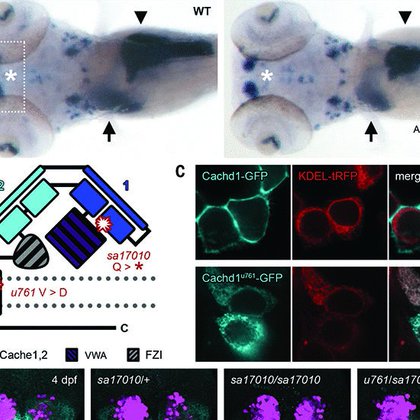
https://t.co/Ycz1mV9vnM Left-side story-Cachd1, Wnt Signalling and Asymmetry Our new paper in Science provides new insights into the development of brain asymmetry and the Wnt signalling pathway. Thanks and congratulations to all authors on this very collaborative study.
science.org
Neurons on the left and right sides of the nervous system often show asymmetric properties, but how such differences arise is poorly understood. Genetic screening in zebrafish revealed that loss of...
5
21
73
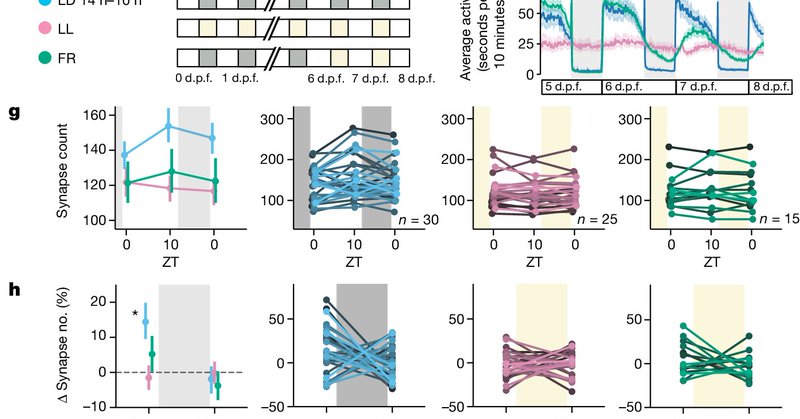
After nearly 7 years, my PhD work is out in @Nature! Big big thank you to everyone involve within the @realRihellab and the 🐟 floor @uclcdb
https://t.co/litRrbhHQv
nature.com
Nature - Synapses are gained during spontaneous or forced periods of wake and lost during sleep in a neuron-subtype-dependent manner in zebrafish.

Our preprint 'Sleep pressure modulates single-neuron synapse dynamics in zebrafish' just dropped on @biorxivpreprint - A concerted effort from @realRihellab @ZWithTheFishes @_LizBroom 🐟💤 🧵👇🏻
20
50
182

A thing we did finally came out @Nature! 100% the result of the extraordinary vision and hard work of PhD student @SuppAnya, who slogged through years of thankless technique building before making some important sleep discoveries.
nature.com
Nature - Synapses are gained during spontaneous or forced periods of wake and lost during sleep in a neuron-subtype-dependent manner in zebrafish.
22
49
171
Unlocking the mystery of brain asymmetry – with the help of zebrafish @wellcometrust
1
16
72

🚨 Job alert 🚨 Research technician position! Come and join the @stevewilsonlab and @KarinTuschl lab at UCL https://t.co/zrc3stnGlT to study zebrafish models of neurometabolic diseases. https://t.co/Lozb8H5imV Closing date 18 Oct.
zebrafishucl.org
0
17
18

We know there are differences between the left and right sides of the brain, known as brain asymmetry. But it’s not yet clear how or why this comes about. @stevewilsonfish and @ibianco3 from @ucl aim to find answers, with support from our Discovery Research Awards ⤵️
1
29
63

Steve Wilson @stevewilsonfish is next to share his work on the development of left/right asymmetry in the brain https://t.co/9z4bK21vVK
#SarsSymposium2022
@ucl
0
2
13
New insights into brain asymmetry and a novel Wnt pathway protein. Time to wake up my sleepy twitter account with some exciting new science https://t.co/LJwJxzD2vU
3
11
141

This mammoth of a study from our lab @stevewilsonlab goes from a molecule down to the protein structure, then on to interacting partners and then on to brain asymmetry!
biorxiv.org
Neurons on left and right sides of the nervous system frequently show asymmetric properties but how these differences arise is poorly understood. Through a forward genetic screen in zebrafish, we...
3
11
30
This was fantastic collaborative effort – not just with @E_Yvonne_Jones, also the labs of @RaibleLab, @VivianLiLab and Gavin J Wright. Thanks especially to the four joint lead authors - @GarethTPowell @farofia @yzoxford and Heather Stickney.
0
0
1
TL:DR CACHD1 is a novel Wnt pathway component that bridges FZD and LRP6 co-receptors. Asymmetric modulation of Wnt signalling by Cachd1 leads to lateralisation of Hb neurons by altering timing of neurogenesis and probabilistic selection between lateralised neuronal fates. [13/13]
1
0
1
It also implies that the role of the parapineal is to unilaterally block Cachd1 function – story for another day! [12/13]
1
0
1
However, cachd1 mutants are still double-left symmetric after pp ablation or loss of sox1a function. This implies that in cachd1 mutants, neurons on both sides of the brain adopt left character independent of the pp signal. [11/13]
1
0
1
Past work from our group and @marnieeh's group has shown that the parapineal (pp) is critical for elaboration of left-sided Hb character. When the pp signal is absent (pp-ablated or sox1a mutant), the left dHb develops with right-sided character (Lekk et al. 2019). [10/13]
1
0
0
Loss of cachd1 function led to precocious neurogenesis in the right Hb, with a higher proportion of early born neurons adopting dHbL (left-sided) character than in wildtype embryos. However, this did not reveal if Cachd1 has any function on the left side of the brain… [9/13]
1
0
0
We observed that Cachd1 (cyan) is expressed in a broad region including Hb progenitors (red, top two panels), gradually getting restricted and largely excluded from mature neurons (red, bottom panel) as development progressed. [8/13]
1
0
0
What does this mean in the context of habenular asymmetry? So far, we learned that Cachd1 plays a potent role in promoting right-sided/suppressing left-sided character and is exerting its function through a Wnt signalling pathway. Let’s return to the embryo for insight… [7/13]
1
0
0