
Margaret Schroeder
@meschro
Followers
213
Following
791
Media
1
Statuses
81
recently minted PhD at @mitbrainandcog Feng Lab & Synthetic Neurobiology Group | surviving synovial sarcoma🎗 now at https://t.co/8EpPXibxwo
Joined October 2018

Online now: A transcriptomic atlas of astrocyte heterogeneity across space and time in mouse and marmoset https://t.co/Yase3hGQnA
0
24
103

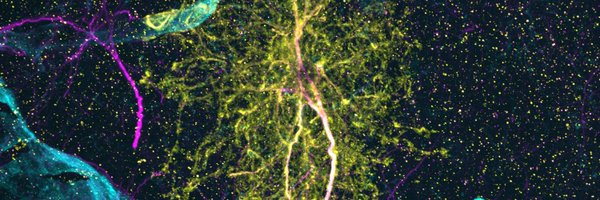
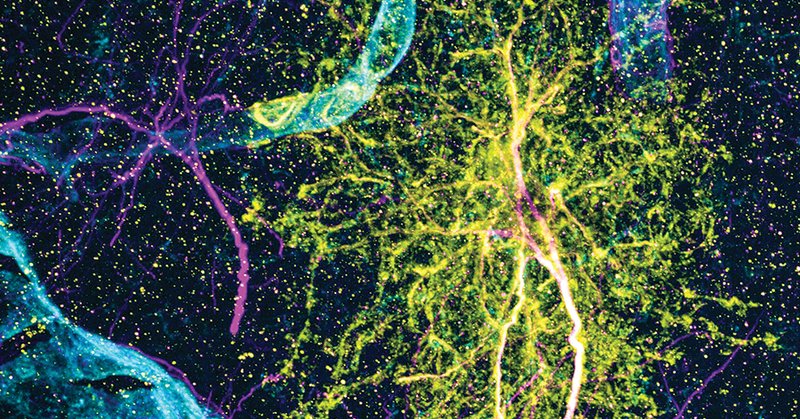
A cellular atlas developed by MIT researchers details the dynamic diversity of astrocytes and provides a framework for exploring how these ⭐️shaped cells contribute to brain development, function & disease. https://t.co/CtzZCiVK5r Stunning astrocyte image courtesy of @meschro
mcgovern.mit.edu
When it comes to brain function, neurons get a lot of the glory. But healthy brains depend on the cooperation of many kinds of cells. The most abundant of the brain’s non-neuronal cells are astrocy...
1
4
12
Code on GitHub ( https://t.co/WOzPKhCbZI) and images on BossDB ( https://t.co/8M6ILQUpff).
github.com
scripts for analysing snRNAseq, FISH, and ExR data accompanying Schroeder et al., 2025 - Feng-Lab-MIT/AstrocyteHeterogeneity
0
0
0
Raw data (fastqs, h5 count matrices) on NeMO ( https://t.co/nSAYU3ixUV) and GEO ( https://t.co/1qKHWMYp0Q).
1
0
0
Processed data on the Broad Institute Single Cell Portal, searchable and interactive: https://t.co/BdpzVDJeOv (mouse) and https://t.co/ssSKazjYtJ (marmoset).
1
0
0
Though we focused our analysis on astrocytes, we did not sort or select for any particular cell type in our prep. Our dataset is a rich, publicly available resource containing all neural cell types - please explore via the links below, and reach out with any questions!
1
0
0
We then virally labeled astrocytes with GFP and used expansion microscopy to visualize their detailed morphology (it was so fun to take these images!). We quantified their morphological differences and differences in protein expression across regions in mouse.
1
0
0
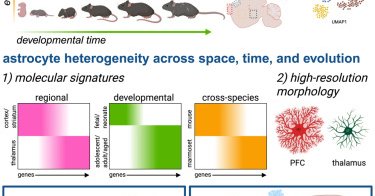
Looking across species, we found broad conservation at the cell type level. However, several marmoset cell types appeared more mature than their mouse counterparts at birth, and the gene expression signatures underlying astrocyte regional heterogeneity diverged significantly.
1
0
0
As others had shown, we found that astrocytic regional heterogeneity is patterned embryonically. What we were surprised to find was just how much regional astrocyte gene expression signatures change over postnatal development, likely in support of local neuronal circuits.
1
0
0
To answer this question, we profiled millions of single nuclei with 10x Genomics snRNAseq across brain regions (motor and prefrontal cortices, striatum, and thalamus) and developmental time (from late embryonic to aged time points) in mouse and marmoset.
1
0
1
What started out as an exploration of astrocyte regional heterogeneity in the young adult marmoset led us to ask, how early in development is astrocyte regional heterogeneity patterned, and how does it change over developmental time and across mammalian species?
1
0
0
I’m so excited to share my first-author PhD paper, out today in @NeuroCellPress as a NeuroResource! A huge thanks to all of my co-authors, and of course to my wonderful mentors Guoping Feng, @fennamk, and @eboyden3.
cell.com
In this NeuroResource, Schroeder et al. present a transcriptomic atlas across brain regions and developmental time points in mouse and marmoset. Detailed analysis focused on astrocytes revealed that...
6
9
92
Defended my PhD on Friday! Huge thanks to all who helped me achieve this milestone, especially my advisors, thesis committee, and lab-mates!
18
7
159

@meschro 📷 @meschro Astrocyte regional specialization is shaped by postnatal development. Interactive visualizations available at https://t.co/NESkqLNOwV and
0
1
1
Very excited to share our pre-print and my thesis work on the postnatal development of astrocyte regional heterogeneity, which includes an integrated dataset of >1.4 million single nuclei transcriptomes in mouse and marmoset brains (now available online)! https://t.co/jT88PILBXo

biorxiv.org
Astrocytes are an abundant class of glial cells with critical roles in neural circuit assembly and function. Though many studies have uncovered significant molecular distinctions between astrocytes...
5
21
98
Last fall @AshleyJ_Thomas and I co-taught a graduate course called 'Tools for Robust Science' at MIT. The syllabus and materials are now all freely available at https://t.co/9up5gX71Q0 🧵 1/7

ocw.mit.edu
This course offers a comprehensive exploration of cutting-edge tools and techniques designed to revitalize and enhance scientific practices in the cognitive and neuro-sciences. Students will identify...
1
90
296
Thank you @neubadah, and thanks for your guidance along the way! Couldn't have done it without the help and support of my amazing lab mates and mentors. Honored and grateful!

Everyone congratulate @meschro from @mitbrainandcog who scored an impact score of 10 aka a perfect (!) score on her NIH F31 fellowship application! She poured a lot of energy into this grant, and is doing phenomenal research in the lab, stay tuned for her work.
5
0
37