

🧬Yubin🧬
@ZhouLaboratory
Followers
390
Following
1K
Media
150
Statuses
1K
🌟 Fellow @AIMBE 🌟Fellow @RoySocChem 🌟 SynBio🌟 Optogenetics & Chemogenetics🌟Calcium Channels 🌟 Cellular & Molecular Engineering 🌟 Immunotherapy
Houston, TX
Joined August 2011
SAMBA from @ZhouLaboratory & @Yun_Nancy_Huang : a chemogenetic platform powered by salicylic acid (aspirin’s cousin!) ✅ Safe, cheap & biocompatible ✅ Modular for RTK, CAR-T engineering. A new SynBio tool for precision immunotherapy. https://t.co/gfeEzbhNHV
1
0
5

CaBLAM: a bioluminescent, genetically encoded calcium indicator for high-contrast imaging in cells and in vivo. @_theglowup @NathanShaner @BiolumHub @ADC_NeuroEnv
https://t.co/WXyV8AeAaa
0
38
125

RNA binding by TFE3 fusion partners facilitates biomolecular condensate formation, which enhances RNAPII activity to drive pro-oncogenic transcriptional programs. PSPC1 is identified as a key co-condensate component. Can we dissolute TFE3 onco- fusion condensates?
1
2
4
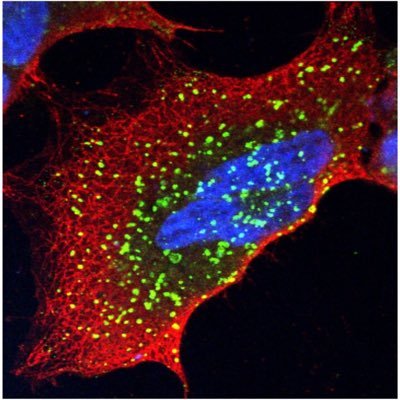
A single-component optogenetic toolkit for programmable control of microtubule

biorxiv.org
Microtubules (MTs) form dynamic cytoskeletal scaffolds essential for intracellular transport, organelle positioning, and spatial organization of signaling. Their architecture and function are...
2
4
17
Uncovering Tumor’s Hidden Networks: A Novel Strategy to Stop Cancer Growth

scienmag.com
In the intricate realm of cellular biology, the line between the ordinary and the extraordinary often blurs, revealing mechanisms that echo structures in the human world. Texas A&M University Health...
0
1
2

The October issue of Cell Press Trends in Pharmacological Sciences is online now. https://t.co/Xa7rdL7e0f
0
1
1

Researchers in our Department of Translational Medical Sciences have uncovered how RNA builds “droplet hubs” that fuel one of the toughest childhood cancers—and how to dismantle them. Read more at https://t.co/zDN6qIRWDS
#CancerResearch #TranslationalMedicine #AdvancingMedicine

vitalrecord.tamu.edu
When RNA gets hijacked, an aggressive form of kidney cancer grows—and scientists at Texas A&M Health have finally learned how to make it stop.
0
1
1
@zhoulaboratory Our latest work on #nanobody #chemogenetics introduces Caffebody and Rapabody — molecular switches controllable by caffeine ☕ or rapamycin 💊 for precise ON/OFF control of protein interactions. | Chemical Science https://t.co/idXDwRgSeN
0
0
2

Join us for the 2025 Welch Conference on Chemical Research, “New Horizons in Drug Discovery,” Oct. 27-28 in-person or virtually. The event is completely free! Find more information here:

welch1.org
0
1
1

New in @NatureNano, we discuss the opportunities of wearable biomolecular sensing technologies in chronic disease management. Cheers to the team! @ShanaOKelley @JiaobingT Connor Flynn @Jeonghee_1004 @Caltech @NorthwesternU

nature.com
Nature Nanotechnology - This Review examines recent advances in body-interfaced biomolecular sensors for chronic disease monitoring, highlighting relevant biomarkers and nanomaterial-enabled...
4
4
48
Disrupting cancer’s secret hubs: A new way to halt tumor growth
vitalrecord.tamu.edu
When RNA gets hijacked, an aggressive form of kidney cancer grows—and scientists at Texas A&M Health have finally learned how to make it stop.
0
0
1
A centuries-old ingredient is being reimagined as a cancer-fighting tool. Early findings show this approach can shrink tumors, improve survival and reduce dangerous side effects in blood cancers like leukemia and lymphoma. Read more at: https://t.co/lnd6ezHmda
#AggieDocs

vitalrecord.tamu.edu
Salicylic acid, a commonly used skincare and pain medication ingredient, could now also be used to treat blood cancers.
0
1
3
A collaborative study with @Yun_Nancy_Huang revealing the molecular etiology of tRCC: RNA-mediated condensation of TFE3 oncofusions facilitates transcriptional hub formation to promote translocation renal cell carcinoma - Nature Communications

nature.com
Nature Communications - Translocation renal cell carcinoma (tRCC) is driven by MiT family gene fusions. Here, the authors demonstrate that RNA-binding features of TFE3 fusions facilitate condensate...
0
1
2
@ZhouLaboratory and @Yun_Nancy_Huang 's recent work featured as a cover article with TiPS | https://t.co/9wqLuwRMCc
#CancerImmunotherapy #Optogenetics #ImmunoEngineering #TranslationalMedicine
0
0
1

Imagine flipping a light switch to control disease inside a cell. Texas A&M Health researchers are making it possible with new genetic tools called PhoBITs. Learn more: https://t.co/3LcO17hTmD
0
1
3
PhoBIT tools from @zhoulaboratory | Compact genetic light switches transform disease control
vitalrecord.tamu.edu
Researchers have created new tools called PhoBITs that respond to blue light with pinpoint accuracy, offering safer, more precise treatments.
0
0
1

Regents with the @tamusystem have approved another two-year freeze on tuition and academic fees for Texas resident undergraduates at every Texas A&M System university. Texas A&M University has not raised tuition since 2021, and tuition will be frozen for the 2025–26 and 2026–27
16
71
784
Repurposing aspirin’s active ingredient for blood cancer treatment: Texas A&M Health researchers developed SAMBA—a salicylic acid switch that improves safety and control in CAR T-cell therapy for leukemia and lymphoma:
vitalrecord.tamu.edu
Salicylic acid, a commonly used skincare and pain medication ingredient, could now also be used to treat blood cancers.
0
2
2
SAMBA tool from @ZhouLaboratory & @Yun_Nancy_Huang | New research repurposes ancient remedy for blood cancer treatment
vitalrecord.tamu.edu
Salicylic acid, a commonly used skincare and pain medication ingredient, could now also be used to treat blood cancers.
0
3
3
💥 Finally, we built a photo-tunable monobody to inhibit BCR-ABL, a leukemia-driving kinase. Light-induced PhoBIT2 clustering enhanced binding to BCR-ABL SH2, blocked its phosphorylation, and suppressed leukemia xenografts in mice. From blueprint to tumor control—all with light.
0
0
1
6/8. 🧬 Want to turn on innate immunity? PhoBIT2-caged STING does just that. With ssrA2 at one preferred terminus, light-induced clustering activated TBK1/IRF3 phosphorylation and IFNβ secretion—allowing remote modulation of host defense.
1
0
0