Kathleen Wendt
@Speleo_Katee
Followers
260
Following
417
Media
13
Statuses
102
Assistant Prof Senior Researcher at @OSUCEOAS Using ice and cave rocks to unlock the history of Earth's climate
Joined April 2020

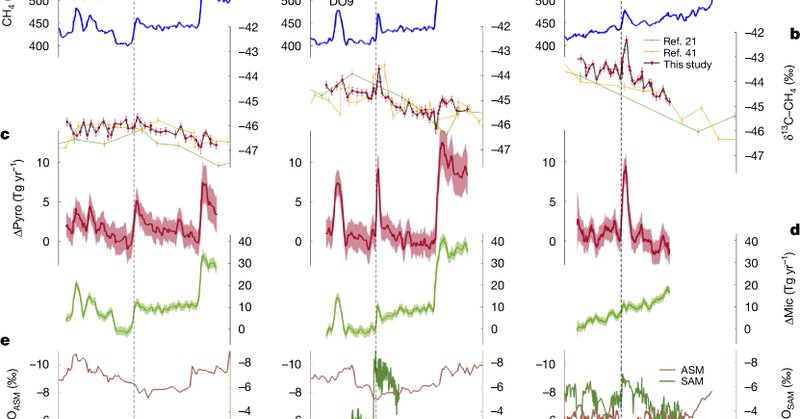
I'm thrilled to share our new @Nature paper! We present ice core methane isotope data revealing that past abrupt climate changes likely triggered surges in wildfires, driving rapid methane—and possibly CO2—rises @osu_ice @NSF 🌎🔥 Read it here 👉
nature.com
Nature - An increase in wildfire extent and related greenhouse gas emissions can be linked to abrupt climatic changes during the last glacial period.
2
12
35

Stalagmites in caves have long been used to understand Earth’s climate past. Now, researchers are using caves to study how wildfires🔥 will burn on a hotter planet. Recently, I joined a trip into one of these caves revealing the deep history of fire: https://t.co/dYvszQYGF6
newscientist.com
Wildfires are already changing as a result of climate change but we don’t know what will happen as our planet gets even warmer. The answer could be hidden underground
1
9
10
Installing a SYP autosampler (@wegeochem) at @OregonCavesNPS with @UCDavisResearch PhD student, Kesego Letshele. The autosampler will quietly collect drip water without disturbing the hibernating 🦇 population this winter @OSUCEOAS
1
3
27
Newest edition of the Encyclopedia of Quaternary Science just dropped! A great teaching resource
0
1
6
🚨Calling all speleothem folks! 🦇 Submitting an abstract to #AGU24? Consider submitting to our session. Deadline - July 31st PP002 - Advances in speleothem science: new records, methods, and applications across timescales https://t.co/KUzdnYybyc
agu.confex.com
1
12
24

Tim Lowenstein and team synthesized Death Valley, Searles, Owens and the Devils Hole - records that span 200,000 years of hydroclimate fluctuations in the Southern Great Basin - read all about it https://t.co/zUj2MwEX7D (30 day free link). #NSFFunded
0
2
8
The driest place on Earth wasn't so dry over the last 200 kyrs 👀...this review compiles new and old data from 4 sites in the southern Great Basin into a region-wide history of past water availability
0
2
5
A unified paleohydro history of the southern Great Basin. Led by Tim Lowenstein w/ contributions from several folks on and off twitter! @dmcgee314 @SFeakins @Triptychphrases
1
2
4

ICYMI: Carbon dioxide measured at NOAA’s Mauna Loa Atmospheric Baseline Observatory surged to a seasonal peak of just under 427 parts per million in May. An increase of 2.9 ppm over May 2023 and the 5th-largest annual growth in NOAA’s 50-year record. https://t.co/sDZJP8xQdC
26
68
115
Calling all Karst-heads! Submit your abstracts to GSA 2024 session T101. Karst Sedimentary, Paleoclimate, and Historical Records by June 18th. https://t.co/IcJLjrkV6K GSA 2024 will be in beautiful Anaheim, California Sept 22-25th. See you there!
0
1
0
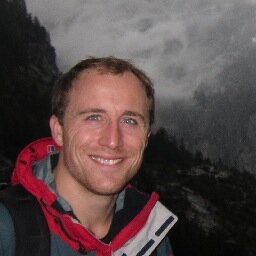
🚨 New paper on rapid CO2 rise 🚨 Decadal-resolution ice core CO2 data show abrupt jumps during each “Heinrich Stadial” event of the last 50,000 years. We show these were linked with rapid warming around Antarctica and coupled upwelling and convection in the Southern Ocean 🧵
🚨 New paper alert! Our ultra high resolution gas measurements show that atmospheric CO2 jumped by as much as 14ppm in 50 yrs during Heinrich Stadials. Where did it come from? 👀 We can't say for sure, but the stable isos in ice point to the Southern Ocean
1
20
48
🚨 New paper alert! Our ultra high resolution gas measurements show that atmospheric CO2 jumped by as much as 14ppm in 50 yrs during Heinrich Stadials. Where did it come from? 👀 We can't say for sure, but the stable isos in ice point to the Southern Ocean
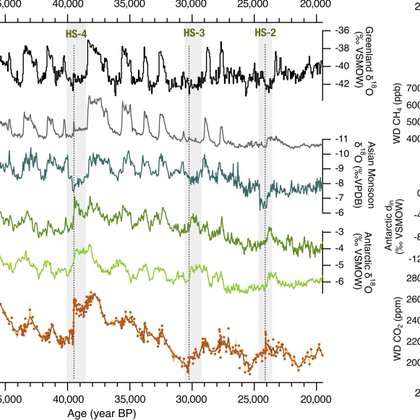
pnas.org
The last glacial period was punctuated by cold intervals in the North Atlantic region that culminated in extensive iceberg discharge events. These ...
1
23
92
What field work looks like at @OSUCEOAS. OSU undergrad Layne samples dripping water from the ceiling of @OregonCavesNPS to better understand the cave's complex hydrogeology.
2
1
19
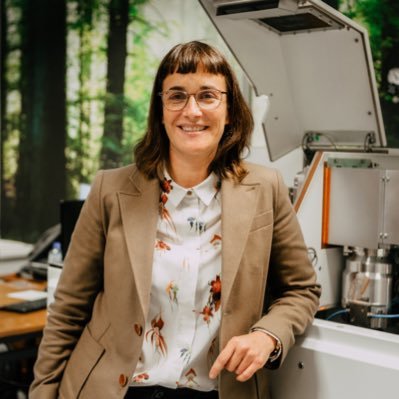
We are delighted to announce that the 10th International Climate Change: The Karst Record (KR10) conference will be held on the African continent for the first time! 24-28 March 2025 at the University of Cape Town, Cape Town, South Africa @UCT_news
1
22
52
Talkin' bout Marie any chance I get. Thanks @SumSchSpelSci for the invite! Have fun this week
0
1
9
Next we have @Speleo_Katee, who is joining us virtually, to talk about u-series dating. #S42023
1
1
2
Invited speakers include Lorraine Lisiecki and Ikumi Oyabu. Don't miss it!

Calling all #chronologists! Please consider submitting an abstract to @theAGU Fall meeting #AGU23 session #PP024 - Integrated Chronology Approaches in Paleo Sciences (I-CAPS) to discuss chronological approaches from various archives.
0
0
1

New paper alert ⏰ Groundwater recharge was >200% greater in the north-central Mojave Desert during the last glacial maximum

Water-table changes in the southern Great Basin, USA, over the last 350,000 years are 3-4 times as sensitive to recharge changes during drier interglacial than wetter glacial conditions. @SimonSteidle @Speleo_Katee
https://t.co/r8MfBwNxTd
3
5
14