
Brian Lerch
@LerchEcoEvo
Followers
367
Following
4K
Media
9
Statuses
528
Theoretical ecologist and evolutionary biologist studying social and reproductive behavior at UNC Chapel Hill
Joined September 2019
New paper out in @ASNAmNat with Reinhard Bürger and @servedio1: "Reconciling Santa Rosalia: Both reproductive isolation and coexistence constrain diversification" (1/11)
journals.uchicago.edu
Abstract Understanding patterns of diversification necessarily requires accounting for both the generation and the persistence of species. Formal models of speciation genetics, however, focus on the...
1
13
36
Had a great time doing this interview!

New episode (1143), with Dr. Brian Lerch (@LerchEcoEvo). We talk about same-sex sexual behavior, indiscriminate sexual behavior, attachment, and divorce. #Biology #Science YouTube: https://t.co/1YXWrpagta
0
2
5
New paper out! Really happy to have played a part in this

New in PNAS! More social baboon mothers are thought to have improved infant survival. But we show this link is confounded: females shift social behavior depending on reproductive state & infant presence. Once accounted for, the effect disappears. https://t.co/2BmwuLfiZC
0
1
4

Inter-species killings not related to predation. "30% of female prairie dogs killed at least one ground squirrel over their lifetimes. Females that killed ground squirrels had significantly higher annual and lifetime fitness than non-killers, probably because of decreased
5
9
47

Are humans the only species that communicates when a collaborator is missing information? @TownrowLuke and I show that our closest relatives, bonobos, can track when a partner is knowledgeable or ignorant, and tailor communication accordingly @PNASNews
https://t.co/OOJerxAOzi
3
56
178

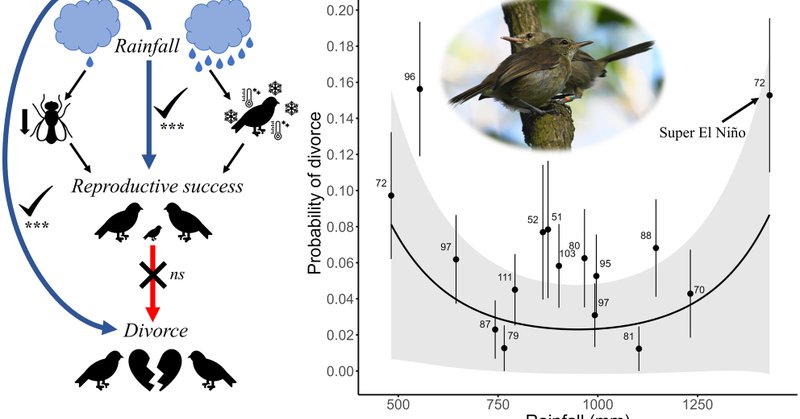
Want to know how divorce in birds is associated with rainfall? 💔🌧️ I wrote a piece (in non-scientific jargon!) about our recent paper in @AnimalEcology 👇👇. If you want to read the science-y version, see: https://t.co/ppfM0u5nQC
@AgusBentlage @hannahdugdale @SeychellesWarb
besjournals.onlinelibrary.wiley.com
To the best of our knowledge, our study is the first to show that extreme rainfall increases the prevalence of divorce in a socially monogamous population. Our findings add to the growing literature...

Divorce in songbirds: extreme weather pushes couples past breaking point, writes @Frigg_Speelman @Macquarie_Uni
0
10
13

Hi all! Our next seminar titled "Learning and Imprinting in Speciation" will include talks by Dr. Maria Servedio and Dr. Gabriel Jamie. See you on 12 November 5 pm CET. Link on the website. https://t.co/Aa5kgQjDkd
0
10
28

New paper: "Density-dependent dispersal reduces conflict over the sex ratio" (#OpenAccess), w/ Chedhawat Chokechaipaisarn https://t.co/3pyewm7cbU Sex-ratio optima for haplodiploid parents converge in viscous populations when dispersal is density-dependent @RSocPublishing #OA
1
13
23

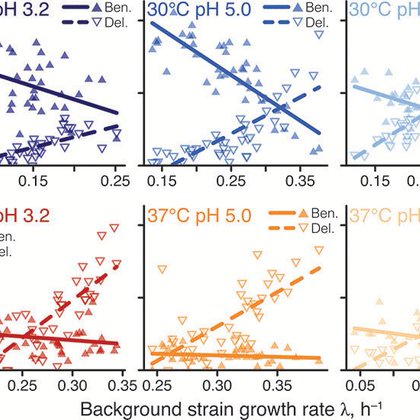
It looks like I never posted anything (*but see below) on what are probably the most surprising results my lab obtained so far. Anyway, this work—led by an outstanding former PhD student Sarah Ardell in collaboration with @_miloj—is now published: https://t.co/FyWOAaZr06
science.org
Predicting how new mutations alter phenotypes is difficult because mutational effects vary across genotypes and environments. Recently discovered global epistasis, in which the fitness effects of...
6
58
181
Overall, we hope that our study helps to bridge gaps between ecological and evolutionary studies of diversity. They show that linking the microevolutionary process of speciation to macroevolutionary patterns requires considering both the generation and persistence of species.
0
0
0
Genetic constraints are most important when competition is only strong among similar phenotypes and assortative mating is weak. These conditions lead to tight phenotype packing and thus frequent hybridization, resulting in an important role for genetics.
1
0
0
We also assess the relative importance of ecological and genetic constraints on species richness. Ecological constraints are most important when competition is still strong even among dissimilar phenotypes and fitness differences are large, conditions facilitating exclusion.
1
0
0
In other cases, however, speciation (even sympatric) can occur only to have competitive exclusion follow. Speciation does not guarantee stable coexistence, demonstrating that coexistence and reproductive isolation can be independent controls on species richness over long times.
1
0
0
We find that ecology and genetics both have critical and often interacting roles into the initial generation of diversity and also the long-term maintenance of diversity. Some conditions, such as large fitness differences, prevent both initial speciation and stable coexistence.
1
0
0
To bridge gaps between coexistence and speciation theory, we develop a model with 3 genetic loci controlling an ecological trait and are used in assortative mating. We also including variation in an underlying distribution of resources to generate fitness differences
1
0
0
in 1981, Felsenstein expressed "Skepticism toward Santa Rosalia" arguing that niche availability only sets an upper bound on species richness: genetics prevents the bound from being reached. These highly influential papers divided how different fields study diversity.
1
0
0
These disconnects have a long history. In 1959, Hutchinson published his "Homage to Santa Rosalia" arguing for the importance of niche availability to species richness. This set the stage for a classic, ecological understanding of species richness and coexistence. Meanwhile...
1
0
0
Despite shared interest, formal models that explicitly consider the evolution of reproductive isolation rarely include enough ecological detail to assess whether new species will coexist and interactions between ecology and genetics are rarely considered in speciation models.
1
0
0
Understanding patterns of diversity is central to both ecology and evolutionary biology. Ecological studies tend to focus on the maintenance of diversity (coexistence), whereas microevolutionary studies tend to focus on the generation of diversity (speciation).
1
0
0

We're searching for a postdoc! Join our team to study stress responses in wild baboons using real-time measurements of heart rate 🐵💓 https://t.co/9inHUgd3SY
0
60
101