

HighlanderLab
@HighlanderLab
Followers
957
Following
363
Media
168
Statuses
470
Research on managing and improving populations at @RoslinInstitute & @TheDickVet. Led by the chief Highlander @GregorGorjanc. Also on fediscience dot org
Edinburgh, Scotland
Joined July 2019
A free online course on "Breeding Programme Modelling with AlphaSimR" will launch this summer on @edXOnline! Discover how breeding and genetics can contribute to #sustainable food production 🌽🥕🍎🐟🐮🐣🐝🐛 Register at https://t.co/mV0IZ7cyqH Read the 🧵! @wcgalp2022
3
32
78
New preprint: "Genomic models for accurate estimation of breeding values in Sitka spruce (Picea sitchensis Bong. Carr)" from the Sitka Spruced project
researchsquare.com
Genomics is advancing estimation of breeding values for selective breeding. Traditional pedigree information used in the estimation of breeding values can still be competitive to genomic information...
1
2
6
AlphaSimR course https://t.co/4vOmBP2HKl Week 3 opens with a discussion on genetic variation between relatives, with a focus on siblings. While mutation is the ultimate source of genetic variation (by introducing new alleles), recombination shuffles it through meiosis.

AlphaSimR course https://t.co/4vOmBP2HKl Week 2: Following the simulation of traits and their genetic and phenotypic values for a trait, we close this week with independent exercises and weekly interview about breeding.
1
3
12

New preprint: “Modelling the impacts of imports of non-native honey bees into the native Apis mellifera mellifera population in Ireland”. We used stochastic simulations to study how non-native genes spread over time and affect fitness and honey production.

biorxiv.org
Human-mediated movement of organisms for agriculture and ecosystem services often results in hybridisation and introgression between native and non-native populations. While introgression may...
1
3
8

Four professors from the Centre for Tropical Livestock Genetics and Health and the Roslin Institute will share their career and research journeys so far at an inaugural lecture showcase marking ten years of science at CTLGH. Free and open to all. Please register ⬇️
0
3
3
Please share: Registration is now open for EUCARPIA Biometrics in Plant Breeding 2025 https://t.co/pcMg79ssjv
0
4
18
* Imprinting / gametic models on simulated and real beef data David Lopez Carbonell * Selection for stability in plant breeding Dominic Waters * Tracking inheritance of alleles within a dog pedigree Rosalind Craddock * EUCARPIA Conference organisation
highlanderlab.github.io
This is the web site of the 2025 EUCARPIA Biometrics Plant Breeding conference. The conference will take place in September 2025 in Edinburgh, UK. It is organised by the Highlander Lab at the...
0
1
3
I feel blessed & hyped after another fantastic HighlanderLab meeting covering: * Selective breeding of artemia Bruna Santana * Selection index (Smith-Hazel, desired gains, economic weights, …) @dantolly19
1
1
3
It can be tricky to visualise large #pedigrees. We have develped 'randPedPCA' for running #PCA on large pedigrees (can be >1M individuals). Check out our preprint https://t.co/k8qjR3q9GV and the R package https://t.co/5jgxkzYhem
@GregorGorjanc @epigenci @hannes_becher
github.com
Principal Component Analysis of Pedigree Relationship Matrix via Randomized SVD - HighlanderLab/RandPedPCA
0
1
7
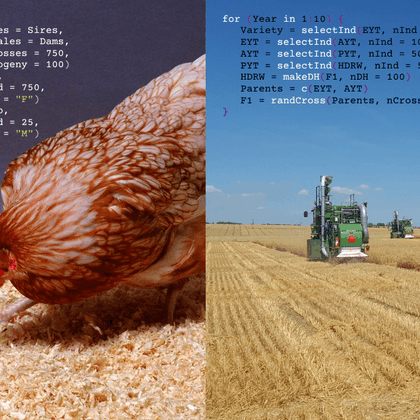
Lastly I gave a short course on Stochastic simulations of breeding programmes with AlphaSimR - a teaser for our free on-line course
edx.org
Breeding programmes are key to the genetic improvement of plant varieties and animal breeds used in agriculture. This unique course shows how to model an existing or new breeding programme and the...
0
1
3
@janaobsteter presented the work of Laura Strachan on Optimizing pedigree reconstruction and patriline determination in honeybees (with Jernej Bubnič and Janez Presern)
1
1
1
@Ireneee_dc presented her work on Modelling the Impact of Non-Native Honey Bee Importation on Native Apis mellifera mellifera Populations (with Laura Strachan, Grace McCormack, Jana Obšteter)
1
1
1
I presented the work of Letícia Lara on Evaluation of selective breeding programme designs for black soldier fly larvae body weight (with María Martínez Castillero, Thiago Oliveira, Ivan Pocrnić, Jana Obšteter)
1
1
1
Last week some of us attended the 1st @EAAPofficial Insect Genetics Workshop, which was organised with COST InsectIMP @CA22140 Action action by @beegirl_nz and @janaobsteter . We presented
1
1
6
In cross-validation for yield prediction, the ARG-based branch relationship matrix (BRM) demonstrated higher predictive ability than the standard site-based relationship matrix (SRM) when combining both subspecies.
0
1
2
(A) The standard site-based relationship matrix (SRM, VanRaden’s) and (B) the ARG-based branch relationship matrix (BRM) revealed similar population structure, with highly correlated (C) diagonal and (D) off-diagonal elements, though on different scales.
1
1
1
The age distributions for (A) nodes (ancestors), (B) mutations, and (C) SNP sites (i.e., first mutation at each site) were heavily right-skewed towards the present (as expected).
1
1
1
The ARG encoded genomic data more efficiently than the standard VCF: the tree sequence file for all chromosomes was 62 MB, compared to 228 MB for the VCF—nearly four times smaller!
1
1
1
Local trees from two genomic regions showed distinct patterns: (A) revealed deep separation between indica and japonica, linked to the DST gene associated with panicle length in japonica. The (B) region segregated in both subspecies and was linked to panicle traits in both.
1
1
1
After building the ARG, we demonstrated it captures biological signals using genealogical nearest neighbors (GNN) - it clearly distinguished indica and japonica rice subspecies and effectively represented population structure.
1
1
1