
DesignIng Cars ⚙️
@EngDesignIng
Followers
1K
Following
8K
Media
175
Statuses
1K
Engineer, design engineer, engine designer, designer.
Joined February 2022
F1 2025 Tech Review: McLaren MCL39 Front Suspension Secrets Revealed Stay tuned for a detailed analysis of the quite unique kinematics of the WDC and WCC-winning car’s front suspension—what made it so good and why steering feedback was lacking.
4
23
188
Great interview with designer Sergio Rinland. Talks about the past—did Piquet influence FW11 design with details of BT-55?—and future: the Catesby Tunnel, aero testing using PIV. https://t.co/5DJLDR2f4K
2
0
4

Hi guys, There was much talk and speculation about whether McLarens had some ingenious system that allowed them to better care for their tires by taking advantage of the brake vents. . #xaviimages #aeroporn #f1technicalphotographer 📸 #F1Tech #formula1 #F1 #grainingf1tech
11
27
860

Safe to say Ferrari's initial implementation of the front wing actuators is rather subtle in comparison. 😅
17
40
2K

MY FAVORITE RACING CARS, PART I. Phil Hill in the Ferrari 156 at the 1961 German Grand Prix. (Photo by Jesse Alexander) READ MORE: https://t.co/cI1RQScRDR
0
1
10
Compare to Ferrari, who’ve used the same basic design for the 4 years of current rules set…
Pic of @ScuderiaFerrari F1-75 from 1st yr. of current rule set shows Ferrari have same basic rear suspension layout—pull-rod inboard loc’n was moved—on the SF-25 after 4 yrs. See deep-dive analysis of current layout in link below. SF-25 vs F1-75 (pic: @AutoJournalMag)
0
1
34
In this @autosport article, TP Stella explains how @McLarenF1 “decided to go for quite a lot of innovation” on MCL39. https://t.co/7SgotmQgPf The result of this decision can be seen in the complex multi-link FR and RR suspensions that serve aero needs + tire management.
5
21
213
Pic of @ScuderiaFerrari F1-75 from 1st yr. of current rule set shows Ferrari have same basic rear suspension layout—pull-rod inboard loc’n was moved—on the SF-25 after 4 yrs. See deep-dive analysis of current layout in link below. SF-25 vs F1-75 (pic: @AutoJournalMag)
Deep Dive - @ScuderiaFerrari SF-25 revised rear suspension: Besides the likely (hidden) mods to spring/dampers & their actuation, upper WB fwd arm inboard pick up was lowered by ~50 mm, resulting in the roll ctr. ht. increase of ~20 mm to ~60 mm. Kinematic analysis comparison:
0
13
147
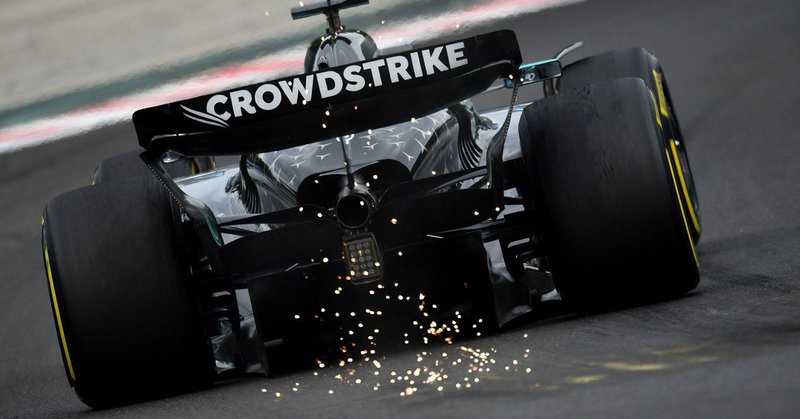
In @autosport article, @MercedesAMGF1 trackside engineering director Andrew Shovlin talks anti-rise (referred to as anti-lift here—bit of a misnomer) effect of angled rear suspension upper wishbone with no mention of anti-squat:
autosport.com
As Formula 1 takes stock during its summer break, we look at why anti-lift rear suspension has become a trend in 2025 - and why it isn't always a golden ticket to a faster car
1
2
17
Braking anti-rise effect, though, is noticeably increased with the reaction vector angle basically doubling from ~12 deg. to ~26 deg. So while it was assumed that Merc and Ferrari changed their rear suspension to increase anti-squat, it’s mostly the anti-rise that was targeted.
1
2
25
The lateral instant center was raised ~40 mm to ~310 mm. As the IC height is below the wheel center, this design actually provides a slight pro-squat design at ~ -3.5 deg (pretty much unchanged) though some anti-squat restoring torque is present if CG below Fwb line-of-action…
1
1
25
Bump steer is slightly increased at the extremes of bump and rebound, while lateral scrub peaks shifted from bounce travel to rebound travel…
1
1
21
The new suspension kinematics maintains a relatively neutral camber gain curve (with -1.75 deg. static setting) which is typical for rear suspension requiring keeping rear tires square to the road surface to ensure maximum tire contact for traction during acceleration…
1
1
24
Deep Dive - @ScuderiaFerrari SF-25 revised rear suspension: Besides the likely (hidden) mods to spring/dampers & their actuation, upper WB fwd arm inboard pick up was lowered by ~50 mm, resulting in the roll ctr. ht. increase of ~20 mm to ~60 mm. Kinematic analysis comparison:
2
14
173
Looks like upper wishbone forward link pickup was lowered among other changes but not to the extreme of Merc W16 changes. So limited change in kinematics and anti-squat/rise. Most likely major changes involve the actuation of inboard spring/damper/bump-stop.
@Sedici_Ferrari @brakeboosted @Auto_Racer_it Very roughly estimated, RC seems to be ~ 100mm above ground level, mostly driven by lower WB leg(s) residing in the half-shaft fairing so RC probably can’t be lowered much. Do a Merc and drop the upper WB front leg? It’ll raise RC & get more anti-squat & rise. Will this help? 🤷🏻♂️
4
21
417
Queen of the Skies ✈️

Boeing 747-8F making a shockwave flying near the speed of sound and speeds where no Airbus could possibly fly. 😎 All hail the Queen!✈️ 📸 by @Vincent5327827
0
0
3
…
@ScarbsTech I expect the virtual steering axis is more outboard (determined by the instant center of the two lower links) so resulting in reduced less scrub rad at tire contact patch and would explain reduced feel. I believe McL went with multi-link lower “wishbone” specifically so they…
0
0
4
🤔… seems I read this somewhere before… 😉
@HenryWi86212968 @samarth_dalvi @dr_obbs Possibly the more outboard virtual kingpin/steering axis resulted in a reduced scrub radius. A larger positive scrub radius increases steering feel but also increases steering effort while reducing stability under braking.
1
0
12
1 step harder compounds, higher pressures all around, and reduced front camber limit compared to Austria.

The midpoint of the season sees Formula 1 return to where it all began 75 years ago. Read more here 👉 https://t.co/TipE2j5mh5
#BritishGP #f1
1
0
18

𝗪𝗘 𝗪𝗢𝗡 𝗟𝗘 𝗠𝗔𝗡𝗦. For the third year in a row. 🏆 Another milestone in Ferrari history to treasure 😍 #LeMans24 #WEC #Ferrari499P #FerrariHypercar
366
5K
22K