
Carlos Collet MD PhD
@ColletCarlos
Followers
4K
Following
3K
Media
264
Statuses
1K
Interventional Cardiologist. Physician-Scientist. Director of Cardiovascular Imaging, Physiology and Translational Therapeutics at CRF
New York, NY
Joined June 2013
Full house at @crfheart today for a fantastic session with Prof. Stewart Pocock, Chief of Statistics. How to get to primary endpoint hierarchy right? His perspective in how to turn numbers into knowledge that changes practice. #Cardiology #ClinicalTrials #Biostatistics
0
7
17
This is the perfect case to randomize in a vulnerable plaque study. Looking forward to the results!
Recta final para la inclusion del @VulnerableTrial con el paciente 500 del RCT aleatorizado. Ya quedan 100 para llegar a los 600 objetivo. Esta vez nos ha tocado en Bellvitge. Caso muy claro de una CF con ALM 2,5 mm2, carga placa 80%, arco lipido >300^ y capa fibrosa de 50 micras
2
3
20
We are thrilled to pioneer the introduction of PPG into U.S. practice, an objective measure of longitudinal pressure loss that refines CAD phenotyping and predicts post-PCI physiology and clinical outcomes. Our recent @JACCJournals Advances State-of-the-Art summarizes the
2
9
30
Enter a new era of interventional cardiovascular innovation! 🌠 We are proud to announce the inaugural TCT Plus Africa, coming to Tunis, Tunisia, in January 2027. 🌍🎊 Mark your calendar and prepare to embark on a journey of discovery and transformation with global experts from
0
6
13

Dr @ColletCarlos is speaking at at #ACIC “Can we reliably predict plaque rupture before it happens?” Join over 500 participants and a global expert faculty Register: https://t.co/DpTDJNK5Wv
0
2
5
Will #CTA become the standard for assessing patients after Left Main PCI? https://t.co/iE4rOuZNbD Our editorial in @JACCJournals @crfheart @ziadalinyc @SCAI
2
18
67

It's the final day of #TCT2025! Watch Ajay Kirtane and @ColletCarlos wrap up the late-breaking science to come out on Day 4. https://t.co/1OrWVeM2NM
0
4
14

In patients with de novo coronary artery disease, #DCB angioplasty with rescue stenting was assoc with a higher rate of Device-oriented Composite Endpoint compared to intended DES implantation regarding DoCE at 3 yrs https://t.co/FfAQg6isuO
#TCT2025 #JACC #cvCAD @DFCapodanno
1
30
98
Congratulations @g_giustinoMD 👏👏👏👏

🏆 Congratulations to Gennaro Giustino, MD (@g_giustinoMD) for receiving the Thomas J. Linnemeier Spirit of #InterventionalCardiology Young Investigator Award at #TCT2025! 🌟Your work is shaping the future of cardiovascular care. 👏 A huge shoutout to all the incredible
0
2
9

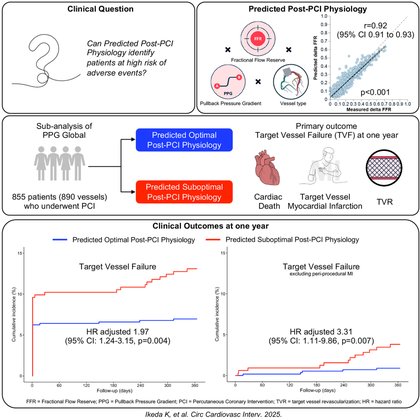
🔥Just published with @TCTConference Impact of PPG on Clinical Outcomes after PCI @American_Heart Patients with low PPG had x2 the risk of adverse events @crfheart @PCRonline @JACCJournals @SCAI
ahajournals.org
BACKGROUND: Impaired flow following percutaneous coronary intervention (PCI) is a known predictor of adverse outcomes. The pullback pressure gradient (PPG) is a novel physiological metric that...
3
22
72
AI generated histology derived from OCT Fascinating images #TCT2025 Learning pathology through OCT! @ziadalinyc @GreggWStone @crfheart @JEscaned @PCRonline
2
33
107
Just published Thanks and congratulations to all the co-authors @JEscaned @ziadalinyc @divaka_perera @AntonioMariaLe2 @sbrugaletta @PCRonline @crfheart @CircAHA @BernardBruyne @fredericbouisse @DamienCollison
1
18
45
🧩 Why does this matter? ❌Diffuse disease → lower PPG → more stents, smaller lumens, more calcium → higher risk of stent failure and MI. ✅Focal disease → higher PPG → lipid lesion -> better PCI results and almost NO events. This is where physiology changes role — No
1
0
5
➡️ Does this predicted physiology correlate with 1-year outcomes? 🚩855 patients (890 vessels) from the multicenter PPG Global registry ⏲️1-year follow-up 💟Primary endpoint: Target Vessel Failure (TVF) = cardiac death, MI, or ischemia-driven revascularization 🔑Vessels
1
0
0
📊 Using a simple equation with PPG, we estimated what the post-PCI FFR would be before doing the procedure. 🩺 How well does the prediction work? Strong agreement between predicted and measured post-PCI FFR (ΔFFR r = 0.92!)
1
0
0
🔥 Physiology has evolved. From a diagnostic method to a prognostic tool. 💡 What if we could predict outcomes before we stent? The Pullback Pressure Gradient (PPG)—a metric describing how disease is distributed along the coronary artery—may hold that key. Our latest study,
5
28
59
Great to see @CardioAalst @CoreAalst ranked #3rd from OUS institutions at #TCT2025 💪🏻💪🏻💪🏻 @BernardBruyne @EricWyffels @jeroensonck @BarbatoEmmanue1
The SET-10 Power List is here! 🏅 See which international institutions are recognized for their contributions to #TCT2025 – transforming heart care and driving research forward. 🌍💙 Congratulations to the #SET10 institutions for leading the charge in #CardioResearch!
2
5
27
Kicking off #TCT2025 on Saturday morning, we will present the 1 year clinical outcomes of patients treated with PCI in Focal vs Diffuse disease #PPG Physiology will become more clinically relevant than ever before 💪🏻

🚨 #TCT2025 Late-Breaker alert! Dr. @ColletCarlos will share how Pullback Pressure Gradient (PPG) impacts clinical outcomes one-year after #PCI. PPG is a predictive tool that quantifies focal coronary disease to enable precise PCI decision-making for better patient outcomes.¹⁻³
0
11
35
🚀 Ready to learn CT to guide PCI? #TCT2025, is the place to be. Don’t miss the CT-Guided PCI sessions 👇👇 I’ll be presenting, for the first time, on🗓 Sunday, October 26 — 10:00 AM, data on how calcium density from CCTA impacts stent expansion — this will redefine calcium
1
8
37