

William Schpero
@wschpero
Followers
2K
Following
3K
Media
225
Statuses
4K
Assistant professor @WCMPopHealthSci @WeillCornell @Cornell. Health economist studying Medicaid, the health care safety net, and inequity.
New York, NY
Joined February 2009
We are excited today to launch the T-MSIS Analytic Files (TAF) Analysis Reporting Checklist, which is designed to guide reporting of research using the TAF, the new generation Medicaid claims data. See @JAMAHealthForum: https://t.co/8dbaGeM5zk Links to key resources⬇️ 1/N
1
3
6

Who delivers maternity care matters. 👩⚕️ More than 90 percent of births are physician-led. But what happens when Certified Nurse Midwives (CNMs) gain full authority to practice independently? 🧵 Here’s what I find in my #JMP:
1
6
12

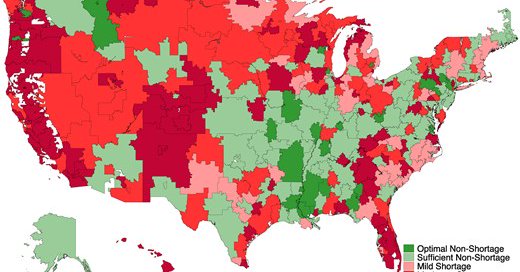
Research from @wschpero, @EmmaBethMcGinty, and Michael Liu in @Health_Affairs Scholar finds that for a decade, more than 60 percent of the US population lived in regions with psychiatric bed shortage. Learn more:
academic.oup.com
AbstractIntroduction. The US faces a growing mismatch between demand for inpatient psychiatric care and available capacity. Little is known about the chara
0
1
2
.@WSchpero and colleagues have developed a checklist, described in @JAMAHealthForum, to improve Medicaid policy research. Learn more:
phs.weill.cornell.edu
Medicaid is the single largest source of health care coverage in the US. However, health policy research on Medicaid has historically lagged due to the limited availability of high-quality
0
2
3
We are grateful for support from @commonwealthfnd and @RWJF. cc @ACintheDC @khemp64 @WCMPopHealthSci 6/6
0
0
0
For more: ➡️ Publication in @JAMAHealthForum: https://t.co/8dbaGeM5zk ➡️ Checklist and Related Resources: https://t.co/9Q2qpvWdo6 ➡️ Video Explainer: https://t.co/w0h3M3GElf 5/N
1
0
0
The Checklist represents a multi-year effort to develop best practices by a sub-committee of the Medicaid Data Learning Network (MDLN), hosted at @AcademyHealth. We benefited from a ton of input across a broad cross-section of the Medicaid research community. 4/N
1
0
0
The TAF Checklist — akin to the STROBE checklist for observational research — recommends a series of items that should be reported in analyses using these data to ensure that TAF-derived research is both high quality and reproducible. 3/N
1
0
0
The advent of TAF in 2019 has done much to catalyze timely research on the Medicaid program. Yet, the data are highly complex, with varying quality across data elements and states. 2/N
1
0
0
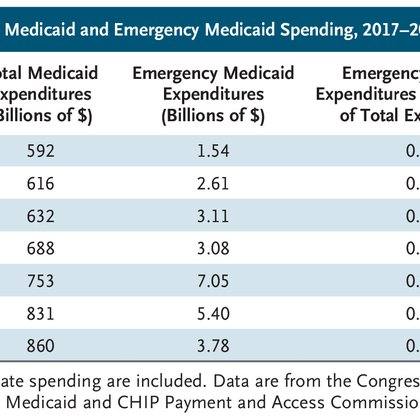
For decades, the narrowly defined Emergency Medicaid (EM) program has reimbursed hospitals for emergency care provided to uninsured, low-income immigrants. In @NEJM, we write in defense of state flexibilities in EM, which now seem at risk:
nejm.org
States that use federal dollars to provide health care to unauthorized immigrants, beyond narrowly defined emergency services, will now face enforcement actions and potential recoupment of funds.

🧵Emergency Medicaid accounts for <1% of Medicaid spending — yet saves lives & money. Restricting it ignores evidence, burdens states, and harms those who keep our communities running. Our latest via @NEJM: Preserving State Authority and Access to Care https://t.co/i1jhB9Rogs
1
2
6
In their new Forefront article, @DhruvKhullar, @wschpero, @EmmaBethMcGinty, @colleenlbarry, and Amelia M. Bond of @WeillCornell and @CornellBPP discuss a survey which suggests that many of the country’s leading health care policy experts believe that work requirements are likely

healthaffairs.org
Although there remains uncertainty about the eventual impact of work requirements, this survey suggests that many of the country’s leading health care policy experts believe that they are likely to...
3
6
12
Check out our article at Health Affairs Forefront: https://t.co/Ak7rMXRhY6 Dig through individual responses (with comments) on the CHPC website: https://t.co/Obhiet9I2r 3/3
healthpolicycenter.cornell.edu
0
0
1
Every 5-6 weeks, the Cornell Health Policy Center (CHPC) will survey 64 leading health policy researchers on the most pressing health policy topics of the day. To start: effects of Medicaid work requirements under the One Big Beautiful Bill Act. 2/N
1
0
1
For many years, the Clark Center at Chicago Booth has regularly surveyed leading economists to assess consensus on timely economic policy issues. We are excited today to launch the Cornell Health Policy Insight Panel, where we extend that model to health policy. 1/N ⬇️
1
1
4
2. The OBBBA includes work requirement exemptions for certain groups, including folks who are "medically frail" or in treatment for SUD. Our paper is an early proof-of-concept that states could use claims to automate exemptions (if allowed to do so in final regs). 5/N
1
0
0
➡️ We see two important implications: 1. Most expansion enrollees are actively receiving care. The coverage losses predicted under the OBBBA's work requirement will thus likely introduce discontinuities in care. 4/N
1
0
0
➡️ Key Finding 2: There was meaningful variation in health care use across states. Rx use exhibited the largest variation across states, followed by outpatient visits, ED visits, and inpatient visits. 3/N
1
0
0
➡️ Key Finding 1: In 2022, over one-third of adult expansion enrollees had at least 1 diagnosed health condition. One-quarter had an ED visit, while over 60% had outpatient visits and prescription drug fills. 2/N
1
0
0