
Gaurav Verma
@verma22gaurav
Followers
687
Following
3K
Media
48
Statuses
360
Senior Applied Scientist at Microsoft | Georgia Tech CS PhD | Research in Multimodal GenAI and LLMs
Joined June 2016
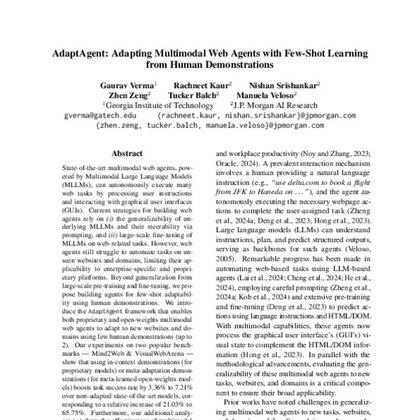
#ACL2025 just started and we are excited to present AdaptAgent – where we boost the performance of multimodal agents on unseen web tasks and domains using few-shot human demonstrations. We share more about how techniques like in-context learning (with proprietary MLLMs) and
aclanthology.org
Gaurav Verma, Rachneet Kaur, Nishan Srishankar, Zhen Zeng, Tucker Balch, Manuela Veloso. Proceedings of the 63rd Annual Meeting of the Association for Computational Linguistics (Volume 1: Long...
👋If you are at #NeurIPS2024, check out our poster on 🤖 'AdaptAgent: Adapting Multimodal Web Agents with Few-Shot Learning from Human Demos' at the Workshop on Adaptive Foundation Models! Catch @kaurrachneet6 at the poster session! 📍10:45 am, Exhibit Hall A, Saturday (Dec 14)
0
1
14

Excited to share our upcoming #AIES2025 paper on how large AI models can be responsibly applied in real-world vertical systems (like in healthcare and education). This also happens to be the the final paper of my PhD journey at Georgia Tech 🎓 Foundation models are powerful,
1
0
5

🚀 I'm joining @nyuniversity as an Assistant Prof. + looking for PhD students in Human-Centered Technology, Innovation & Design! https://t.co/tDVQZqz41N
#AcademicTwitter [1/4]
25
35
357

New paper from my group at @MSFTResearch! 📄 https://t.co/bRwk7auUAn Promises about how AI will change work are cheap. What does the actual data say? We measured which work activities people use AI for, how successful they are, and which jobs do those tasks. 🧵1/8

arxiv.org
Given the rapid adoption of generative AI and its potential to impact a wide range of tasks, understanding the effects of AI on the economy is one of society's most important questions. In this...
2
12
15
Another week, another conference! CSE students and faculty are in Albuquerque presenting #NLProc research at @naacl! The GT @ #NAACL website is your one-stop shop for everything you need to know about our teams and their research! 🔗 https://t.co/o8Lwy7pcDv
0
5
14
Excited to share that our work got accepted at #NAACL2025 Main. 🥳 1️⃣ How good are LLMs in detecting adverse drug reactions and providing mitigation strategies? 2️⃣ How can we measure LLM-expert alignment in long-form generations? To know more: https://t.co/s3uspFOY95

Adverse Drug Reactions are among the leading causes of hospitalizations for mental health issues. LLMs have the potential to detect ADRs and provide mitigation strategies. But do LLMs align with experts? 🤔 We explore this in our work 👇🏼🧵 https://t.co/s3uspFOY95 1/11
4
5
42

I've created slides for those curious about the recent rapid progress in linear attention: from linear attention to Lightning-Attention, Mamba2, DeltaNet, and TTT/Titans. Check it out here:
11
165
852
Pretty impressed by NVIDIA's Cosmos! As someone who's not in robotics research, I wondered how one goes from A→B, where: (A): generating video simulations of a world that I want to run a robot in (from a seed image and/or text instruction) and (B): getting the robot to actuate a
0
0
8
Check out our new work, led by @mohit__30! In addition to evaluating the classification-style diagnostic capabilities of LLMs for psychiatric ADRs, we conduct a multi-dimensional evaluation to determine how closely LLM-generated responses align with expert responses. More below:
Adverse Drug Reactions are among the leading causes of hospitalizations for mental health issues. LLMs have the potential to detect ADRs and provide mitigation strategies. But do LLMs align with experts? 🤔 We explore this in our work 👇🏼🧵 https://t.co/s3uspFOY95 1/11
0
1
15
Check out the paper for more analyses, insights, and details: https://t.co/FEBM95zO5t; resources coming out soon! It was a pleasure working on this with collaborators at JPMorgan AI Research – @kaurrachneet6, Nishan Srishankar, Zhen Zeng, @tuckerbalch, and Manuela Veloso! ❤️
0
0
2
🔑 More broadly, we believe that training the agents for adaptability – with frameworks like AdaptAgent – could unlock their broader potential to operate in domains beyond the reach of training datasets—such as enterprise-specific software and proprietary workflows! 4/
1
0
2
🎯 Our experiments on the VisualWebArena and Mind2Web benchmarks show that the AdaptAgent framework is an easy and efficient way to gain a relative increase of 21.03% to 65.75% in task success rates on new web tasks/websites/domains. 3/
1
0
1
Our work proposes data-efficient approaches to adapt multimodal LLM-based agents to unseens tasks, websites, and domains by using ⚡️ upto 2 ⚡️ human demonstrations! ⚙️The framework proposes in-context learning for models like GPT-4o and meta-learning for models like CogAgent! 2/
1
0
1
👋If you are at #NeurIPS2024, check out our poster on 🤖 'AdaptAgent: Adapting Multimodal Web Agents with Few-Shot Learning from Human Demos' at the Workshop on Adaptive Foundation Models! Catch @kaurrachneet6 at the poster session! 📍10:45 am, Exhibit Hall A, Saturday (Dec 14)
1
4
27

☀️Excited to share our new paper! Generative AI agents are powerful but complex—how do we design them for transparency and human control? 🤖✨ At the heart of this challenge is establishing common ground, a concept from human communication. Our new paper identifies 12 key
2
70
359
🪃 I'm on the academic job market! I study digital applications for work, focusing on mental well-being + social dynamics. My work merges AI, sensing, informatics, and organizational science to help workers work differently. Pls bump and keep an eye out:
vedantdasswain.com
Vedant Das Swain’s personal website
3
48
137