
Valentina Pacella
@valepacella
Followers
327
Following
302
Media
24
Statuses
172
Researcher @IUSSPavia
Pavia, Lombardy
Joined June 2018
🔥 Our new paper reveals a 3D #morphospace mapping the #brain’s functional universe 🌌 https://t.co/zoQxfBbxID! Using meta-analytic data, we can #predict unseen #functions & decode #neural activity during movie-watching 🎬. Just the beginning of exploring #human #cognition! A 🧵
4
10
27

🧠 Just out in Nature: A human brain map of mitochondrial diversity. A powerful collaboration with Mosharov and @MitoPsychoBio. Big step toward bridging cell biology and neuroimaging! 🔗 https://t.co/4X7PVKFsaU 🧬 #MitoBrainMap #neuroscience
5
70
205
This work was made possible thanks to our incredible co-authors: @bertagnoli_sara, Riccardo Danese, Cristina Bulgarelli, Valeria Gobbetto, and Giuseppe K Ricciardi @IussIcon @IussPavia @BcBlab @NpsyVr @SCNL_AgliotiLab
0
1
4
Our findings support the hypothesis that AHS is a disorder in the awareness of motor intentions. Both conscious intent generation and awareness of that intent are disrupted, leaving patients unable to suppress involuntary actions, modify inappropriate targets, or control timing.
1
1
2
Thus, we indirectly explored white matter involvement in all 3 patients, revealing a shared disconnection pattern critical for action initiation and purposefulness. These disruptions underpin both "productive" (e.g., grasping) and "negative" (e.g., action failure) AHS symptoms.
1
1
1
In one patient, detailed tractography revealed disconnections in the posterior callosal and fronto-parietal/fronto-occipital pathways. These disruptions explain the heterogeneity of patient's symptoms: forced grasping, levitation, and persistent mirror movements and synkinesis.
1
1
2
Through detailed assessments of 3 cases, we identified hallmark symptoms of AHS, including magnetic apraxia (object-induced grasping), levitation, and bimanual incoordination. Despite overlapping symptoms, our patients' distinct lesion locations showed no common cortical damage.
1
1
2
Thrilled to share our latest and punkest study in @CORTEXjournal 'Anarchy in the Brain'!🧠 With @ValeMoroUnivr's team, we explore the fascinating Anarchic Hand Syndrome, revealing a neural network behind its symptoms. Check out the #OpenAccess
https://t.co/ahwpPzEhfg Follow the🧵
2
6
15
... all tutors (@DrSjBrooks @MichelTdS @StephForkel @valepacella @ANNAMTSV @ChrisFoulon @danyelhewitt Benamina Mercante, Paolo Enrico, Sizwe Zondo & @introspection) and most importantly all attendees who made this week amazing!
0
2
3
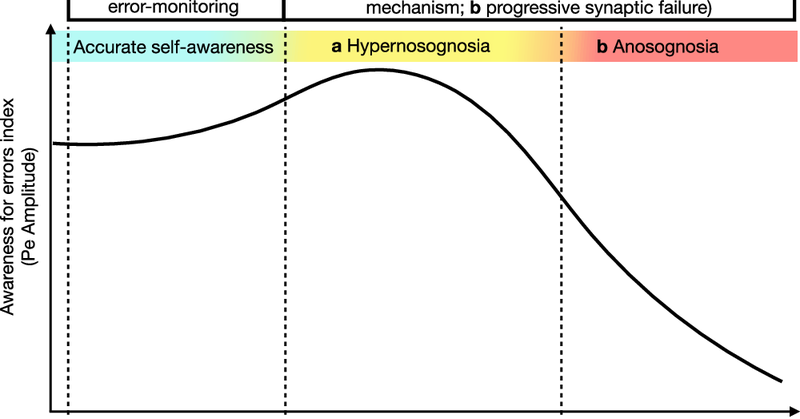
🌀 Imagine being caught in a loop where unrecognized memory issues worsen, reinforcing decline without the chance to adapt. That's the vicious cycle Alzheimer’s patients face as anosognosia takes hold. By targeting awareness early on, we may slow the disease and improve outcomes.
0
0
0
🧠This cascade suggests that damage to the PCC and its connections—a network for self-referential processing—impairs patients' ability to detect and respond to performance errors. Other forms of anosognosia, as seen in stroke and TBI, support the critical role of the PCC network.
1
0
0
🔎 In Alzheimer’s, early amyloid-β deposits in the PCC trigger a less-wiring-more-firing response, heightening self-awareness in the preclinical phase. As amyloid-β accumulates, this compensatory mechanism falters, error-monitoring weakens and awareness fades, deepening decline.
1
0
0
Exciting collab with Katia Andrade is out now! We uncover a new perspective: #anosognosia not only impacts daily life but actively drives #Alzheimer’s trajectory. This insight opens doors for new courses of research in the disease. Read on @CommsBio
https://t.co/1gEtAz08r9. 🧵
nature.com
Communications Biology - This article advances the view of anosognosia as a driver of cognitive decline in Alzheimer’s disease, due to early amyloid-β deposits in the posterior cingulate...
1
2
7
🧠🔍 Ever wondered if we can read the mind while watching videos? Our new paper explores the brain's "morphospace" to predict inner thoughts & mental states in real-time! 🎥Dive into the future of cognitive decoding 👉 https://t.co/gR3L5bilII
#Neuroscience #BrainDecoding #AI
0
11
42

We started this journey together at the @BcBlab, and I’m so glad to see the “cognition morphospace” finally published in @NatureComms, joining the “disconnectome morphospace” in our morphospace family! Congratulations @valepacella 👏
1
26
111
This is an #OpenAccess publication with all materials and codes freely available #openscience 💻 https://t.co/pxTrGQpKIy (code) 📹 https://t.co/arOrTpQ055 (activations decoded) 👩🔬 https://t.co/PCJWxEyP0d (video abstract)
0
3
3
My co-authors @MichelTdS @StephForkel @lia_talozzi @VNozais @demwassermann @majdabd33 and I hope this #framework will spark new research into unexplored #brain #functions, guiding the future of human cognition exploration.
1
1
3
It can also decode thoughts and inner states during #movie #watching
https://t.co/arOrTpQ055. This brings us closer to understanding the brain’s full capacity.
1
0
0
But that’s not all! The morphospace can even predict the activation patterns of new, unseen brain functions.
1
0
0
The morphospace shows how predictable each function is based on its similarity to others. This #predictability #index offers new insights into brain function organization.
1
0
0
Our new research reveals the hidden structure of current brain-cognition knowledge! Using @neurosynth comprehensive meta-analytic #fMRI database, we developed a 3D morphospace to map how the brain functions interact as we understand them today.
1
0
1