

Steven Pal
@steven_pal
Followers
218
Following
87
Media
38
Statuses
1K
Founder @kukiniapp. Product leader (ex @sprinklr, @getsatisfaction). Duke. Cal.
San Francisco, CA
Joined June 2009
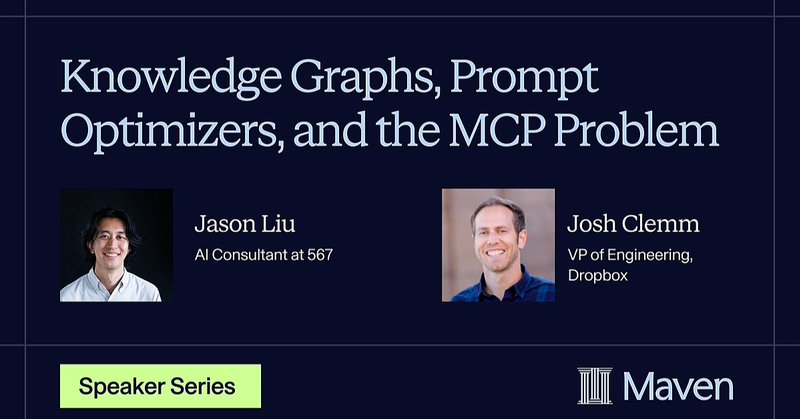
Awesome talk from @joshclemm on how Dropbox Dash is built, including why they went with indexes rather than federated search/retrieval, using LLM as judge in evaluating retrieval quality, and using prompt optimizers like DSPy.
maven.com
Production RAG requires architectural decisions most tutorials skip: whether to index, how to structure knowledge for complex retrieval, when prompt optimization compounds value, and solving tool...
0
1
7
Great talk from @0thernet on velocity (not vibe) coding. Interesting analogy to "point and call" that emphasizes why planning is the most important step. Plans are the new code, but you should still know your codebase and verify what's being changed. https://t.co/SfwEkVKrRH
0
0
0
Gavin explains that the bear case for AI capex spend is on-device inference: "In three years, on a bigger phone, you'll be able to run a pruned-down version of Gemini 5, Grok 4, or ChatGPT. And that's free. This is clearly Apple's strategy - we're going to make it privacy-safe

This is my fifth conversation with @GavinSBaker. Gavin understands semiconductors and AI as well as anyone I know and has a gift for making sense of the industry's complexity and nuance. We discuss: - Nvidia vs Google (GPUs + TPUs) - Scaling laws and reasoning models - The
111
145
1K
Gavin on why it's a mistake for SaaS companies to resist AI because it has a lower margin structure: "When there's a transformative new technology customers are demanding, it's always a mistake not to embrace it. If you're trying to preserve an 80% gross-margin structure, you
This is my fifth conversation with @GavinSBaker. Gavin understands semiconductors and AI as well as anyone I know and has a gift for making sense of the industry's complexity and nuance. We discuss: - Nvidia vs Google (GPUs + TPUs) - Scaling laws and reasoning models - The
25
45
451
Awesome thread! Implicit in it is that there are multiple diffusion curves to look at for each innovation (i.e. there were thousands of adoption curves of engines before they were good enough for the transportation use case). But when you get to "whole product" launch, look out!

So after all these hours talking about AI, in these last five minutes I am going to talk about: Horses. Engines, steam engines, were invented in 1700. And what followed was 200 years of steady improvement, with engines getting 20% better a decade. For the first 120 years of
0
0
0
Nice intro to user activation with some practical examples:

productschool.com
Forget vanity metrics. User activation is the compass that shows if your product or organization is lost or scaling.
0
0
0
Great overview of product-led growth:

productschool.com
Why is everyone talking about Product-Led Growth? Find out what it is, how Slack and Pinterest use it for big wins, and how to replicate it for yourself.
0
0
0
First product release in a while and my first leveraging GenAI behind the scenes!

New Recipe Box lets your store all your family's favorite recipes and easily add ingredients to your shopping list; create calendar events without any typing by taking a photo of a flyer, poster, or email; and more!
0
0
0
Weaponizing open source, when to raise money, unwavering blind focus, and how the founder is the brand
review.firstround.com
From Burger King shifts to a billion-dollar business, Sentry co-founder and CPO David Cramer shares his lessons for early stage founders.
0
0
1
Playbook for Forward Deployed Engineers (FDEs) in AI startups. Reminds me of both Merced and Sprinklr. Interesting analogy: "OpenAI is the home product team and the startups are the FDEs figuring out how to get adoption" https://t.co/TGtdBNO4CH
0
0
0
World models are leveling up. Release from @theworldlabs lets you create 3d worlds from text and image prompts. Exportable as Gaussian splats so you can render it in browser or in other apps.

Generate persistent 3D worlds from a single image, bigger and better than ever! We’re excited to share our latest results and invite you to try out our world generation model in a limited beta preview.
0
0
0
Really Simple Licensing (RSL) - interesting solution building on robots.txt to help publishers get paid when AI apps crawl content or use it during inference.
0
0
0
Open source world model from @TencentHunyuan built on top of HunyuanWorld. Lot of advancements here, especially the 3D point "world cache" to ensure long-range consistency.

HunyuanWorld-Voyager is here and fully open-source! The world’s first ultra-long-range world model with native 3D reconstruction, redefining AI-driven spatial intelligence for VR, gaming, and simulations. ✅Direct 3D Output: Exports point cloud videos to 3D formats without tools
0
0
0
"I've grown skeptical of product validation approaches I previously championed: landing pages w/ email capture, social media traction metrics, or viral preview videos. The key is solving existing customer problems, ones that have precedent." https://t.co/Rg8oB1kc4z
0
0
0
6/6 On not separating engineering from product and design: "If you know your business from A to Z, there's no problem you can't solve. PM's should understand code. Stay as close to the actual work as possible. Do not separate yourself from the pain of your decisions."
0
0
0
5/6 On progress requiring hard work: "Technological progress is not inevitable. Humans make technology. It just doesn't march forward on its own. And in many cases, it could even backslide. It only improves if a lot of people work very hard to make it better."
0
0
0
4/6 On learning everything you possibly can: "Elon read everything. The shorthand I have for this is they devoured entire shelves. Thomas Edison, Winston Churchill, Michael Dell, Edwin Lann. They would read every single thing in the library on their subject of interest."
0
0
0
3/6 On failure: "Make sure you have failures. Your first 50 failures are going to be really painful. Over time, you're less emotional. And if you're less emotional, you [can] take more calculated risks. The people that succeed the most also have the most failures."
0
0
0
2/6 On design and problem solving (aka the "algorithm"): 1. Question every requirement (w/ names of who made each). 2. Delete any part of the process you can (add back later). 3. Simplify and optimize (don't optimize deleted steps). 4. Accelerate cycle time. 5. Automate.
0
0
0
1/6 Great lessons from the Founders podcast #399 "How Elon Works": - design and problem solving (the "algorithm") - failure - learning everything on a subject - progress requiring hard work - not separating engineering from product and design https://t.co/qzq6wsDkaR
podcasts.apple.com
Podcast Episode · Founders · 08/25/2025 · 1h 33m
5
0
0