
SimBricks
@sim_bricks
Followers
49
Following
3
Media
3
Statuses
23
Open-source simulation framework for heterogeneous systems, especially with custom hardware. SimBricks modularly combines existing and new simulators.
Joined March 2021
Very much looking forward to being part of the FoC conference in Munich this year!

Our line-up for the Future of Computing Conference 2024 is growing – here are the first 10 computing startups that will pitch: @anabrid_tech @semron_ai @SpiNNcloud GEMESYS @synthara Lumai @Akhetonics NcodiN Linque @sim_bricks If you’d like to pitch your computing startup,
0
0
1
Today, Hejing Li introduces the SimBricks orchestration framework and how it enables users to simulate even complex systems with ease! This is a key feature to manage the complexity of connecting together multiple simulators. Read More:
simbricks.io
The SimBricks orchestration framework automatically configures and runs even complex simulations from simple simulation scripts.
0
3
2

@sim_bricks @li_hejing I always forget: is UW in Switzerland or Germany?
1
1
0
The start of our "meet the team" series. Over the next weeks the rest of the team will follow! You can look forward to @li_hejing 's spotlight next week!
1
3
5
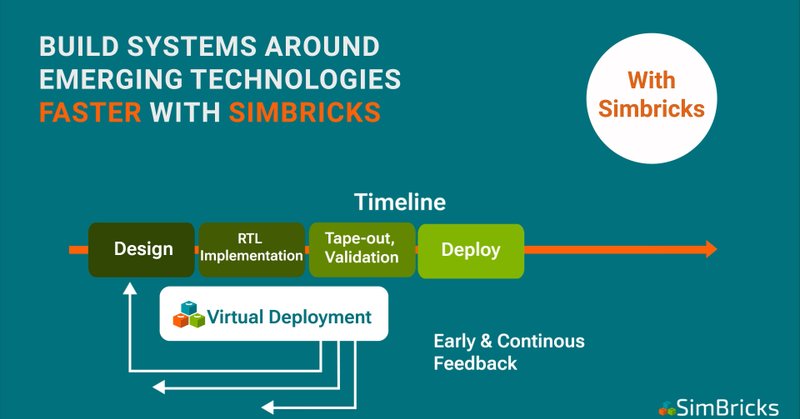
SimBricks accelerates development of heterogeneous systems and reduces cost. Virtual prototypes in SimBricks enable systems & hardware architects to make informed design decisions, and bridge different HW and SW teams. Learn more:
simbricks.io
Modular full-system simulation is particularly useful for disruptive systems with even longer time to deployment.
0
2
1
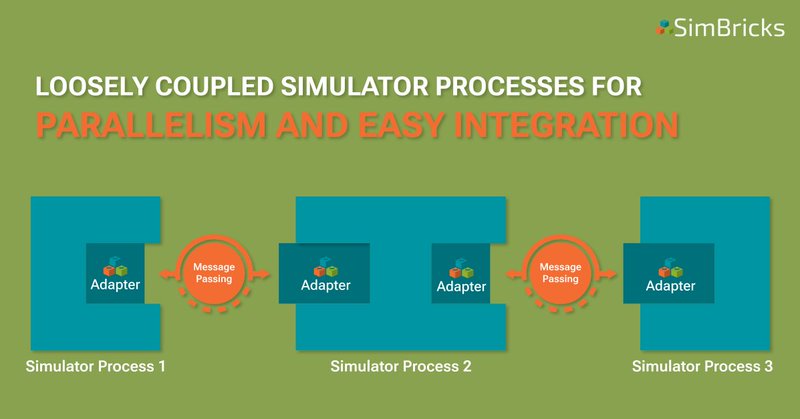
Today, Jonas blogged about our secret to scalably connect and integrate a range of independent and often seemlingly incompatible simulators into a coherent whole. https://t.co/Ri6PeAIo3b
simbricks.io
Our secret to scalably connect and integrate a range of independent and often incompatible simulators into a coherent whole.
0
2
4
Our newest post sheds light on when and why you should care about full-system end-to-end evaluation in simulation:
simbricks.io
Why should you care about end-to-end evaluation in simulation? How can SimBricks help you conduct end-to-end evaluations?
0
1
2
How does SimBricks work? What technical pieces are required to assemble full system simulations from component simulators? Find answers in today's blog post: https://t.co/wY9rWJKJv2
simbricks.io
How does SimBricks work? What technical pieces are required to assemble full system simulations from component simulators?
0
1
4
While we were presumably mistagged, we are still happy to recommend this library. 😅

If you get a chance to visit one place while in Prague 🇨🇿 @sim_bricks would highly recommend visiting the majesty of the klementinum library https://t.co/HB6MQYIMhl Breath taking @SESAMSimulation #sesam2024
@PragueEU
0
1
2
What is SimBricks? Why and when should you use SimBricks? Get a first overview through in our inaugural blog post: https://t.co/J1cJiGeHi1 You can look forward to future posts going into more detail.
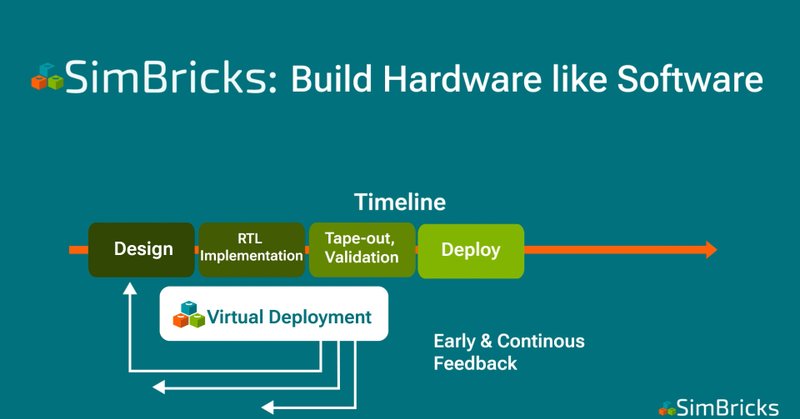
simbricks.io
What is SimBricks? Why and when should you use SimBricks? Get a first overview through in our inaugural blog post. You can look forward to future posts going into more detail.
0
2
4
With this release we have moved on from an initial research prototype, to now a tool that can be and is already used by independent users. Our goal is to make it simple for users to get started with full-system simulation without needing expertise for each and every simulator.
0
0
0
All our code, along with pointers to pre-built docker images and examples as starting point are on github: https://t.co/mstkApKvCI Dive right in with the interactive first steps in our example repo:

github.com
Main Repository for the SimBricks Modular Full-System Simulation Framework. - simbricks/simbricks
1
0
0
We present our first release for SimBricks, our open-source simulation framework for HW-SW systems. SimBricks modularly combines existing simulators for machines, networks, and hardware, allowing you to build, test, and evaluate intricate complete systems: https://t.co/nchYMyv7F3
1
3
6

We are testing our systems methodology for building and evaluating HW accelerators in a classroom setting, focusing on end-to-end system behavior throughout. The project also provides an easy (open source!) starting point outside of teaching. https://t.co/nFyRZ684QG (1/n)

gitlab.cs.uni-saarland.de
GitLab Enterprise Edition

We released the final HW acceleration course project milestone: https://t.co/fUxTNqdRKK. Here, the students implement Verilog RTL for the accelerator and synthesize it in 130nm, determining feasible clock rate and chip area and putting these in context of full system performance.
1
3
3
This course is using SimBricks to provide students with hands on experience of exploring the complete systems stack for HW acceleration: designing a HW/SW interface, implementing drivers, implementing HW simulation models, and finally implementing actual HW RTL!
🚨New Course Alert🚨 @AntoineKau is teaching a course on Accelerating Applications with Specialized Hardware ( https://t.co/8GTRT6lLmO). The project uses @sim_bricks and will be released in parts over the course of the semester. More info on the project:
0
1
3
In our group meeting today, Jakob gave us a brief overview and a live demo of his ongoing https://t.co/ilI8p8TEND. thesis work, Columbo: Low-Level End-to-End System-Traces through SimBricks Simulations! Find out more about the project here: https://t.co/TDBRqPFdsk
0
5
8
Bin Gao will present our position paper on using SimBricks for improving end-to-end evaluations for disaggregated systems at WORDS'22. https://t.co/9HTFFoH6ZS
@li_hejing @JialinLiNUS @AntoineKau
1
1
2
The paper further probes various technical aspects. Among other things we demonstrate scalability to up to 1000 simulated hosts (>1000 interconnected simulator instances.) with only minimally longer simulation times compared to simulating 40 hosts.
0
0
0
In particular, SimBricks runs the complete software stack including the unmodified operating systems, drivers, and applications. With the open-source corundum NIC we've also shown that we can simulate existing custom HW systems not built for simulation. 3/n
1
0
0