

Global Change Research Group
@pinskylab
Followers
3K
Following
6K
Media
74
Statuses
3K
We study how species adapt (or not) to changing environments, especially climate change. Tweets by Malin Pinsky, Assoc. Professor (he/him/his).
U. California Santa Cruz
Joined March 2017

I am looking for a PhD student to join our work at @CASUSscience and work on ecological pattern formation. The project is not tied to a specific system, and options range from microbes to vegetation in water-limited ecosystems. Starting date is Feb 2025 and app. deadline Nov 22.
1
21
28

Applications for regional events are open! Members can apply for up to $2,000 to host events in their region. Submission deadline is December 1st!
0
4
4

Please RT and spread the word widely: Our department is hiring a tenure-track Assistant Professor in Global Change Biology (GCB), as part of a cluster hire in Global Change & Sustainability at Boston University:
2
128
136
It's not just #temperature that drives changes in marine species distributions... #oxygen and prey are important as well. Online early and open access in @GlobalChangeBio, led by the very talented @wajrajeew ! https://t.co/bZ2cmTnZXe
0
36
110

I want to take a moment to acknowledge international students: The constant worry & energy spent working on immigration documents Being excluded from funding opportunities valued for postdoc & faculty positions And the emotional toll of being away from family
17
201
1K

Congrats to Chie Murano @ChieMurano for winning the Population Ecology Young Author Award 2023🏆 Unique population dynamics of Japanese field vole: Winter breeding and summer population decline https://t.co/z7kdOWYdmr
#openaccess now! #PopEcol2023
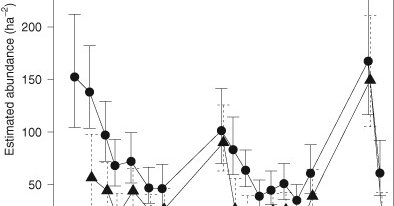
esj-journals.onlinelibrary.wiley.com
We report a population of Japanese field vole Microtus montebelli, which reaches a peak in population after snowmelt in the early spring and lowest in the autumn. This early spring peak in populati...
1
1
4
Congrats to Caterina Ferrari @CATERFERRARI for winning the Population Ecology Young Author Award 2023🏆 Marginal habitats provide unexpected survival benefits to the alpine marmot https://t.co/qXYFyilzpu
#openaccess now! #PopEcol2023
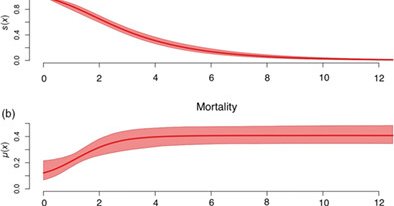
esj-journals.onlinelibrary.wiley.com
Results from this article suggest that marginal habitat may have some benefit for population survival, based on lower number of conspecific and a potential differential predation pressure. Survival...
1
1
1
Congrats to Yoichi Tsuzuki for winning the Population Ecology Young Author Award 2023🏆 Genetic consequences of habitat fragmentation in a perennial plant Trillium camschatcense are subjected to its slow-paced life history https://t.co/P1jJsIKDJY
#openaccess now! #PopEcol2023
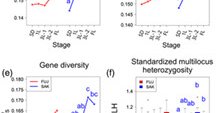
esj-journals.onlinelibrary.wiley.com
This study examined genetic consequences of habitat fragmentation in two populations of a perennial plant Trillium camschatcense with reference to its life history characteristics in the Tokachi...
1
4
7

Uneven genetic data limits biodiversity assessments in PAs globally but not in data-rich areas. Increased efforts to gather, harmonize & share existing population-level nuclear genetic data can inform area-based conservation initiatives. New preprint here: https://t.co/FFI1ONrPDF
2
16
34
Genetic diversity is the foundation of biodiversity and now a global conservation priority, and yet there is much work to be done to understand where and in which species it is being lost or conserved! New paper in preprint led by @ivanpazvinas ! https://t.co/bt7n3QGPqU
0
6
22

Fear alone is not enough to motivate climate action; if people are afraid but don't know what to do, they will do nothing. That's why it's essential to communicate both the risks of inaction (the bad news) + the potential of action (the good news) in equal proportions.
28
320
774
#popgentwitter Has anyone run LFMM with genotype likelihoods? Seems like it should be possible.
2
2
2
New paper about attrition of women in Academia has some interesting results under the hood. Higher rate is driven by non-STEM fields, low prestige unis, and largest for full profs. Attrition lower or equal for STEM women at top unis (B-D). Thoughts on why? https://t.co/utvhJAMSd0
2
3
7
Deadline coming up Nov. 2. This is one of the highest honors at @ESA_org, so please apply!
Please nominate your colleagues or mentees for the ESA Mercer Award, and please RT! Underrepresented groups particularly welcome. The Mercer Award is for an outstanding ecological research paper by a younger researcher (<40 years at time of pub). See https://t.co/pW3PcivjsJ
0
0
2

The Majoris Lab at TAMU-CC is open and recruiting a PhD student to study intra- and interspecific variation in larval dispersal traits. Full details at: https://t.co/zBfKzxsRJX
@IslandCampus @AFS_ELHS @SICB_DAB
1
43
60

What will recovering whale populations look like in a changing climate? So happy to see our paper on gray whale population dynamics out today in @ScienceMagazine! We show that gray whales go through major boom and bust cycles in response to dynamic and changing Arctic conditions.
5
36
135
Three (3!) postdoctoral fellowships at the UCSC Center for Coastal Climate Resilience! Applications due Dec. 15. Contact me (or any other faculty here) if you're interested in coming to work in an exciting community and beautiful place. Details at
3
54
53
Two amazing new members of the Global Change Research Group! @maya_zeff is a PhD student diving into how networks of species interactions change through time and across climate gradients. Roy Roberts is our research specialist extraordinaire building the temporal genomics lab.
0
4
40

Our new paper in @MethodsEcolEvol announces https://t.co/6dSG3jz0Ta, an @evolvingseas website sharing tools for rigorous, reproducible genomics in non-model & marine species We outline the site's resources, how they're made, and how YOU can contribute! https://t.co/Nd3ds4RcsX
1
29
83