

Daniel González
@danielgc25
Followers
311
Following
3K
Media
201
Statuses
1K
I am very happy to announce our latest work, together with @iqoqi and @harvardphysics, where we use @QueraComputing Rydberg quantum simulator ⚛️💻 to observe string breaking 💥 on a (2+1)D lattice gauge theory! https://t.co/o5yoahkdur

arxiv.org
Lattice gauge theories (LGTs) describe a broad range of phenomena in condensed matter and particle physics. A prominent example is confinement, responsible for bounding quarks inside hadrons such...
1
2
14

Two quantum-simulation experiments make a step towards understanding the forces between elementary particles https://t.co/SeFK7K6dL4
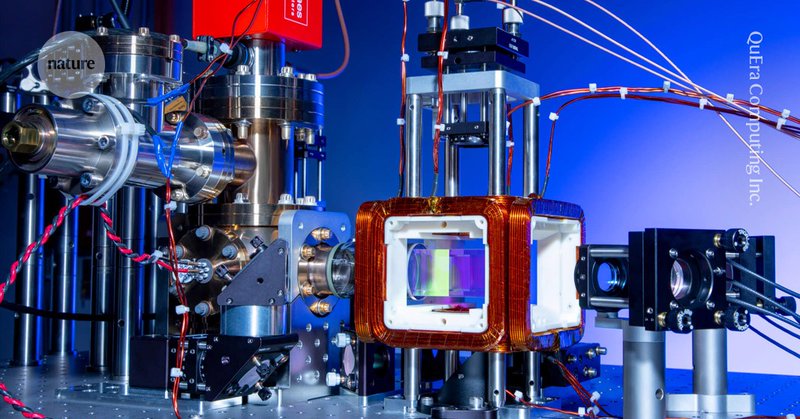
nature.com
Nature - Two quantum-simulation experiments make a step towards understanding the forces between elementary particles.
2
11
50
Two-dimensional quantum platforms have simulated a process in particle physics called string breaking that generates matter–antimatter pairs https://t.co/sVWepd88Js
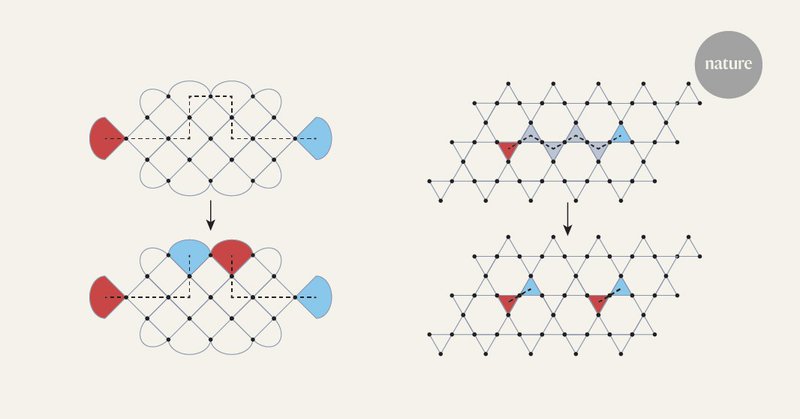
nature.com
Nature - Two-dimensional quantum platforms have simulated a process in particle physics called string breaking that generates matter–antimatter pairs.
4
12
61

PhD position in Quantum Algorithms for High-Energy Physics at the Institute for Theoretical Physics in Madrid @ift_uam_csic
https://t.co/nWUJhFcTyd
1
2
5

Looking for a #PhD in Quantum Computing + Particle Physics? Join the Quantum Matter and Information group at IFT #Madrid to develop quantum algorithms for high-energy physics! 📅 Apply by April 30 📧 dgonzalezcuadra@fas.harvard.edu (@danielgc25) 👉 https://t.co/2NqIxRRvxF
0
2
7
I am very happy to announce that I will soon join @ift_uam_csic as a Ramon y Cajal Fellow ‼️ I am also offering a PhD position on "Quantum Algorithms for High-Energy Physics" ⚛️ Deadline is April 30 and the details can be found here: https://t.co/DGzJZZp4MR Please share!
gonzalez-cuadra.com
PhD position in Quantum Technologies for Theoretical Physics
0
5
18
I just came here to tell you that you should try @bluesky if you still haven't. After a few days using it, it really feels like recovering a space they took from us. You can find me there as https://t.co/cAQHARR1w9 Seriously, leave X and don't look back.
0
0
2
I want to finish by thanking my amazing collaborators, specially @TVZache. This was a long and challenging project, and it could not have succeed without their help and support.
0
0
0
Personally, this was a very special project, since I started thinking how to simulate similar gauge theories during my master thesis. During the last decade, Rydberg simulators have developed tremendously, allowing us to bring these theoretical ideas to an experimental reality.
1
0
1
In summary, our experiments confirm string breaking in (2+1)D both in equilibrium and non-equilibrium. These results nicely complement the very recent observations of similar phenomena with superconducting qubits and trapped ions: https://t.co/VCpklWJsyM
https://t.co/zY7o56Ercw

arxiv.org
Lattice gauge theories (LGTs) can be employed to understand a wide range of phenomena, from elementary particle scattering in high-energy physics to effective descriptions of many-body...
1
0
0
Finally, we quench these string states and investigate the dynamics of string breaking. We observe a high-order process where the initial string maximally breaks when it has the same energy as the broken string. We characterize this resonance through many-body spectroscopy.
1
0
0
Moreover, strings in (2+1)D can fluctuate between different shapes, and we indeed observe all of them in the states we prepare.
1
0
0
We map out the phase diagram of the gauge theory by preparing the ground state adiabatically. We observe how, as we increase the Rydberg interactions (and thus the confining potential), the probability of the broken string dominates, signalling string breaking in equilibrium.
1
0
1
In the experiment, we can prepare and measure states corresponding to both unbroken and broken string configurations 👇🏽
1
0
0
Here we encode a U(1) gauge theory in a Rydberg atom array, where atom configurations naturally map to particles and strings since: 1) The local (gauge) symmetry emerges from the Rydberg blockade. 2) Long-range Rydberg interactions give rise to a confining potential.
1
0
1
These new particles can be detected in particle accelerators, but string breaking was never observed directly. Moreover, simulating the dynamics of this process is very challenging. Both problems can be overcome using quantum simulators with spatio-temporal resolution.
1
0
0
String breaking occurs in gauge theories such as quantum chromodynamics, where quarks are confined into composite objects (e.g. protons), connected by strings of gauge field. When quarks are separated, the energy increases until new particles are created, breaking the string.
1
0
0

I am offering a 4 year PhD position to work on quantum algorithms for many-body problems, to stat in Winter of 2025. Please do forward the announcement to potentially interested candidates!
5
67
215

There's a popular narrative here that says immigrants are destroying Western culture. I'd like to assert the opposite: immigrants are not only contributing to Western culture, they are often saving parts of it. Let's explore. 🧵
262
2K
18K