Prof David Ziegler
@ProfDavidZieg
Followers
801
Following
2K
Media
19
Statuses
368
Paediatric oncologist, clinical trials, neuro-oncology, precision medicine.
Sydney
Joined December 2019
Listen to Oprah! Time to book your trip to Australia. #ISPNO2026
https://t.co/KWJl4z07H6

instagram.com
0
1
2
Registration and abstract submissions now open for ISPNO 2026! https://t.co/EMrifxcvdF The world's entire paediatric brain tumour community will be heading Down Under in 2026 - don't miss out!
0
1
3
Join us in Sydney for ISPNO 2026! Experience one of the world’s most vibrant cities, where golden beaches, iconic landmarks & rich First Nations culture await. 🌊🌿 📍 Watch: https://t.co/Po2ZlKBLMm Registrations open: https://t.co/EMrifxbXo7
#ISPNO2026 #Sydney #SeeAustralia

ispno2026.org
22nd International Symposium on Pediatric Neuro-Oncology (ISPNO 2026), ICC Sydney, June 28 – July 1, 2026. World's largest and most important scientific meeting focused on paediatric central nervous...
0
2
6
You might even get a free koala 🐨

ISPNO 2026 now just over a year away! We will be attending PedSNO - come visit for a chance at complimentary registration!!
0
3
6
ISPNO 2026 now just over a year away! We will be attending PedSNO - come visit for a chance at complimentary registration!!
0
2
8
Great work from the team and hopefully a helpful resource for many @ JoVE
0
0
2

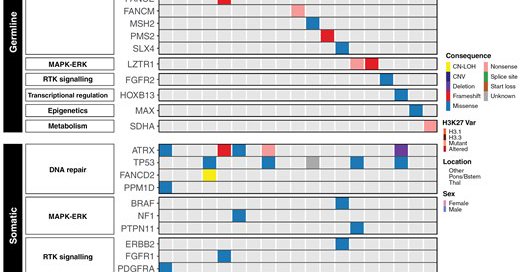
Excited to see our work published in Neuro-Oncology @NeuroOnc. Large international study of 252 patients with #DMG #DIPG with paired #germline #somatic. One patient had a near-complete response to PARP+immune checkpoint inhibition. https://t.co/nqQZCNShim
@ProfDavidZieg

pubmed.ncbi.nlm.nih.gov
Our study determined the prevalence of pathogenic germline variants in pediatric DMG and suggests a role in tumorigenesis for a subset of patients.
1
3
13
Thanks to all collaborators who helped assemble the largest cohort of DMG patients with germline sequencing. Helping us understand the cause and new DMG treatments: Germline analysis of an international cohort of pediatric diffuse midline glioma patients
academic.oup.com
AbstractBackground. Factors that drive the development of diffuse midline gliomas (DMG) are unknown. Our study aimed to determine the prevalence of pathoge
0
10
24
12: Thanks to funding from NHMRC, CINSW, Cancer Australia, Cure Brain Cancer, The DIPG Collaborative, The Cure Starts Now, Levi's Project, Benny Wills Fund.
0
0
3
11: Thanks to all the patients and families who have supported this work through advice, encouragement, fund raising and allowing us to use their child's tumour samples - without which no research is possible
1
0
3
10: We have discovered fenretinide is one of those treatments, but we need effective combinations to make it more active. We have new therapeutic vulnerabilities that will help us in our search for a cure.
1
0
3
9: We have had too many failed trials, and we need to ensure that the treatments with real promise are prioritised for our patients.
1
0
2
8: What did we learn? Most drugs tested in lab models of DIPG will not work, and most will fail in vivo because the blood brain barrier is so tight. Rigorous lab testing is essential to ensure that only drugs with real potential are taken to clinical trial.
1
0
2
7: Examining the mechanism of action identified fenretinide acting via "old" and "new" pathways: inhibition of PDGFR; upregulation of ER stress and UPR; downregulation of neurogenesis; induction of mitophagy and autophagy.
1
0
2
6: Of the 3,500 drugs screened - fenretinide was the only one to be active in vitro, to penetrate the blood brain barrier, and to show activity in DIPG mouse models.
1
1
2
5: We then tested all 6 drugs in mouse models of DIPG - and all but one failed! Most of them showed no activity at all - the reason: for all but one, they did not penetrate the blood brain barrier and therefore were inactive against the tumour.
1
0
2
4: Extensive review suggested only 28 of these compounds were likely to cross the blood brain barrier - which we know is intact in DIPG. Further testing against more cells, and normal cell cultures whittled this group down to only 6 drugs that were likely to be active
1
0
2
3: Despite including hundreds of anti-cancer drugs, most of them were completely inactive against DIPG cells - however a small number - 90 - were highly potent
1
0
1
2: We started this project by doing a high throughput drug screen against multiple DIPG cell cultures - one of the largest screens ever undertaken - using thousands of drugs
1
0
2