
Penn Memory Lab
@MemoryLab
Followers
1K
Following
12
Media
6
Statuses
86
Penn Psychology research lab studying human memory and its neural bases under P.I. Professor Michael Kahana.
Philadelphia, PA
Joined August 2012
New publication in eLife! https://t.co/lNbBcO43cY
@eLife Single neurons don’t just communicate with other nearby neurons — they can synchronize with faraway activity too! In humans, the firing of neurons throughout the MTL, synchronizes to the hippocampal theta rhythm (1–10 Hz).
elifesciences.org
Neural spiking throughout the MTL is synchronous with hippocampal theta phase during spatial memory and navigation experiments in humans, even after controlling for phase-coupling to local theta...
0
6
28

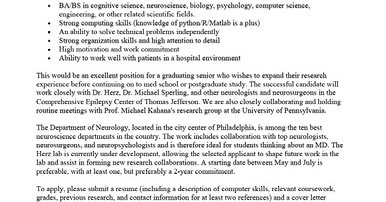
Come join us in Philly! I am recruiting a research assistant to join our emerging team at @JeffersonUniv. We use direct brain recording and stimulation in neurosurgical patients to study memory-related disorders. Please reach out!
acrobat.adobe.com
Click or tap to view this file.
0
5
17
Interested in using intracranial recordings and stimulation in humans to study memory, and leveraging this knowledge to treat memory-related disorders like PTSD? I am recruiting a postdoc to our emerging interdisciplinary team at @JeffersonUniv! RTs appreciated
1
20
28


*VERY* excited to be featured in @SfNJournals's "This Week in The Journal" for our new work: https://t.co/4ljFuRDidB Will write a quick tweet thread below (with figures) to introduce what we (@KahanaMichael, @david_j_halpern, @d_schonhaut as part of the @MemoryLab) did! (1/5)
3
10
43
New paper with @MemoryLab, @david_j_halpern! Free-recall paradigms are commonly used to study memory in lab settings. How do the reliability and validity of these lab-based paradigms compare with traditional neuropsychological memory measures? Check here: https://t.co/WSirpqWCcM

psycnet.apa.org
Objective: Much of our knowledge concerning the neural basis of human memory derives from lab-based verbal recall tasks. Outside of the lab, clinicians use validated and normed neuropsychological...
1
9
43
Hello everyone! The Computational Memory Lab is recruiting subjects for an ongoing memory study! You will be compensated anywhere from $108 - $230. If you are interested follow this link https://t.co/Gb12sNE0om or send an email to kahanalab@gmail.com to learn more. Thank you!
0
5
5
Hello everyone! The Computational Memory Lab is recruiting subjects for an ongoing memory study! You will be compensated anywhere from $108 - $230. If you are interested follow this link https://t.co/Gb12sNE0om or send an email to kahanalab@gmail.com to learn more. Thank you!
0
5
5
New preprint with @MemoryLab! 📜🧠 Leveraging EEG recordings and machine learning, we designed a system to guide learning in a memory task -- modifying stimulus timing to present items when they were predicted to "stick" in a person's memory https://t.co/U7N7Wx1aCH 1/
1
14
33
We are excited to release the PEERS dataset on @OpenNeuroOrg !!! We hope that the @BIDSstandard format will make our data accessible to others 🤩 @KahanaMichael @AdaAka18 @ehhbroit @BKaterman @NkratzMiller @dorsolateralpfc @cogspy @jrudoler #OpenScience #memory #neurotwitter

📈🧠EEG Data Release!!!🧠📈 @MemoryLab's data from the Penn Electrophysiology of Encoding and Retrieval Study (PEERS) is on @OpenNeuroOrg in @BIDSstandard format!!! Feat. 364(!!) subjects performing up to 24 sessions of #memory tasks with scalp #eeg. https://t.co/7wkoWcomPr 1/3
0
10
25
We used classifiers to predict memory performance over multiple items and track internal memory encoding states at the scale of minutes, arguing that the associated neural signal likely reflects a causal SME.
0
1
5
Check out our new article, Direct Brain Recordings Suggest a Causal Subsequent-Memory Effect, in Cerebral Cortex!
2
9
25
🚨New Paper🚨 Extremely excited that my first paper, "Hippocampal theta and episodic memory" was published today in @SfNJournals #JNeurosci !!! Many thanks to @MemoryLab and my co-authors @NoraHerweg @KahanaMichael! TLDR: theta ~ recall Check it out: https://t.co/FpQihgnLom 1/3
6
29
112
Interested in single neuron replay in HUMANS during sleep…and leveraging the recordings to improve memory? @ItzhakFried and I are recruiting postdocs to @UCLA for state-of-the-art translational neuroscience. Please reach out to meet @SfNtweets or set up a call. RTs appreciated!
1
18
34
If you’re interested in ripples, single units, replay, brain stim to improve memory, & ☀️: @ItzhakFried and I are recruiting a postdoc @UCLA to work at the cutting edge of memory research. Please don’t hesitate to get in touch—even if your past work is nonhuman! RTs appreciated!
Proud to report @jjsakon's new paper has been published in @PNASNews! https://t.co/wVjX8bsOO0 We find hippocampal--but not extrahippocampal MTL--high frequency ripples reflect the retrieval of *episodic* memories. This phenomenon is consistent with...(1/3)
1
21
25
...where we find ripples specifically occur when people form *episodic* memories. https://t.co/mJkpsSaLt7 That is, ripples during word encoding promote participants subsequently recalling that word and others related to it via episodic reinstatement. It's quite a story!(3/3)
0
2
9
...ripples mediating an item-to-context process, since ripples occur significantly more when participants recall clusters of words with temporal and/or semantic relationships. Our follow-up manuscript--now on @biorxivpreprint--investigates ripples during memory formation...(2/3)
1
3
8
Proud to report @jjsakon's new paper has been published in @PNASNews! https://t.co/wVjX8bsOO0 We find hippocampal--but not extrahippocampal MTL--high frequency ripples reflect the retrieval of *episodic* memories. This phenomenon is consistent with...(1/3)
2
21
90
The Computational Memory Lab is hiring a Research Specialist to assist with our clinical studies applying brain stimulation to improve memory! This position is ideal for someone planning for med or grad school. Apply here:
0
7
9