Matt Beane
@mattbeane
Followers
4K
Following
12K
Media
263
Statuses
8K
Study work with intelligent machines, esp. robots. @MITSloan PhD, @Ucsb Assc Prof, @Stanford fellow, @tedtalks Book, Substack: https://t.co/OJQa0bxBXl
Santa Barbara, CA
Joined November 2008
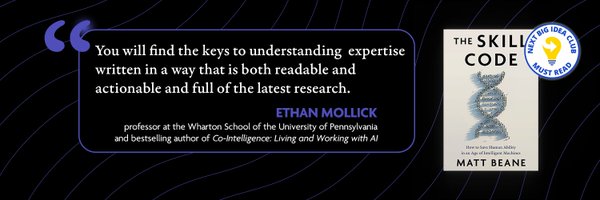
I'm so grateful and exited to share that my book will be published on June 11th! It's called "The Skill Code: How to Save Human Ability in an Age of Intelligent Machines" Available for preorder now, here's a bit of the story: https://t.co/IQ1rncIiPt

wildworldofwork.org
"The Skill Code: How to Save Human Ability in an Age of Intelligent Machines" will be published on June 11th by HarperCollins. You're getting the scoop early!
11
35
204

This is an extremely beautiful plot because it sheds light on why scaling laws are so smooth, and reconciles empirical findings from both scaling laws and grokking. Even though mean loss across all tasks (red line) decreases smoothly, we see that individual subtask losses drop

How does scaling up neural networks change what they learn? Despite its importance, our understanding of this question remains nascent. I've written a long post reflecting on my model of neural scaling and its relationship to interpretability, etc.: https://t.co/4V4AMoDzQD
13
70
690

this was scott adams’s favorite dilbert comic you shall live on forever in your body of work, sir 🫡
560
3K
27K

Today in my "AI for Business Leaders" class ( https://t.co/BuDbH71RXQ) at @BerkeleyHaas we did a live demo of Claude Cowork and many students checked it out on their own. this was before 12:06 PM -- so I think we went from product release to class demo in less than 24 hours.

Introducing Cowork: Claude Code for the rest of your work. Cowork lets you complete non-technical tasks much like how developers use Claude Code.
1
5
37
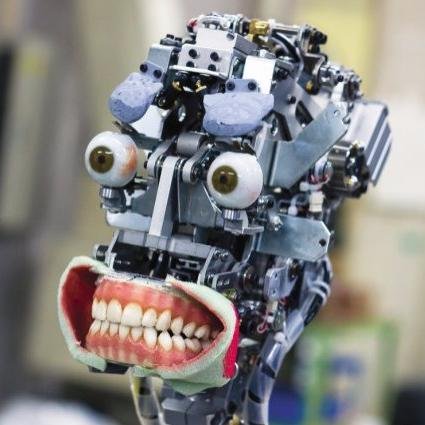
Colin Angle's desk did this at iRobot about ten years ago.
0
0
0

Whenever I see stuff like this, I think about when my wife worked at this huge non-profit and their training instructions for how to use the internet included: • "Make sure both feet are planted firmly on the ground." • "Sit upright in your desk chair (to not hurt your back).
Introducing Cowork: Claude Code for the rest of your work. Cowork lets you complete non-technical tasks much like how developers use Claude Code.
89
131
3K
This is amazing to watch. Key to why: Steve is such an engaging writer! Stay tuned for the next installment in the future of the future of knowledge work...

It's been 12 days since I dropped Gas Town. The response has been off the charts. I've been working hard to keep up. Thanks to all the early adopters. I wrote up this survival guide.
1
0
7
Hot take: if very good scientific journal submissions are not heavily AI generated, we should be concerned. Top quality scientists need to accelerate themselves! The writing isn't the thing. Neither is the stats.
2
0
5

millennial gamers are the best prepared generation for agentic work, they've been training for 25 years
276
643
7K
Nice! If you want to save your career, you must fight for the friction you need to build skill while doing your job. The main thing? Take a break from ChatGPT so you need help from the junior person nearby. That's how you got ahead, and how you'll stay sharp. h/t: @_KarenHao

Tech companies are succeeding in making us think of life itself as inconvenient and something to be continuously escaping from, into digital padded rooms of predictive algorithms and single-tap commands: Reading is boring; talking is awkward; moving is tiring; leaving the house
0
1
2
Wow. Honestly had no idea this bit had flipped. Off to read about how.

Seems like a good time to plug this audit @brian_jabarian and I did of detectors. Some are better than others, but the good ones are *really* good. https://t.co/7lscS61prU
0
0
5
I miss these days. There's something special about this. Our dreams are buried in these machines and we've smoothed that over...
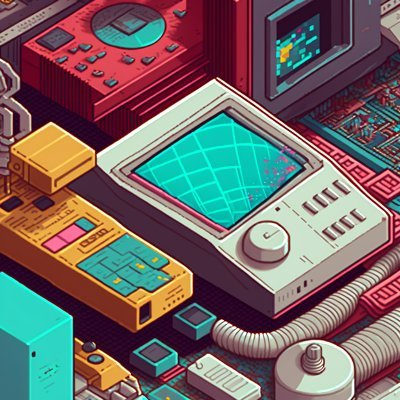
A great use for AI-generated images from @mattbeane, asking the system to visualize paper titles to see what they would look like if they were 1980s science fiction covers. Here’s “On the Folly of Rewarding A, While Hoping for B” as awesome AI fever dream. https://t.co/BGOsRlCCkE
0
1
7
I am with @joshgans - *strong* recommend for https://t.co/521b9j3Usq. $50/review is a great deal. CC can only get you so far - it's just not tuned to nail the microwork needed for substance and genre suitability. CC for the bones, Refine for QA. Great complements.
refine.ink
Refine helps researchers analyze papers, collaborate with teams, and streamline their research workflow with AI-powered tools.
0
0
2

I wrote a bit of a manifesto about the need for a circulatory AI economy. I'd love feedback on the piece, but more importantly, pointers to people who are doing interesting work on aspects of this problem.

oreilly.com
The narrative from the AI labs is dazzling: build AGI, unlock astonishing productivity, and watch GDP surge. It’s a compelling story, especially if you’re the
12
18
77

"Models keep getting more impressive at the rate the short timelines people predict, but more useful at the rate the long timelines people predict." This is a great essay from @dwarkesh_sp:
22
41
385
Exciting paper, highly recommend. This subpoint, for me, is the kicker. Using AI might make us more equal but freeze us in place skillwise. And, humbly, the authors didn't address the fact that using AI reduces the need for novice help, blocking skill transfer.
But there's a catch: While simplification reduces inequality, it also reduces workers ability to accumulate skills by doing difficult tasks. Our model predicts that, because of this skill accumulation effect, simplification actually decreases wages on average. (Augmentation and
1
2
5
Truly delighted to see this formal treatment of the problem I've been focused on since 2012. Neatly articulates - and extrapolates on - the logic that led me to claim this is an urgent, trillion-dollar problem. Been working on solutions for the last two years. More soon.
I have a new paper with Luis Rayo on a key, simple question: will AI end careers as we know them? Link below. We all experience AIs usefulness every day: AI writing code, drafting legal memos, and analyzing spreadsheets. AI can already do many of the tasks that young people
0
1
1
Oh, this is big. Many of us have been Claude Coding our way towards something like this and Dashun and colleagues started early and with greater ambition. Great for science!

🚨New paper out in Nature Computational Science! Introducing #SciSciGPT: an open-source, multi-agent, prototype AI collaborator designed to support research and discovery, using the science of science as a testbed. Led by the amazing @ErzhuoShao Demo + paper below! 1/n
1
1
9

My view is that this is underestimating what will happen in one or two years. @ben_golub and @joshgans both are heavy users of AI tools for their research, and yet are very cautious in predicting where we will be in January 2027 or 2028. The same arguments in @joshgans post

Interesting reflections from Joshua Gans on a year of vibe researching. Thanks for the mention of Refine. There are low-risk uses of AI: e.g., using GPT 5.2 Pro to fill in the details of a proof that you know is right. Even for these, AI output should not be trusted. 1/
8
21
91
🚨New NBER working paper out!🚨 “Unwilling to Reskill? Experimental Evidence from Real-World Jobseekers” (with A. Delfino, A. Garnero, S. Inferrera and M. Leonardi). We study why take-up of “good” reskilling opportunities is so low—even when jobs are in demand.
4
52
184

Good example of "taste" - PhDs need ability to know what interesting questions are & what an interesting answer is. If you have more good questions that you could have feasibly answered in 2016, you are in great shape. If your skill is cranking through code or algebra, though...
But a corollary is that we are about to see some incredible Ph.D. theses. The gap between people who are successfully using the tools and those who are not will be something to behold.
2
16
359