Giovanni M. Pavan Lab
@LabPavan
Followers
1K
Following
2K
Media
52
Statuses
482
Into self-assembly, complex molecular systems & materials science w/ computer models, simulations & machine learning | Managed by @LabPavan members @PoliTOnews
Torino (IT)
Joined December 2019

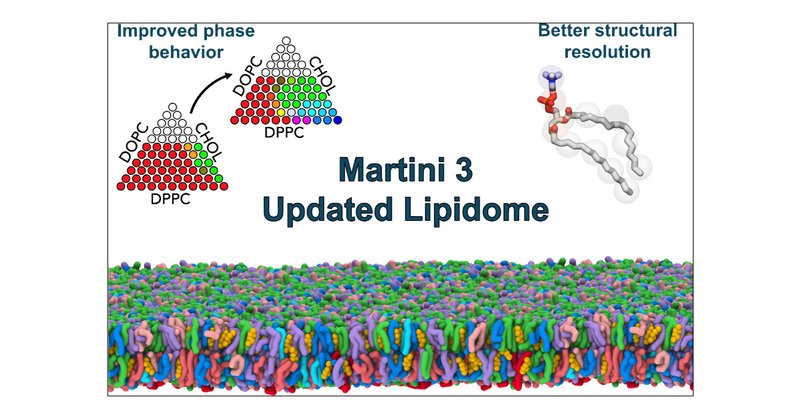
Our collaborative work "The #Martini3 #Lipidome: Expanded and Refined Parameters Improve Lipid Phase Behavior" is now published in #ACSCentralScience! 🎉 📄 Read: https://t.co/86EQCoKrfp 💾 GitHub: https://t.co/Ody8z5zlzp
#MolecularDynamics #Biophysics #Simulations #Lipids
1
14
58
A true community effort ! The Martini 3 Lipidome: Expanded and Refined Parameters Improve Lipid Phase Behavior | ACS Central Science
pubs.acs.org
Lipid membranes are central to cellular life. Complementing experiments, computational modeling has been essential in unraveling complex lipid-biomolecule interactions, crucial in both academia and...
1
10
59
Great to see this finally out!! Congrats to all coauthors!🍾
A true community effort ! The Martini 3 Lipidome: Expanded and Refined Parameters Improve Lipid Phase Behavior | ACS Central Science
0
1
4
Congratulations to all coauthors @mattiaperr
@MatteoCioniMC @MaxDellePiane @pamara54!!🙌🥳👏 Work supported by @ERC_Research & CINECA & DISAT & @PoliTOnews!🙏🙏
0
0
4
This provides a general data-driven approach for studying the internal physical behavior of metallic (but also other types of) systems just building on the abstract concepts of fluctuations & spatio-temporal fluctuations' correlations. 🤯🤩
1
0
4
Our analyses demonstrate, in a completely unsupervised & abstract way, how metal lattices transition from the elastic to the plastic phase when new local defects/fluctuations cannot avoid emerging as correlated in space & simultaneous in time, leading to dislocations! 🤓
1
0
4
Metals owe their properties to how local defects emerge & amplify in collective dislocations under stress.🛠️ 👉We show how tracking local atomic fluctuations & their space&⏱️correlations allows tracking metals' behavior through the elastic&plastic phases🚀 https://t.co/XgdUosXWU0
pubs.aip.org
Metals owe their unique mechanical properties to how defects emerge and propagate within their crystal structure under stress. However, the mechanisms leading f
1
4
7
Congratulations to all coauthors!👏🙌🚀 🙏@ERC_Research CSCS @PoliTOnews DISAT SUPSI🙏
0
0
2
In non-cooperative systems, all entities populating them suffer comparably from external perturbations. In cooperative systems (with internal "interactions-avidity"), the stronger units survive at the expense of the weaker ones!🤯
1
0
3
How much complexity is needed in self-assembling molecular systems to observe non-trivial emergent behaviors typical of more complex, higher-scale systems?🤯 Not much!😲 See @NatureComms our work on the collective resilience of supramolecular polymers!🚀 https://t.co/iQGTgj0vQW

nature.com
Nature Communications - Supramolecular polymers possess features typical of complex systems, but the mechanisms that lead to the emergence of collective properties inside them are often difficult...
1
2
16

Twenty case studies showing theoretical predictions in chemistry that were later confirmed experimentally. #CompChem
https://t.co/jIH50iFZMi

degruyterbrill.com
For decades, computational theoretical chemistry has provided critical insights into molecular behavior, often anticipating experimental discoveries. This review surveys twenty notable examples from...
9
32
120


Only a few days left before we kick of the GRS and GRC meeting in Les Diablerets! We hope you have safe travels!
0
2
10

🤫 you can get a better universal #machinelearning potential by training on fewer than 100k structures. too good to be true? head to arxiv:2503.14118, to the atomistic cookbook, or to the better science social if you want to find out more about PET-MAD. 🧑🚀 over and out 👋
1
14
48
This work required the support of many people! Congratulations to @c__caruso for the massive effort!👏 Congrats also to all other coauthors -@martanit @asicardellini @MatteoCioniMC @mattiaperr Massimo Delle Piane @pamara54 - for the huge work!🙌 🙏 Supported by @ERC_Research 🙏
0
0
7
Complete details & LEAP analysis code available at: https://t.co/JG0vKlVz8z and at: https://t.co/f3lt6v9ePP

github.com
Contribute to GMPavanLab/LEAP development by creating an account on GitHub.
1
0
2
#LEAP analyses are agnostic & require just that a trajectory of the building blocks constituting the complex dynamical system is available. Useful to explore complex dynamical systems whose physics is unknown a priori & to revisit well-known phenomena under a new perspective.🤯
0
0
3
#LEAP allows to: 1) Detect relevant fluctuations in noisy trajectories 2) Classify fluctuations in classes based on their physics 3) Identify correlations in space & time between fluctuations 4) Unveil local & collective events, their correlations, causal relationships, etc.
1
0
3
#LEAP is out @PNASNexus!🚀 Building on abstract concepts of local fluctuations & their correlations in space & ⏱️, #LEAP provides info on the physics of complex dynamical systems from the atomic- to the macro-scale in agnostic & purely data-driven way!🤩 https://t.co/Rs7HtD5IRv

academic.oup.com
Abstract. The behaviors of many complex systems, from nanostructured materials to animal colonies, are governed by local events/rearrangements that, while
1
2
14

Our latest work, led by @xu_youzhi, is dedicated to the memory of Fraser Stoddart! In May, I asked him about his favourite molecule ever made in his lab. After a while, he chose the iconic "Olympiadane" (ABCBA-type) [5]catenane. @LabPavan @Pingwu_Du
https://t.co/5FotRfGGpH

onlinelibrary.wiley.com
By threading a secondary ammonium salt through the crown ether and closing the third ring via CuAAC click reaction, we obtained a rare ABC-type hetero-[3]catenane comprising [12]CPP, 24-crown-8 and...
1
25
142