Haydn Kissick
@HaydnKissick
Followers
1K
Following
2K
Media
42
Statuses
293
Assistant Professor at Emory University. Interested in all things Immunology!
Joined November 2018

Very happy to share our new review on stem-like cells and their role in CD4 T cell differentiation in @TrendsCellBio
https://t.co/VzLQeDiiFx It was great to tackle this topic with my prior mentor @HaydnKissick. Excited to share our thoughts!
0
10
36
Super interesting! I'm really enjoying seeing all the CART papers and how they seem to have some similarities to normal T cell biology, but also their own entire set of rules that dictate their function. Looking forward to reading this closely and thanks for sharing!

What factors enable CAR-Ts to respond to checkpoint blockade, and can they be engineered to be more sensitive to enhancement? We explore this question in our lab’s first pre-print, led by MSTP student @AndrewAJSnyder1 with great collaborations with @EvNewell1 and @ScottFurlan. 1/
2
1
16
Phase 2 single-arm #Clinicaltrial of neoadjuvant cabozantinib in patients with locally advanced nonmetastatic ccRCC, assesses efficacy and finds antitumor CD8+ T cell response activation upon treatment. by @bilenma @virajmaster @HaydnKissick ⬇️ https://t.co/ZEJh99Vqx8

nature.com
Nature Cancer - Bilen et al. perform a phase 2 single-arm clinical trial of neoadjuvant cabozantinib in patients with locally advanced nonmetastatic clear cell renal cell carcinoma, assess efficacy...
0
8
37

@Maria_Carden1 talk is now on YouTube! 📣 Differentiation fate of a stem-like CD4 T cells control immunity to Cancer @HaydnKissick lab @EmoryMedicine
https://t.co/IpdV6qyII8
0
6
10
Most thankful to Baohan Vo, the scientist who led all the research and kept the team running strongly, my 2 good friends @bilenma & @virajmaster who are exceptional people who run these difficult neo-adjuvant trials, and @WinshipAtEmory and @NatureCancer for their support
1
0
5
Across many cancer types, PD1 blockade is much less effective in low T cell tumors, so cabo might be a drug that can turn cold tumors hot, something we have been looking for for a long time. Mouse experiments are ongoing and building on lots of prior research on this topic
3
0
3
Overall, very interesting to me as an immunologist. Generally ~50% of kidney tumors have very poor immune infiltration, but after Cabozantinib treatment, 100% of patients looked like the top quartile of all patients we have looked at
1
0
1
Interestingly, the patients who had the highest decline in tumor size (PR) had a much higher level of these niches in their tumor.
1
0
2
Most interesting to me was that the immune niches we previously described where TCF1+ stem-like CD8 T cells are located in tumors, were all greatly increased in treated patients. We believe these niches are required to both generate a T cell response, and respond to PD1
2
0
2
Having baseline biopsy and surgical specimens, we could look at how the immune response changed in tumors. Every patient had an increase in CD8 T cells in their tumor compared to their biopsy baseline and disease matched controls by IF. Same result by FACS
1
0
1
Most consistent feature of the immune response in blood was big decline in classical monocytes. We didn't measure MDSCs because of the method we froze blood samples, but this seems in line with several studies suggesting Cabzantinib inhibits myeloid cell generation.
1
0
1
Now what I actually know about.. I was surprised to see some patients showing new CD8 T cell activation. HLA-DR/CD38 are the same we see in PD1 treated patients. It wasn't quite significant, but there are clearly patients that have a T cell response early.
1
0
2
Changes in cfDNA over the course of the treatment were associated with the overall reduction in tumor size, suggesting this could be a marker to investigate in future trials. Blood markers including VEGF and cMet increased while on treatment and could also be investigated
1
0
2
Patients with advanced ccRCC received 12 weeks of Cabozantinib followed by nephrectomy. All patients had a reduction in tumor size over the 12 weeks, 6/17 had an objective PR in that time. 2 patients downgraded from full to partial nephrectomy, 1 unresectable -> resectable.
1
0
2
Check out our new paper @NatureCancer studying the effects of cabozantinib as a neoadjuvant therapy for patients with clear cell renal cell carcinoma. https://t.co/h2rj1au9QN To my surprise, large effect on T cell infiltration in tumors post-therapy, thread below.
nature.com
Nature Cancer - Bilen et al. perform a phase 2 single-arm clinical trial of neoadjuvant cabozantinib in patients with locally advanced nonmetastatic clear cell renal cell carcinoma, assess efficacy...
3
12
77
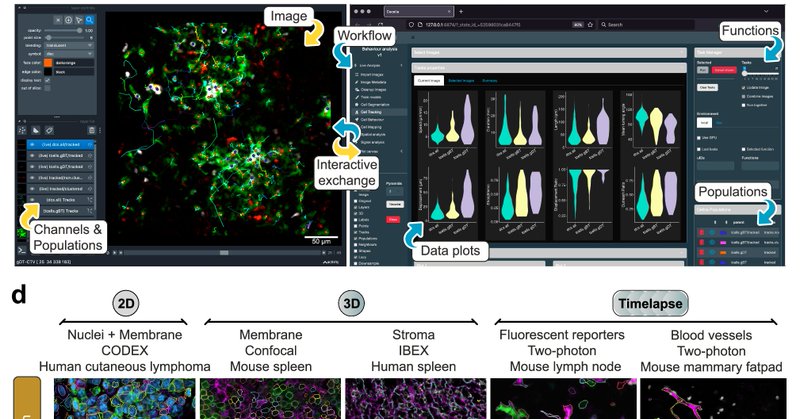
Our paper introducing Cecelia: a multifunctional image analysis toolbox is now online! check it out @NatureComms
nature.com
Nature Communications - Integrated solutions for the analysis of complex 3D and live cell images remain scarce. Here, the authors present Cecelia, an image analysis toolbox based on R and Python,...
3
46
162
How can you do such nice work and think 3d umap was something we needed... 2025 is bad enough without this. Congrats though, cant wait to read closely!
This is a thread on our paper by Eric Fagerberg . KLF2 maintains lineage fidelity and suppresses CD8 T cell exhaustion during acute LCMV infection https://t.co/wS3WiiJdqJ
1
1
10
Thanks for discussing us again! If this is applicable to patients is key and we also doubt you can tolerize late stage rejection. In the patients it was always the same region of the DQ gene recognized, so we hope a small pool of peptides from the region might work for patients
Why do some transplanted organs get rejected? @Zhuldyz_Zhanzak and a team in Dr. @HaydnKissick's lab at @EmoryMedicine investigated the role of indirect CD4+ T cell epitopes. 📝 @ImmunityCP - https://t.co/ZF7D5I2EVM 🎧 - https://t.co/yFbdrnbg6T
0
0
5

Excited to share my PhD work in @ImmunityCP . We show CD4 T cell epitopes related to rejection. Through computational prediction and functional studies in humans and mice, we bridge fundamental research and clinical application. Special thanks to @clarsenEmory and @HaydnKissick!
Online now: Identification of indirect CD4+ T cell epitopes associated with transplant rejection provides a target for donor-specific tolerance induction
1
4
14
Thank you to our all our co-authors @clarsenEmory, @Maria_Carden1, @wiwuwiwu6, the patients in these studies, reviewers for very helpful and constructive feedback and @ImmunityCP
0
1
5