Chyrene Moncada
@ChyMoncada
Followers
469
Following
949
Media
119
Statuses
397
Postdoc @marinemicrobio studying how Arctic sediment microbes live and what they eat | tweets about fieldwork, lab life, bioinformatics, and memes | she/her
Bremen, Germany
Joined December 2020
🧵1/6 The second paper of my PhD is out now! Advanced access article here: https://t.co/Einx6WEP5H I’ll also be presenting these results at the ISME19 in Cape Town this week @MarineMicrobio @MolEcol_MPIMM
academic.oup.com
Abstract. Heterotrophic microbes are central to organic matter degradation and transformation in marine sediments. Currently, most investigations of benthi
1
3
30
Vagabonds and homebodies: #Bacteria have neatly organized their housing space in the #seafloor: Some enjoy the bustle in the yummy porewater. Others stick to sand grains, living off the leftovers. https://t.co/gEsoNCKEM6 Out now @ISMEJournal
https://t.co/kRJW9WfbvK
1
3
6
Interested in how sediment bacterial communities are structured and what they’re doing? Drop by my poster today and let’s chat about sediment bacterial niches, and the so-far under appreciated role of porewater (and loosely attached) bacteria in surface sediments 😃 #ISME19
1
3
48
6/6 If you're at ISME19 this week, I will be happy to hear your thoughts and talk about this more at my poster (PS3.15.036) at the marine microbial ecology afternoon poster session on Thursday!
0
0
2
5/6 We propose that cells in the porewater and those loosely attached to grains can easily access food and oxygen through the movement of water in the pore space. Firmly attached cells could be those occupying protected, yet diffusion-limited areas like cracks on the grain.
1
0
1
4/6 We found that the porewater and loosely attached fractions are enriched in taxa that are specialized/primed to respond to fresh inputs of organic matter. The firmly attached fraction had a different community which do not necessarily need oxygen or fresh organic matter
1
0
1
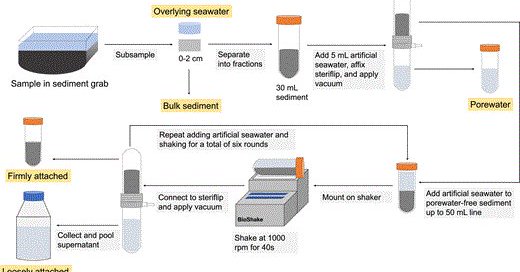
3/6 We fractionated the sediment community into those in the porewater, loosely attached to grains, and firmly attached to grains. We assessed the community composition & activity through sequencing and measuring hydrolysis rates, O2 consumption, and frequency of cell division.
1
1
1
2/6 We wanted to gain higher-resolution info about bacterial communities in sediments and go beyond the bulk. In the water column realm, we have learned so much from fractionating the community into free living and particle attached. So we did something similar in the sediment!
1
0
2
Had a fantastic time at the GRC Marine Microbes last week! Highly recommend this GRC as a great opportunity to meet fellow PhD students, early career scientists, and PIs at the forefront of marine microbiology. Also, the location and scenery were outstanding! 🏔️🐄🧀
0
1
28
The Isthmus of Panama separated them, now these lucinid symbionts live different lifes: @isimorel @benedict_yuen @M_helvetiae et al show the role of #HGT in bacterial #adaptation & impact of #nitrogen availability on ecological divergence @PLOS Genetics https://t.co/xqsdek6ZBg
0
4
18
We are in Bremen at the It Ma(t)ter(s) conference between @MarineMicrobio and @mpi_marburg! We have had the pleasure to hear an opening keynote by @GretaReintjes, who started this conference in 2017. Looking forward to the 3 days of scientific exchange between the two institutes!
0
3
19
What a team!! 🤩 More than 60 #MaxPlanck-Runners went out there to represent our institute at the #B2Run #Bremen. A great group of enthusiastic, dedicated and fun people – so many thanks and congratulations to all of you! 😍🏃♀️🏃💪 @BiogeoMPIBremen @MolEcol_MPIMM @Habitat_MPI
1
6
35
Check out the Ellrott grab in action + some behind the scenes! Thanks for featuring our work on #MethodsMonday @aslo_org! @MarineMicrobio 🌊

💡Happy #MethodsMonday! Today, we're exploring an #ASLO_Methods #openaccess article on the #EllrottGrab. Designed and built by @ChyMoncada et al. from @MarineMicrobio, this innovative sediment sampler was created to collect undisturbed surface sediments. 🔓 https://t.co/EqxZeuqU2u
0
3
15
cat is the most misused thing by programmers new to linux. I cringe every time someone uses it wrong in a bash script. Thread below with proper uses of cat only
153
3K
15K
Check out the accompanying #openaccess paper in #ASLO_Methods: https://t.co/EqxZeuqU2u
#MethodsMonday
aslopubs.onlinelibrary.wiley.com
Sampling sandy surface sediments is an important first step in understanding biogeochemical processes in these dynamic environments. However, sampling such sediments poses several challenges,...
Come summer, come winter: Despite the strong seasonality, #bacteria in #arctic #sediments are active year-round ☃️🌊 New research & instrument presented @ISMEJournal & #LnO @aslo_org Read more here: https://t.co/3Wh7CqIYbw
@ChyMoncada #Svalbard #EllrottGrab #marinescience
0
4
5

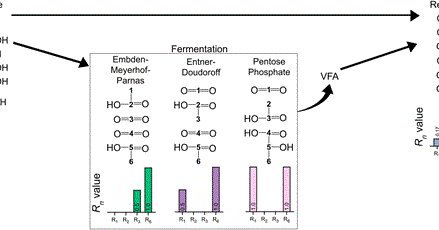
Sharing our new manuscript in @ISMEJournal led by Dr @TessFHutchinson and @MBiogeochem. By tracking how the carbon in glucose is broken down in samples and isolates, she definitely shows fermentation dominates in sands, anaerobic respiration in muds.
academic.oup.com
Abstract. In marine sediments, microbial degradation of organic matter under anoxic conditions is generally thought to proceed through fermentation to vola
0
16
67
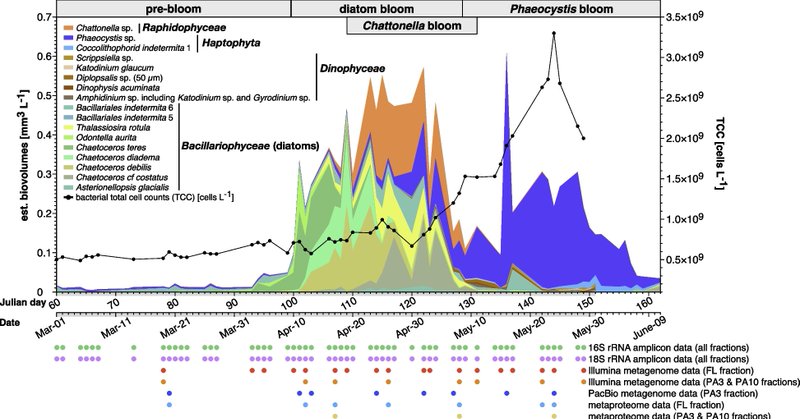
I’m delighted to share our research paper has been published in Microbiome. I invite you to read it, which delves into bacterial community and function concerning polysaccharide utilization during a phytoplankton bloom, including both FL and PA fractions.
link.springer.com
Microbiome - Marine microalgae (phytoplankton) mediate almost half of the worldwide photosynthetic carbon dioxide fixation and therefore play a pivotal role in global carbon cycling, most...
5
8
52
Come summer, come winter: Despite the strong seasonality, #bacteria in #arctic #sediments are active year-round ☃️🌊 New research & instrument presented @ISMEJournal & #LnO @aslo_org Read more here: https://t.co/3Wh7CqIYbw
@ChyMoncada #Svalbard #EllrottGrab #marinescience
0
7
17

Apply now for our International #MaxPlanck graduate program in marine #microbiology #MarMic @MarineMicrobio Open until Feb 28, https://t.co/kUutse9oNf
#mastersdegree #graduatestudies #scholarship #WomeninSTEM #marinescience #imprs @maxplanckpress
@maxplanckphdnet #PhD Please RT
1
86
114
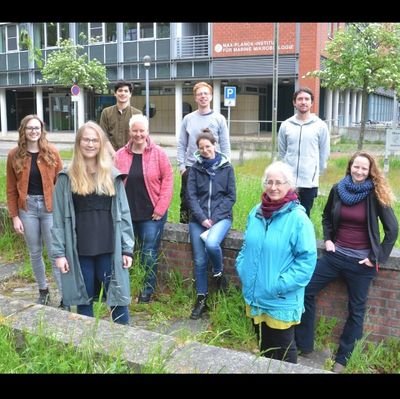
Excited to announce that the group will be moving to the University of Innsbruck, Department of Microbiology. Thank you to #MarineMicrobio for an amazing and productive time! We are looking for a PostDoc that wants to joins us: https://t.co/Pb8YFe54ab
1
20
62