

Brian D. Earp, Ph.D.
@briandavidearp
Followers
26K
Following
35K
Media
14K
Statuses
112K
A/Prof Bioethics, Philosophy & Psychology (ctsy), @NUS_CbME. Director: @OxNeuroEthics, @bioxphi. Editor, @JME_BMJ. Member, @UKYoungAcademy
Singapore
Joined July 2011
Might be a good time to repost this, as a reminder of my views. I argue against all forms of medically unnecessary nonconsensual genital cutting including the “ritual nick” form of what the WHO defines as FGM
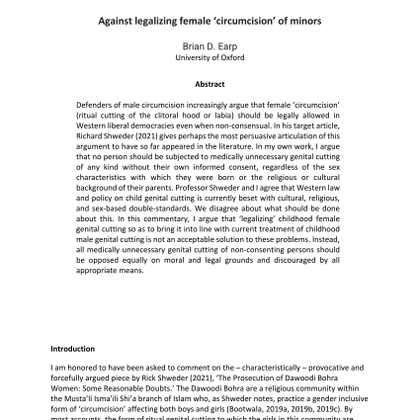
researchgate.net
PDF | Defenders of male circumcision increasingly argue that female ‘circumcision’ (cutting of the clitoral hood or labia) should be legally allowed in... | Find, read and cite all the research you...
0
7
19
The risk of more reliable AI ... why less (but nonzero) hallucination could end up being a problem
1
1
3
Nice meditation on grading and assignments in the age of AI by Dan Greco
0
0
1
The risk of more reliable AI ... why less (but nonzero) hallucination could end up being a problem
1
1
3

There's an entire parallel scientific corpus most western researches never see. Today i'm launching https://t.co/6FZMFpFvSb, a fully automated translation pipeline of all Chinese preprints, including the figures, to make that available.
188
1K
7K
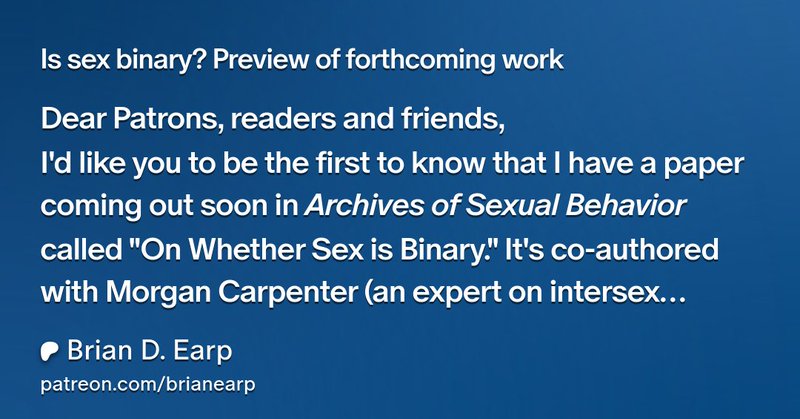
New paper 🚨 Are LLMs just “calculators for writing”? In this new paper led by Cristina Voinea, we argue that while there are some aspects of the analogy that can be defended, ultimately it is inadequate. Link and highlights below.
1
5
16

This paper claims that many separately trained neural networks end up using the same small set of weight directions. Across about 1100 models, they find about 16 directions per layer that capture most weight variation. A weight is just a number inside the model that controls
20
55
335

Download our large database of funding opportunities for early-career faculty and researchers Download it here: https://t.co/RGXGrdp2uf 433 funding opportunities.
2
191
794
A new PNAS paper finds that polarization increased immediately after the invention of smartphones and the advent of social media, which both appeared around the same year, 2008. Both profoundly changed the way humans communicate and this rise of connectivity may have fueled
102
629
2K

It feels pretty obvious at this point that someone’s going to make billions building a social app that’s just for friends, no AI slop, no brainrot, calm design, chronological feed and no concept of followers.
1K
609
15K

New (short) paper by Silvia Milano (@SilviaMilano1) and me: "Advanced AI assistants that act on our behalf may not be ethically or legally feasible", in Nature Machine Intelligence (@NatMachIntell) #aiethics
https://t.co/0uKTGg8xmr
@MunichCenterML @LMU_Muenchen @aiatlmu
2
26
87

I just read a paper that made me deeply uncomfortable about the future of science. It’s called “When Reject Turns into Accept”, and it quantifies how easy it is to manipulate LLM-based scientific reviewers without ever touching the review prompt. Here’s what they actually
39
122
570
@NatMachIntell @JulianJKoplin @HaotianYuan0630 Here is the link, with a preview of the article below https://t.co/g9zh1RW4JV
0
1
2
Really proud of this new piece 🚨 in Nature Machine Intelligence (@NatMachIntell), with S. Porsdam Mann, @JulianJKoplin & @HaotianYuan0630 - who is still in high school! ➡️ "LLMs in Scholarly Writing Pose a Provenance Problem" ... i.e., when LLM's 'fill in the gaps' in your
1
1
4
🚨Free access link to our new article in Nature Machine Intelligence: “Guidelines for ethical use and acknowledgement of large language models in academic writing” https://t.co/LonZLdPCro Includes template LLM use statement. Led by the intrepid Sebastian Porsdam Mann.
0
11
31