

William Jacob Villano
@BillyVillano
Followers
170
Following
818
Media
31
Statuses
567
Affective neuroscience @manateelab @univmiami | These words say this, these words do not.
Miami, FL
Joined August 2011
Many of us deal with uncertain waiting periods by bracing for bad news. But does this buy us any relief when bad news arrives? Short answer: Yes, but only briefly; and it can have unexpected consequences. New work out in @PsychScience: https://t.co/JKn4dti31P (More below 🧵👇)
journals.sagepub.com
Awaiting news of uncertain outcomes is distressing because the news might be disappointing. To prevent such disappointments, people often “brace for the worst,”...
2
14
31

Very excited for this paper to be out in which we continue to use very personally meaningful real-world events to understand emotion and cognition: Expectations are not stable in systematic ways and this has systematic consequences. Great work by @BillyVillano
Many of us deal with uncertain waiting periods by bracing for bad news. But does this buy us any relief when bad news arrives? Short answer: Yes, but only briefly; and it can have unexpected consequences. New work out in @PsychScience: https://t.co/JKn4dti31P (More below 🧵👇)
0
5
21

'brace yourselves' I think this is a cool result, happy to have been a part of this
Massive thanks to my #manateelab team and collaborators for making this work possible: @helleryeahz, @arossotto, @BrittJaso, @NoahKraus8, & Rick Reneau. Read the full paper here: https://t.co/JKn4dti31P
@PsychScience @SageJournals
0
1
7
Massive thanks to my #manateelab team and collaborators for making this work possible: @helleryeahz, @arossotto, @BrittJaso, @NoahKraus8, & Rick Reneau. Read the full paper here: https://t.co/JKn4dti31P
@PsychScience @SageJournals
journals.sagepub.com
Awaiting news of uncertain outcomes is distressing because the news might be disappointing. To prevent such disappointments, people often “brace for the worst,”...
0
0
4
TL;DR: Real-world expectations drift while people wait for outcomes, and the way they change has important consequences not just for emotion, but for how we learn from surprises to better anticipate the future.
1
0
0
Students who lowered their expectations had less accurate expectations for the next exam. Despite its short-term emotional benefits, bracing may impede one’s ability to learn from surprises, and counterintuitively increase the chances of surprising outcomes in the future.
1
0
0
So if lowering expectations can bring short-term emotional relief, should we go ahead and brace for the worst while we wait for important news? Before you decide, consider this:
1
0
0
But does bracing actually numb the pain of surprising bad news? In this context, lowering expectations buffered negative emotion after minor upsets but not for larger negative PEs. This emotional buffer was also short-lived, lasting for about 1 hour after viewing grades.
1
0
0
Above all else, we found that expectations tend to drift downward after recent unexpected upsets (i.e., negative prediction errors/PEs). Surprising bad news is painful, and bracing for an upset seems to be an emotional hedge against the likelihood of future negative PEs.
1
0
0
So when do expectations drift downwards, and why? We know from prior work that people brace when outcomes are highly uncertain. But uncertainty comes in a variety of flavors: new situations are uncertain, as are familiar situations where outcomes are unpredictable or surprising.
1
0
0
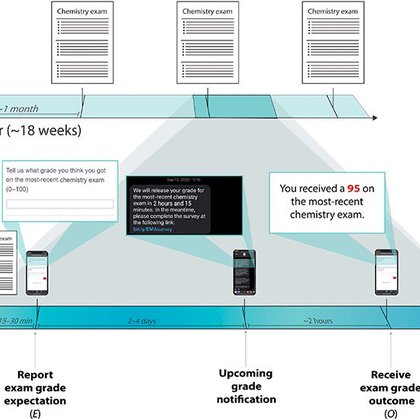
We tracked 625 students’ expectations for major exam grades, assessed whether expectations drifted before feedback, and sampled emotion for 12 hours after viewing grades. We also measured the accuracy of their initial expectations to see how well they predicted their performance.
1
0
0
In our latest work, we show that bracing during a waiting period has short-term benefits for emotion, but long-term consequences for learning. It alleviates the initial sting of bad news but makes future predictions less accurate, leaving the door open for surprising upsets.
1
0
0
If we expect the worst, we’ll never be surprised by bad news. But surprises (prediction errors) – though painful at times – are crucial for learning, and lowering our expectations to avoid surprising upsets might hinder our ability to learn what’s likely to occur in the future.
1
0
1
@lizlosin @ColinHawco @BillyVillano discusses research indicating that hippocampal activity during emotional anticipation moderates the future reinstatement of distributed cortical activity states
1
1
2
Giving a blitz talk at #SANS this afternoon (blitz topics 3): ‘Hippocampal recurrence moderates the reinstatement of cortical events during emotional anticipation’ Come by and chat at the poster afterwards! (poster is P2-C-28). @SANS_news
0
1
10
Feelings are important! We need to understand subjective experience to understand mental health. We need more research in this area!

🎉 New review article! 🎉 Computational models of subjective feelings can help us understand subjective psychiatric symptoms. By @ChangHaoKao1 @gloriawfeng @jihyuncindy_hur @huwbris in Neuroscience & Biobehavioral Reviews! https://t.co/rPrexke3kG🧵👇1/n
0
5
25

Pessimistic learning tendencies could indicate a risk for developing anxiety, a real-world study involving 625 college students suggests. https://t.co/e1ALOlfVW2
@ScienceAdvances
1
7
34
It was a joy to work with my @manateelab team and collaborators on this project. Check it out at the link below! https://t.co/tKmhWXkutf
science.org
Surprising real-world outcomes drive learning, and deviations from rational learning predict future anxiety symptoms.
0
0
3
TLDR; we used EMA to track students as they took high-stakes exams and found that real-world PEs drive learning, that learning is optimistically biased on average, and that learning biases in individuals with elevated negative emotionality predict future anxiety symptoms. (11/n)
1
0
1
We conclude that a conditioned sensitivity to unexpected outcomes and an aversion to negative PEs in particular might result in a pessimistic and inaccurate model of the world, ultimately manifesting as anxiety. (10/n)
1
0
1