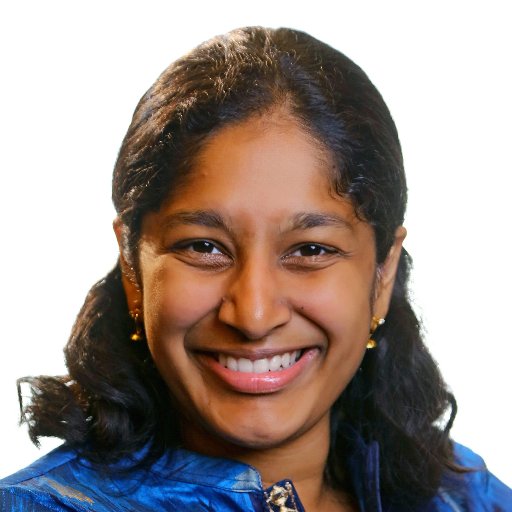
Priya L. Donti
@priyald17
Followers
5K
Following
6K
Media
69
Statuses
1K
Assistant Professor @MIT | Co-founder & Chair @ClimateChangeAI | MIT #TR35, #TIME100AI | she/they
Cambridge, MA, USA
Joined November 2014
Beyond humbled to be on this year's #TIME100AI AI can be an asset for climate & energy - but only if its development is guided by actual climate needs & planetary limits. Shoutout to those in the community working to shape a responsible, equitable, climate-aligned AI future 🌍💪
24
18
264

In today's episode of programming horror... In the Python docs of random.seed() def, we're told "If a is an int, it is used directly." [1] But if you seed with 3 or -3, you actually get the exact same rng object, producing the same streams. (TIL). In nanochat I was using the
218
496
8K
We're excited for our #NeurIPS2025 workshop tomorrow from 8am-5pm PT! 🎉🚀 Join us for keynotes, panels, poster sessions and more, either in-person or via our free livestream 👉 https://t.co/EnYjNHsKMH
1
5
17
* PFΔ: A Benchmark Dataset for Power Flow under Load, Generation, and Topology Variations (Ana Rivera, Anvita Bhagavathula, Alvaro Carbonero):
⚡Excited to share our work "PFΔ: A Benchmark Dataset for Power Flow under Load, Generation, & Topology Variations," to be presented as part of the #NeurIPS 2025 Datasets & Benchmarks Track Led by my students Ana K. Rivera, Anvita Bhagavathula (@anvita_b_) & Alvaro Carbonero 1/
0
0
1
ICYMI, my students presented the following work earlier this week, and will still be around this weekend: * FSNet: Feasibility-Seeking Neural Network for Constrained Optimization with Guarantees (Hoang Nguyen): https://t.co/acG4yYPHjq (ctd.)
Excited to share our new NeurIPS 2025 paper: "FSNet: Feasibility-Seeking Neural Network for Constrained Optimization with Guarantees" Paper: https://t.co/szPiy1YX5S Code: https://t.co/O8A4USHOO2 MIT News article: https://t.co/vVyuNjaSzn
1
0
1
On my way to #NeurIPS2025! Let me know if you're around and want to catch up :) I’ll be at the Tackling Climate Change with Machine Learning workshop: https://t.co/i1DsvjHWTR And look forward to participating in a panel at the AI for Science workshop:
ai4sciencecommunity.github.io
1
0
4
If you'll be at NeurIPS, please consider stopping by our poster! Wednesday, December 3 from 4:30-7:30pm PST https://t.co/0vGaLOcgD9
0
0
1
We show that FSNet performs remarkably well across a wide range of problem classes, including QP, QCQP, SOCP, and AC Optimal Power Flow, achieving orders-of-magnitude speedups. Surprisingly, in several nonconvex problems, FSNet even finds better local solutions than IPOPT!
2
0
0
FSNet combines a neural network with a feasibility-seeking step to ensure constraint satisfaction with significantly lower computational cost than projection. This general framework works for both convex and nonconvex problems, and comes with provable guarantees.
1
0
0
Excited to share our new NeurIPS 2025 paper: "FSNet: Feasibility-Seeking Neural Network for Constrained Optimization with Guarantees" Paper: https://t.co/szPiy1YX5S Code: https://t.co/O8A4USHOO2 MIT News article: https://t.co/vVyuNjaSzn
1
0
4
We're recruiting for the Climate Change AI core team! 🌍 Core team volunteers play a vital role in shaping CCAI’s content & activities. Join us in our efforts to democratize AI-for-climate expertise and enable effective coordination across sectors, disciplines, & geographies 💪

Interested in joining the CCAI core team? We are hiring for several roles across our communication, education and community building efforts. If one or more of these positions sound interesting to you, apply here 👉 https://t.co/NP1j3K9ru0
0
1
3
Power flow is the backbone of real-time grid operations, across workflows incl. contingency analysis & topology optimization. Our hope is that PFΔ accelerates the development of fast, feasible, and deployable ML models for power flow 🚀 #powerflow #datasets #machinelearning 6/6
0
0
0
PF provides (ctd.): * Novel data generation pipeline implemented in Julia that builds on OPFlearn. * User-friendly PyTorch InMemoryDataset class 5/
1
0
2
PFΔ provides (ctd.): * Open-source PyTorch implementation of CANOS (originally developed for the optimal power flow problem, but now adapted for PF) * Evaluations of several state-of-the-art models, including CANOS-PF, PFNet, and GraphNeuralSolver 4/
1
0
0
PFΔ provides: * 859,800 solved PF instances spanning 6 power system sizes and incl. N, N-1, & N-2 contingencies, alongside multiple evaluation tasks * Close-to-infeasible cases near steady-state voltage stability limits that enable stress-testing of ML models under edge-cases 3/
1
0
0
This paper introduces a comprehensive machine learning benchmark for power flow (PF), capturing diverse variations in load, generation, and grid topology. 🎉Check it out: Paper: https://t.co/sgLhjjq1WZ Code: https://t.co/gKmitb9G2h Dataset: https://t.co/TIbMvOx5TS 2/

huggingface.co
1
0
0
⚡Excited to share our work "PFΔ: A Benchmark Dataset for Power Flow under Load, Generation, & Topology Variations," to be presented as part of the #NeurIPS 2025 Datasets & Benchmarks Track Led by my students Ana K. Rivera, Anvita Bhagavathula (@anvita_b_) & Alvaro Carbonero 1/
1
4
16

⚡️A faster problem-solving tool that guarantees feasibility. The FSNet system, from MIT LIDS grad student Hoang Nguyen and PI Priya Donti (@priyald17) could help power grid operators rapidly find feasible solutions for optimizing the flow of electricity. https://t.co/ioxvWNP8Tv
0
3
4

Why can’t programmers tell the difference between Halloween & Christmas? Because oct 31 = dec 25.
62
167
1K
It was such an honor to meet and work with this incredible group of 25 changemakers from across different Amazonian countries, to provide training on AI & climate change and discuss practical pathways forward. Resources and results will be launched at #COP30 - stay tuned!
Last week, we co-hosted the pilot workshop of the AI Climate Institute in Brazil, as part of the preparatory activities for #COP30. We want to thank all organizers, facilitators and supporters! 💚🌎 Learn more: https://t.co/Wyv8KgWaP3
0
2
19
"In a single week, AI processed many thousands of images each night, in which experts detected 2,000 moth species—half of them unknown to science." Cool article on AI for large-scale biodiversity monitoring, feat. my awesome colleague @david_rolnick! https://t.co/hZX1zZScL9

theatlantic.com
A suite of technologies are helping taxonomists speed up species identification.
0
0
1