Park Williams
@peedublya
Followers
3K
Following
2K
Media
204
Statuses
730
Bioclimatologist interested in the causes and consequences of drought. Associate professor UCLA.
Joined June 2015
UCLA Geography is hiring! Assistant Professor in the general area of "Environmental Challenges". If you're a physical scientist wanting to research and teach on policy-relevant environmental issues please apply:
3
48
63
If you're going to @theAGU this year and work on western US climate & water please consider submitting to our session: A094 - Hydroclimate and Extremes in the Western United States in a Changing Climate https://t.co/YggHI53L1G
agu.confex.com
The western United States is particularly susceptible to adverse impacts from a wide range of hydroclimate events including droughts, floods, heat waves, fire weather extremes, and compounding...
0
3
4

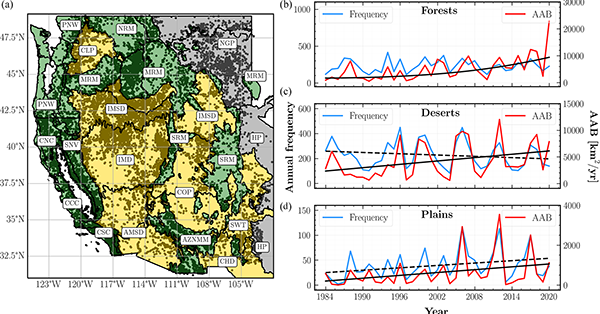
As we head into Fall, I wanted to share results from my paper (w/ stellar colleagues @peedublya, @caro_in_space, Winslow Hansen, and @PierreGentine) https://t.co/LNnB9A1UoU introducing a stochastic machine learning model for wildfires in the western US (WUS). A mini-🧵:
gmd.copernicus.org
Abstract. The annual area burned due to wildfires in the western United States (WUS) increased by more than 300 % between 1984 and 2020. However, accounting for the nonlinear, spatially heterogeneous...
2
11
60
Here in the Department of Geography @UCLA we're searching for a new colleague at the Assistant Professor level who works on anything under the big umbrella of Physical Geography. Ad below. Please help me distribute widely:
1
36
37

Openings for PhD students and postdoc/project scientists to work on climate science and climate impacts in my group @ucmerced
https://t.co/xoGal8wLdt
2
99
152

Very excited to share our paper published at @NatureComms today! @peedublya @PierreGentine @trevorkeenan @zhangyaonju
https://t.co/ctys6Q8gKM
0
21
111

Sea-surface temperature (SST) trends over the last ~40 years show an unusual pattern, with cooling in the SE Pacific & Southern Ocean, despite ongoing global warming. In a recently published paper, we investigate if climate model large ensembles (LEs) can simulate this pattern.
6
52
209
11/11 This thread is an update a study published with Ben Cook (@DustyBowl) and Jason Smerdon from @LamontEarth earlier this year ( https://t.co/DHGbelbEqX), which was itself an update of a study we published with other friends in 2020 ( https://t.co/LrYmD2XMUF).

science.org
Global warming is causing megadrought in southwestern North America.
2
4
38
10/ The exact magnitude of the human-caused contribution is highly uncertain, mostly due to model disagreement on precipitation trends. Here, grey lines show how our calculation of the human-caused climate change trend would differ if we considered any single climate model.
1
1
18
9/ Had the sequence of wet-dry years occurred as observed but without the human-caused drying trend, we estimate that the 2000s would have still been dry, but not on the same level as the worst last millennium’s megadroughts.
1
5
20
8/ We estimate that the 29-model average trends in precipitation, temperature, and humidity account for 44% of the severity of the 2000–2022 summer soil-moisture drought in southwestern North America.
1
4
20
7/ Subtracting away these model-simulated climate trends, we can isolate the component of the recent drying that was caused by climate change. The human-caused drying effect is generally still small relative to the size of year-to-year swings, but it adds up.
1
2
17
6/ How much of the current megadrought’s severity has been due to human-caused climate trends? We assess human-caused climate trends as the average trends in precipitation, temperature, and humidity simulated by 29 climate models used in the recent CMIP6.
1
3
17
5/ The especially severe drought conditions in 2021–22 were due to the 3 consecutive years of very low regionally averaged precipitation in addition to continued high temperatures and vapor-pressure deficits that are consistent with a ~3°C warming trend since 1901.
1
4
20
4/ Here's how the severity of the past 23 years of soil-moisture drought ranks relative to other 23-year dry periods in the past 1200 years. The spatial extent of high-ranking drought severity during the current event is by far the highest in the past 1200 years.
1
4
26
3/ The current megadrought has also not been exceptionally dry everywhere, but dry has greatly exceed wet in most places. Here are maps of summer soil-moisture drought rankings (relative to the 122-yr record of obs climate) for each year of the megadrought.
1
5
25
2/ The current megadrought has not been dry the whole time in terms of regionally averaged summer soil moisture, but the other megadroughts of the past 1200 years weren’t either. Of the last 23 years, 19 were dry, tying a record set by the 1100s and 1200s megadroughts.
1
4
27
1/ With August now over, the ongoing soil-moisture drought in southwestern North America has now, at 23 years old and counting, matched the duration, and probably exceeded the severity, of the “megadrought” that struck the region from 1571–1593.
6
110
347
With the labor day weekend here + oppressive heat coinciding with the apex of summer drying, fire danger is high across much of the West https://t.co/TVB9LndjFU In addition to weather/fuels facilitators of fire, the human dimension of ignitions during the holiday 1/6
1
21
51