
Paresh Chaudhary
@pareshrc
Followers
36
Following
23
Media
4
Statuses
8
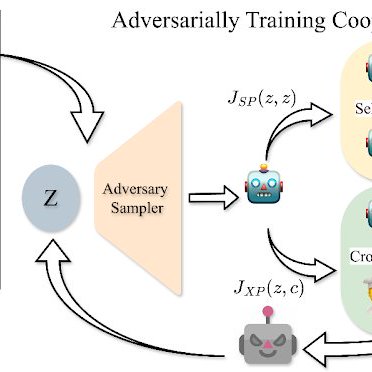
1/6 Current AI agent training methods fail to capture diverse behaviors needed for human-AI cooperation. GOAT (Generative Online Adversarial Training) uses online adversarial training to explore a pre-trained generative model's latent space to generate realistic yet challenging
1
7
18
6/6 Thrilled to share my first paper as lead author! I had the pleasure of working with incredible collaborators: @liangyanchenggg @Daphne__Chen @SimonShaoleiDu @natashajaques Links: Website: https://t.co/VWRLtuqQOZ Arxiv: https://t.co/zjD4YXMJGT Github(Cooperative Matrix
sites.google.com
TLDR: We use generative models in an online adversarial training loop to train the learning agent against difficult coordination scenarios while maintaining realistic behavior.
0
1
3
5/6 GOAT is 38% better than prior work when evaluated in real time with novel human users.
1
0
1
4/6 The training creates a dynamic curriculum where the adversary finds challenging but realistic partners while the cooperator agent learns to adapt. As the cooperator improves, the adversary is pushed to find increasingly complex scenarios, resulting in a robust cooperator.
1
0
0
3/6 While the minimax objective focuses on the low reward region (red) that does not contribute to the game, GOAT (regret objective) explores multiple regions (blue) while actively participating in the game.
1
0
3
2/6 Adversarial training might help us train robust cooperators, but there’s a catch: in cooperative tasks, the “adversary” might learn to sabotage the game entirely rather than create realistic training partners. Because GOAT uses a generative model (VAE) pretrained on only
1
1
3

It is a proud moment for the Faculty of Engineering, MIT-World Peace University, Pune as its team was declared as the winner in The ABU Robocon 2020 and will get a chance to represent India at the international level. Final run: https://t.co/48HFqKXnGs
0
1
0