
MPI-PKS Dresden
@mpi_pks
Followers
1K
Following
178
Media
68
Statuses
205
Twitter account of MPI-PKS Dresden; tweets by Pablo Pérez, Uta Gneisse, and Pierre Haas @lepuslapis. Now also @mpipks dot bsky dot social.
Dresden, Germany
Joined April 2023
Libor Šmejkal,group leader at MPIPKS/MPICPfs,has been awarded the 2025 Walter Schottky Prize "For his prediction of altermagnetism, a new class of magnetic order with diverse fundamental and application-oriented perspectives" Congratulations,@LiborPhysics! https://t.co/4RR4voeHdv

dpg-physik.de
Übersicht der Preisträgerinnen und Preisträger
0
5
21
Selected for a Viewpoint in Physics by Matteo Ciarchi and Ivan di Terlizzi @mpi_pks: https://t.co/N6vqPdpofB Publication highlight:
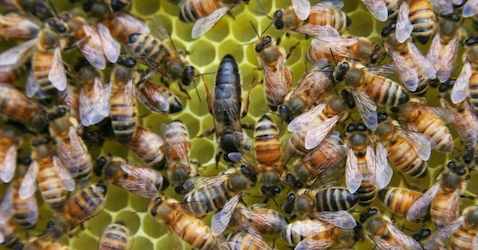
physics.aps.org
Bacteria, cells, swarms, and other organisms pluck information from noisy environments with extraordinarily high precision.
0
0
5
Now published @PhysRevLett: @gnicoletti09 & @dbusiello1 @mpi_pks combine information theory and stochastic thermodynamics to identify the fundamental principles behind the mechanisms used by living organisms to extract information from a noisy environment. https://t.co/ZvgztF3j09
1
7
35

In biological systems, optimal transduction strategies may boost information harvesting compared to the ideal case in which all the degrees of freedom are known Letter: https://t.co/tL6okzjH5E Viewpoint: https://t.co/XbLhERfnFb
1
15
28
Now published @PhysRevLett: Paul Schindler and @MarinBukov @mpi_pks supplement the quantum simulation toolbox with a variational principle to control Floquet-engineered quantum matter created out of strong nonequilibrium drives. https://t.co/MyqO7k4WIO
1
1
8
Opening for a Distinguished Postdoctoral Fellow @mpi_pks ! This is an independent Fellowship with free choice of research topics and individual appearance on our research page https://t.co/MPWyw97kaT , apply by 15 November: https://t.co/SY5uzzHThw
0
5
17
Publication highlight: https://t.co/WzKqzAqck8 See also the related thread by @RicardAlert:

New preprint! How do traction forces produce motion in cell groups? Combining experiments and theory, we relate the velocity of cell groups to the asymmetries in their traction forces, encoded in the quadrupole of the traction field. https://t.co/68ycelFQ14
0
0
3
Cells move in groups often led by specialised leader cells. Work @NaturePhysics by @RicardAlert @mpi_pks & collaborators shows that leader cells cannot autonomously guide groups: followers must contribute to build a global force asymmetry for group motion. https://t.co/QeFEvEHH66
1
5
32
Congratulations Patrick!! We are thrilled that you decided to continue as postdoc with us @mpi_pks after this impressive thesis work!
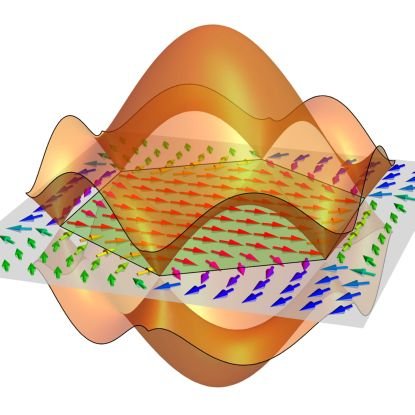
Congratulations 👏 to our student Patrick Lenggenhager, whose PhD thesis was recognized by the SPS (Swiss Physical Society) Award in Condensed Matter Physics - sponsored by IBM & handed by SPS president Teresa Montaruli. Another trophy 🏆 after receiving the Silver Medal of ETH!
0
1
11
Always wanted to learn about superconductivity? Before leaving for @covcampus , Chris Hooley left us @mpi_pks a wonderful farewell present with his lecture series on superconductivity, which we are excited to share! You're in for a treat! https://t.co/V0D9DEkcYI
0
5
14
Multiple PhD positions available! The call of our International Max Planck Research School for Quantum Dynamics and Control is now open. We offer a large variety of projects in Physics and Chemistry, apply by 31 October! https://t.co/AjEY6bKPL8
1
15
37
We are hiring! You are great with people from all over the world, well-organized, and fluent in English and German? Then join our dynamic visitors program team! Application deadline is 30. September.
mpg.de
Job offers of the Max Planck Society and Institutes. You can combine the "jobtype" with either "research subjects" or "region". Confirm your choice with OK.
0
2
9
You have a background in math/physics/computer science/ML and are looking for an interdisciplinary postdoc fellowship in life science, with free choice of host groups? Then join us at the CSBD as an ELBE postdoc, application deadline is 19. September! https://t.co/9tpBMzMC0A
1
18
26

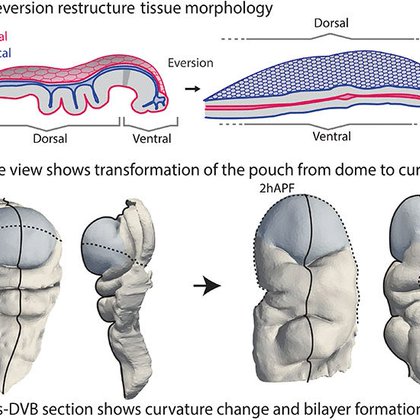
Our latest is out!! 🙌Active shape programming drives Drosophila wing disc eversion | Science Advances https://t.co/cC8DNVT2w2
@PoLDresden @mpicbg @mpi_pks @csbdresden @_JFuhrmann_ @abhijeet095 @mpopov1c @carldmodes 🧵
science.org
In-plane cellular dynamics drive 3D tissue morphogenesis of the everting Drosophila wing disc epithelium.
7
26
112

From dual-unitary to biunitary: a 2-categorical model for exactly-solvable many-body quantum dynamics https://t.co/YuP6PcEEIf - new and #openaccess from Pieter W Claeys @mpi_pks, Austen Lamacraft and Jamie Vicary for our issue on Quantum-Circuit Models
iopscience.iop.org
From dual-unitary to biunitary: a 2-categorical model for exactly-solvable many-body quantum dynamics, Claeys, Pieter W, Lamacraft, Austen, Vicary, Jamie
0
2
7
Publication highlight: https://t.co/SenAFQ7uIm See also the thread by @RicardAlert:
👉Excited to share a fun discovery! Self-propelled particles can flock even if they turn away from one another. We demonstrate it experimentally in active Janus colloids, and we understand it with kinetic theory. And we find active Wigner crystals too! 😃 https://t.co/cWT49PEAXG
0
0
2
Active agents such as birds can flock by aligning with one another. New work @PhysRevX by Suchiasmita Das, Matteo Ciarchi, @RicardAlert @mpi_pks and collaborators now shows that active particles can flock even if they turn away from one another! https://t.co/gFoRoIz3Ab
2
3
25

It's believed flocking emerges through alignment interactions among self-propelled agents. New experiments and theory reveal that flocking can also emerge through interactions that turn agents away from each other Read https://t.co/g7YrqZpiT8
@RicardAlert @mpi_pks @csbdresden
0
18
50