
MoFEM / @[email protected]
@mofemjoseph
Followers
2K
Following
992
Media
252
Statuses
1K
Open and Free Finite Element Code (License MiT)
Glasgow
Joined November 2014
Diversity in applications and group diversity. We are working with EDF, Amentum, Rolls-Royce, Fredenberg and Siemens.
0
0
0
MoFEM group at the front of Pearce Lodge, on the coldest day in Scotland so far this year. We have grown over the last 11 years since we set up an account here. We are working with the nuclear, automotive, aerospace, chip and civil engineering industries. #MyXAnniversary
1
2
6
Patrick Loughnan from Amentum is presenting his work with #MoFEM at the IAEA in Vienna. Amentum is utilising #MoFEM to assess the safety of existing and new generations of nuclear reactors. @UofGEngineering @GCEC_ @mofemjoseph
1
2
4
Call for contributions - Mini-Symposium "Open-Source Software in Mechanics" at the 17th World Congress on Computational Mechanics https://t.co/K7n0nQA44e
0
2
5
MoFEM team is growing. We are in the process of reviewing tasks, which we do each Friday, and reviewing pull requests. The social aspect of code development is the most challenging part.
0
1
2
Implement arc-length control in MoFEM using the off-the-shelf arc-length control in PETSc. Students will have fun playing with this during the nonlinear mechanics course.
2
3
13
Adjoins method, in core is a tool which can fast calculate Lie derivatives, on manifold implicitly expressed by partial differential equation. You can calculate sensitivity for model parameters of some physical problem, i.e. coefficients PDE, or domain shape, or weights, …

I wrote a shape optimisation code in #MoFEM that uses the adjoint method (rebranded as backpropagation by people from AI) and a gradient-based descent optimisation scheme. It works pretty well and is very fast. The adjoint method makes inverse problems easy with finite elements.
1
5
15
I wrote a shape optimisation code in #MoFEM that uses the adjoint method (rebranded as backpropagation by people from AI) and a gradient-based descent optimisation scheme. It works pretty well and is very fast. The adjoint method makes inverse problems easy with finite elements.
2
3
33
There was good attendance at the @cmbbesymposium #CMBBE2025 MoFEM workshop, which was delivered by Lily Sierra (@UofGSciEng) and Jakka Veera (Universitat Pompeu Fabra). Lily is a MEng Civil Eng. student at @UofGEngineering who is about to start a PhD.
0
5
15
There was good attendance at the @cmbbesymposium #CMBBE2025 MoFEM workshop, which was delivered by Lily Sierra (@UofGSciEng) and Jakka Veera (Universitat Pompeu Fabra). Lily is a MEng Civil Eng. student at @UofGEngineering who is about to start a PhD.
1
2
6
MoFEM (@mofemjoseph) + #Paraview + #Blender = a cool visualisation. Incomprehensible material, buckling, and self-contact are always tricky, but they work. Note this wrinliking :)
1
3
18
We are not robot designers. Grip is crap. But now, with a forward model, we can train a neural net to move tentacles and optimise the shape, estimate strength of greep, along with other cool stuff. BTW stress representation with a coarse mesh is pretty cool. Mixed element rules.
0
2
6
Great story that tools created at MoFEM @mofemjoseph are used creatively by @MetamaterialsUK Summer School. https://t.co/8XAi2dZCl8
linkedin.com
A key part of metamaterials research is optimising the design of microstructures by choosing the topology of the material properties. This can be particularly difficult given the size of the search...
0
1
4
There is a lot of torsion and bending.
1
3
8
Pressing a ball in a metamaterial. #MoFEM @mofemjoseph
Final preparations for the hands-on session on computing metamaterials include buckling with self-contact and an antichiral structure with ball indentation, all in a Docker container on Jupyter. Thanks to Adriana and Callum for setting up the environment.
1
3
10
Final preparations for the hands-on session on computing metamaterials include buckling with self-contact and an antichiral structure with ball indentation, all in a Docker container on Jupyter. Thanks to Adriana and Callum for setting up the environment.

Remember to sign-up for the Mechanical Metamaterials Summer School
1
1
13
You never know what AI Agents will like to run with modelling tools, but whatever it is, it has to run.
Seeking robustness while preserving high accuracy is a tricky business. We are on the right track, but not yet where I would like us to be. We are testing the Higham method for projecting onto a cone of symmetric positive-definite matrices.
0
2
4
Seeking robustness while preserving high accuracy is a tricky business. We are on the right track, but not yet where I would like us to be. We are testing the Higham method for projecting onto a cone of symmetric positive-definite matrices.
1
2
17

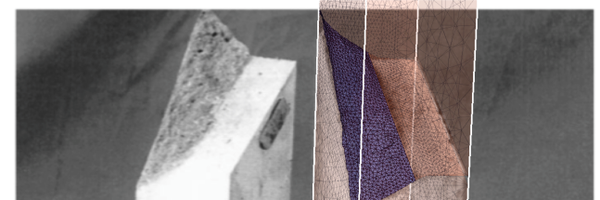
At MOS our mixed formulations are not only rigorously mathematically verified but also validated with real-world experiments.
0
2
4