
Jon Judd
@jonj_udd
Followers
259
Following
678
Media
4
Statuses
75
Started from the bottom, now we're here. @Stanford Genetics PhD student. Just a guy that likes science, food, and, Quidditch
Joined September 2019
So big-ish news, I am happy to announce that I've submitted the first paper of my PhD!!! And now get the chance to write my first twitter tutorial. (Thread + Preprint link below)
3
13
51

For many traits there is a correlation between the number of duplications or loss-of-function (LoF) mutations someone carries, and their phenotype. Curiously, for most traits, these effects are aligned in the SAME direction. Why?
4
42
111
Lastly, I’d just like to thank my mentors and friends who have helped in this process. This includes the mentors above, but especially Casey (@casey6r0wn ) who isn’t with us anymore, but was essential in me to pursuing a PhD. So thanks and hope you enjoy this work!
0
0
6
In total, we reaffirm the germline genetics role on prostate cancer risk, find that neighborhood deprivation may influence prostate cancer etiology, and conclude these two variables largely act independently in their associations with PCa. https://t.co/iQpPYmNyCL

medrxiv.org
Background Genetic factors play an important role in prostate cancer (PCa) development with polygenic risk scores (PRS) predicting disease risk across genetic ancestries. However, there are few...
1
0
7
We then investigate potential GxE interactions between neighborhood deprivation and a validated prostate cancer PRS. We found that these two largely act independently on prostate cancer risk.
1
0
2
To investigate the association between neighborhood deprivation and PCa, we used a series of logistic regression models finding that series domains of deprivation were inversely associated with PCa risk.
1
0
4
We did this analysis in UK Biobank because of the available genotyping data, clinical information, and access to the English Indices of Deprivation, a series of metrics that calculate relative neighborhood deprivation in geographic areas across England.
1
0
5
In our new preprint, with @spence_jeffrey_ , @jkpritch , @Linda_Kachuri , and @johnwitte , we investigated the role of neighborhood socioeconomic status - and its potential GxE interaction with germline genetics - on PCa etiology https://t.co/iQpPYmN0Nd
medrxiv.org
Background Genetic factors play an important role in prostate cancer (PCa) development with polygenic risk scores (PRS) predicting disease risk across genetic ancestries. However, there are few...
1
7
30
To start off, prostate cancer (PCa) is the most common non-skin cancer in men and a ton of research has gone into understanding the etiology of this disease
1
0
5

HLA is the locus that everyone loves to hate, so it rarely gets invited to the GWAS party... There’s good reason for this. The region has extensive LD, high gene density and high polymorphism. (Thread + preprint link below ⬇️) (1/8)
5
50
173
We are recruiting postdoctoral fellows! Interested in using quantitative tools to study gene regulation in stem cell-derived developmental models? See below for more info and reach out
3
58
114

How is your genome build choice influencing your RNA-seq results? We saw ~4% of all genes, and ~39% of all quantified genes from six biospecimen types were impacted in one of three ways

📢Online now @AJHGNews! 📰Impact of genome build on RNA-seq interpretation and diagnostics 🧑🤝🧑@raungar @page_goddard @sbmontgom & colleagues https://t.co/IpbE0MthT7
1
15
34
So excited to share our work describing our experience creating & teaching a class on genetics,ethics, & society! tl;dr- bioethics education on relationship between science/scientists/society is impactful, something students want, and important for structural change in our field

thrilled to share @raungar's and my paper on our genetics + ethics course! still shocked, awed, and incredibly grateful that our little idea grew into a full-fledged course and accompanying paper
3
10
37
@raungar and I are thrilled to share our paper on the trainee-led course on genetics, ethics, and society that was developed at Stanford: https://t.co/y7LiY5Bv6x (1/9)

biorxiv.org
Despite the profound impacts of scientific research, few scientists have received the necessary training to productively discuss the ethical and societal implications of their work. To address this...
1
31
89

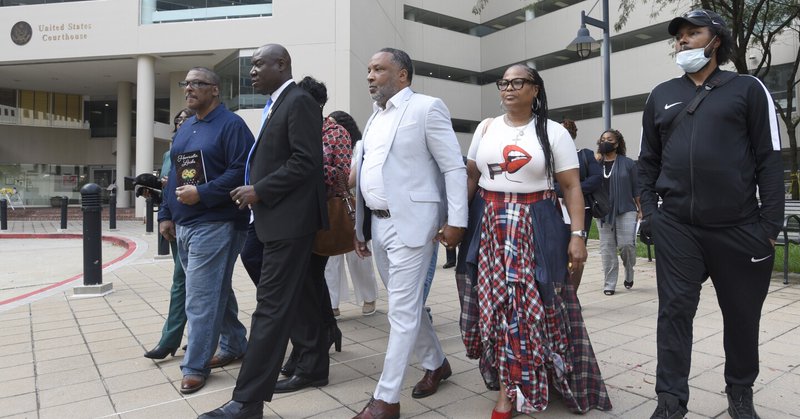
BREAKING: The family of Henrietta Lacks is settling a lawsuit against a biotechnology company they accused of taking her cervical cells without her knowledge. They accused the company's leaders of reaping billions of dollars from a racist medical system.
apnews.com
The family of Henrietta Lacks is settling a lawsuit against a biotechnology company it accuses of improperly profiting from her cells.
53
881
2K
If you are a member of ASHG, consider voting for me. I know a few things and I think there's some good I could do in this position. Alright, back to avoiding twitter for a few months
0
0
4
2nd tweet of the day (very exciting)! As some of you know, I'm running for the Trainee Director position on the @GeneticsSociety (ASHG) Board of Directors. I'm passionate about service, advocacy, and education, and this is my way to continue serving the Human Genetics community.
1
8
24


Today, the President’s Council of Advisors on Science and Technology (PCAST) released recommendations to help support and grow the U.S. public health workforce. Learn more here:
4
18
25