
Wake
@WakeFramework
Followers
2K
Following
5K
Media
303
Statuses
4K
Complete Solidity security: Wake Framework (open-source) for testing & fuzzing + Wake Arena for AI audits with graph-driven reasoning. By @AckeeBlockchain
EVM
Joined September 2023
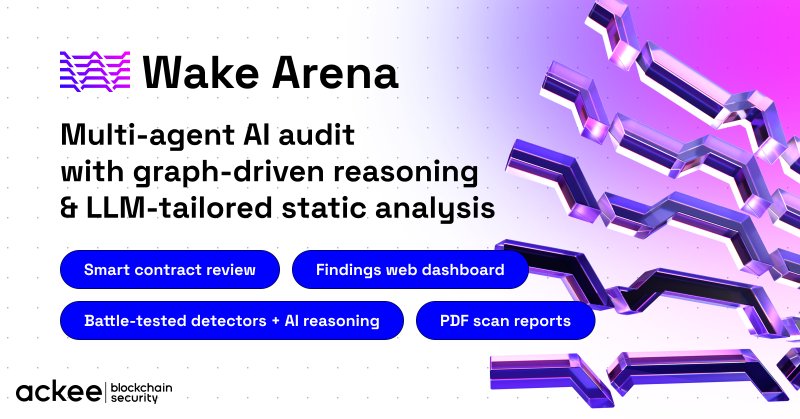
Wake Arena: multi-agent AI audit with graph-driven reasoning and LLM-tailored static analysis. 43/94 high-severity vulnerabilities in benchmark tests on historical audit competitions. 3 production audits (Nov 2025, Ackee Blockchain): 26 findings, including 5 criticals. Thread
48
194
249
AI audits aren't theoretical anymore. They're catching half the critical bugs in production protocols. Wake Arena just dropped benchmark results from real audits: Lido, Printr, Everstake. 26 findings across 79 issues 5 out of 10 critical vulnerabilities discovered False
Wake Arena: multi-agent AI audit with graph-driven reasoning and LLM-tailored static analysis. 43/94 high-severity vulnerabilities in benchmark tests on historical audit competitions. 3 production audits (Nov 2025, Ackee Blockchain): 26 findings, including 5 criticals. Thread
0
0
0
We tested Wake Arena against 14 historical audit competitions, the same dataset Zellic used to benchmark their automated scanner. Wake Arena outperformed both Zellic's V12 scanner and plain GPT-5 without specialized guidance. The results: Wake Arena detected 43 out of 94
8
4
10
Unit and integration tests check specific scenarios. Invariant testing checks universal truths. "This deposit function works with amount=100" vs "Total deposits must always equal the sum of individual balances." One tests a case. The other tests a guarantee.
2
1
4
2/ Ready to catch vulnerabilities before your premium audit? → Upload your codebase (GitHub or direct upload) → AI-driven analysis with graph-driven reasoning → Receive a comprehensive PDF report Start here: https://t.co/WDYKZqzOhy Follow @WakeFramework for more security
ackee.xyz
Catch protocol-specific vulnerabilities before a premium audit. Static analysis combined with deterministic AI reasoning. Built by Ackee Blockchain Security.
0
0
4
We tested Wake Arena against 14 historical audit competitions, the same dataset Zellic used to benchmark their automated scanner. Wake Arena outperformed both Zellic's V12 scanner and plain GPT-5 without specialized guidance. The results: Wake Arena detected 43 out of 94
8
4
10
This workflow from @DevJaphy is the one that clicks for experienced devs. Foundry for your standard unit tests. Wake when you need to model complex scenarios that are cleaner in Python than mirroring your Solidity patterns. The "Foundry + Wake" combo isn't about replacing

Testing FundMe.sol with @WakeFramework (Python Tests) 🐍🔗 After Foundry tests, you can level up by testing FundMe.sol using Wake. 🔧 Setup Steps • Ensure wake and anvil are in your PATH • Configure wake.toml to match your project • Generate Python types from Solidity with
1
1
6
Great opportunity! Wonderland partners with Optimism, Aztec, and Ethereum Foundation on generational projects. Their 4-year commitment model means you're building something real, not just shipping features and moving on. Note from the security trenches: cutting edge also means

My startup, @Wonderland, is hiring 10 Senior Solidity developers. We work at the cutting edge of crypto. There’s no better place to get exposure to the coolest shit being built in this space. DM me, you won't regret it! RTs appreciated for reach.
0
1
2
5/ Wake's Struct helpers turn EIP-712 debugging from trial-and-error into systematic verification. If this helped: • Follow @WakeFramework for more testing insights • RT to help other Solidity devs The full guide ↓ https://t.co/Pw1YrlCfsJ
ackee.xyz
Inspect EIP-712 type strings and preimage bytes in Wake to match Solidity exactly, catch schema errors early, and prove signatures before deployment.
0
0
2
4/ Wake removes guesswork from EIP-712 testing → Log type strings to catch typos → Compare preimages to Solidity → Assert digests match on both sides
1
0
2
3/ Cross-check against your contract directly Sign the same struct manually and with sign_structured(), verify both match your contract's hashTypedData. Wake's fuzz tests prove signatures work before deployment.
1
0
2
2/ Wake's encode_eip712_type() and encode_eip712_data() expose the preimage Print the actual type string being hashed: Mail(Person from,Person to,string contents)Person(string name,address wallet) Spot field ordering and nesting errors instantly.
1
0
2
1/ Type hashes are computed blindly in most frameworks Build the struct, call sign(), hope it works. When signatures fail, you're debugging an opaque keccak256 output with zero visibility into what went wrong.
1
0
2
EIP-712 tests pass. Production signatures fail. Domain matches. Struct matches. Everything looks perfect. The bug? One typo in a type hash you computed by hand and never saw. Here's how Wake exposes the preimage: Thread ↓
5
2
4
TypeScript + Solidity + security + AI is the right stack. But here's what most people miss: AI tools generate code fast, security tools need to catch issues faster. The gap between writing Solidity and shipping secure Solidity is where most projects stumble. You can scaffold a

TypeScript + Solidity + Security + ai. You're unstoppable in 2026.
1
1
2
ERC721 looks simple until you ship it. Reentrancy through callbacks. Missing receiver checks. Approval races. Token lockups. Every edge case here has drained real protocols. The standard is 6 years old, and developers still miss these patterns. Wake catches all of these in VS

🦖 Day 183 of learning blockchain 🚀 Today I learned about ERC721 edge cases and how attackers can exploit them:📍 ✅ Reentrancy via onERC721Received callbacks ✅ Unsafe transferFrom usage without checks ✅ Missing ownership / approval validation ✅ Approval misuse leading to
5
1
10
2/ For more details, check out Appendix C of the full report here: https://t.co/kqphiM5HMR Follow @WakeFramework for more insights. Scan your protocol:
ackee.xyz
Catch protocol-specific vulnerabilities before a premium audit. Static analysis combined with deterministic AI reasoning. Built by Ackee Blockchain Security.
2
0
5
Wake Arena identified 5 critical vulnerabilities in Printr. The protocol enables permissionless token deployment with bonding curves that graduate to external DEXs, plus cross-chain teleportation. The critical issues found by Wake Arena: 1. Native token drainage via partial
4
2
6
Tiny numerical edge cases. Massive protocol losses. The pattern repeats because precision bugs hide during unit testing. Your happy path tests pass. Integration tests look clean. Then production finds the edge case. Runtime invariant checks aren't enough. You need to hunt

Recent Balancer + yETH exploits share a common pattern: tiny numerical edge cases becoming real vulnerabilities. We outline the mechanics and argue for a missing defense: runtime checks on precision + invariants. This needs to be a first-class design requirement in DeFi.👇
0
1
3
'+=' vs '=' - one character, one vulnerability. These bugs hide in plain sight. Code reviews miss them. Unit tests don't catch them. They ship to production. The fix is simple once you see it. Finding it is the hard part. Wake's static analysis catches write-after-write

Spent a bit time with the team (@Zyy_0530 @HatforceSec @KaihuaQIN ). I think the vulnerability is here. This should be `=` instead of `+=`. Will write a more detailed post later.
2
1
5