
Sena Coskun
@SenaCoskun11
Followers
497
Following
260
Media
23
Statuses
160
Economist, PhD @NUEconomics, Assistant Professor @UniFAU @FAUWiSo, Senior Researcher @iab_news, Research Affiliate @cepr_org
Germany
Joined December 2019
Our findings imply that models ignoring the quality-quantity margin will overestimate fertility responses to policies. For example, childcare subsidies may lead families to substitute towards higher quality (more expenditure) rather than just increasing fertility (quantity).
0
0
1
Time: Time-use data shows mothers in linear sectors adopt a more time-intensive parenting style.
1
0
1
We find strong empirical evidence for these mechanisms: Quality: Controlling for income and education, mothers in non-linear sectors have less children but with higher test scores/school tracks, suggesting higher quality investment.
1
0
1
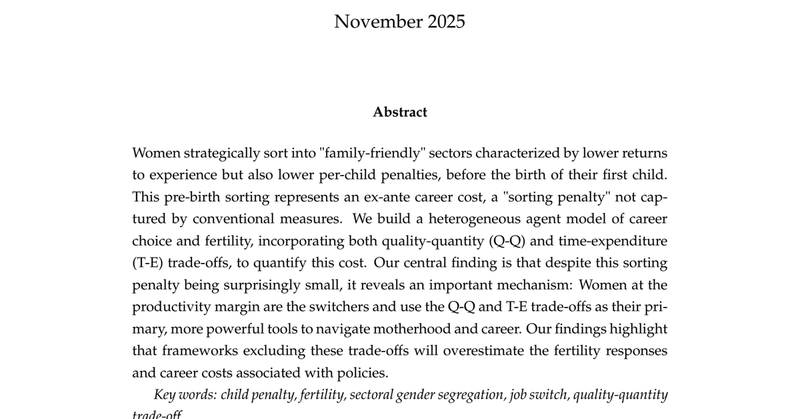
If the sorting penalty is small, how do high-productivity women navigate motherhood? Our model shows they primarily use two other margins: Quality-Quantity trade-off (lower fertility-higher investment) Time-Expenditure trade-off (substituting monetary investment for time)
1
0
1
Surprisingly, we find the "sorting penalty"—the lifetime income loss from choosing a family-friendly sector over a high-growth one—is small (only ~2.5% of the total penalty). Why? The model reveals that "switchers" are at the productivity margin.
1
0
1
Standard child penalty estimates capture income loss after birth, missing this ex-ante career adjustment. To quantify this "sorting penalty," we build a heterogeneous agent lifecycle model featuring joint choices of career, fertility, and child investment (time vs. money).
1
0
1
The "smoking gun" for strategic behavior is timing. We find that women are significantly more likely to switch into these family-friendly sectors ~3-5 years before the birth of their first child. Those who switch end up having higher completed fertility.
1
0
1
These sectors are characterized by lower returns to experience ("linear" jobs), fewer overtime hours, and lower child penalties for career interruptions.
1
0
1
We document that women systematically sort into "family-friendly" sectors (e.g., Education, Health) and women in these sectors have higher fertility.
1
0
1
New working paper: "Navigating Motherhood: Endogenous Penalties and Career Choice" joint with Husnu Dalgic(@HCD342 ) and Yasemin Ozdemir. We study the link between job sorting, fertility and motherhood type, using Dutch administrative data. https://t.co/cmtyAmQpoe
dropbox.com
Shared with Dropbox

New CEPR Discussion Paper - DP20872 Navigating Motherhood: Endogenous Penalties and Career Choice Sena Coskun @SenaCoskun11 @UniFAU, Husnu Dalgic @HCD342 #UniMannheim @EconUniMannheim, Yasemin Ozdemir @unibt
https://t.co/6uSQ0rcVNJ
#CEPR_MG #EconTwitter
1
0
3
As shown in our earlier paper, understanding the dynamics of the gender pay gap (within families) is crucial to understanding fertility trends. https://t.co/4VKjbl2NYT
0
0
1
The different nature of these recessions— the Great Recession being a "mancession" and the Pandemic Recession a "shecession"—affected within-family relative income differently.
1
0
2
However, in the Pandemic Recession, states with the highest gender pay gaps saw larger fertility increases, despite significant GDP declines.
1
0
2
During the Great Recession, in German states with the smallest gender pay gap, GDP declined the least and fertility increased the most.
1
0
1
We analyze fertility across German states during two recessions: the Great Recession of 2009 and the Pandemic Recession of 2020. Germany generally has an acyclical fertility, but around recessions, it becomes slightly countercyclical, with lower GDP and higher fertility rates.
1
0
2
Here is our piece on fertility in Germany, just published in IAB-Forum (joint with @HCD342). A brief summary in English👇👇👇
1
0
3
6) I offer a new complementary explanation, the productivity hypothesis, and provide a framework to micro-found various types of unemployment differences. These contributions enhance the understanding of unemployment rate differences across groups within and between countries.
0
0
1
5)My paper contributes to the literature with novel facts about cross-country unemployment rates, establishing a crucial link between labor market frictions & relative efficiency & developing a new method to estimate relative efficiencies using wage data & model implied frictions
1
0
1
5) In countries with “young, educated, unemployed”, the productivity difference (skilled-unskilled) is narrower. Mismatch rates are lower, vacancy creation is in favor of unskilled jobs & worsening the situation for educated workers.
1
0
1
4) Relative efficiency estimation is highly affected by labor market frictions such as mismatch and vacancy costs.
1
0
1