

Samarth Mathur
@SamarthPhD
Followers
145
Following
170
Media
12
Statuses
112
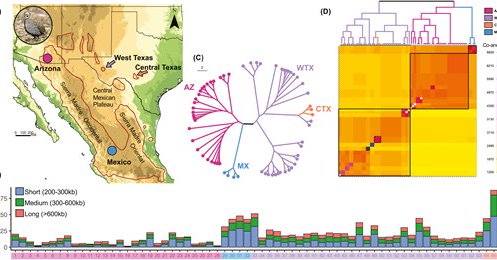
Thank you @sse_evolution presidents for honoring my dissertation work with such great recognition. Looking forward to attending the @Evol_mtg in Montreal and celebrating with everyone. 🥳 For those who are interested, article link (it’s open access):
academic.oup.com
Abstract. Small populations are vulnerable to increased genetic load and drift that can lead to reductions in fitness and adaptive potential. By analyzing

This year’s SSE Presidents’ Award goes to Dr. Samarth Mathur for his paper, “An evolutionary perspective on genetic load in small, isolated populations as informed by whole genome resequencing and forward-time simulations.” https://t.co/8M88v9zIWe
@SamarthPhD @journal_evo
2
5
22
Excited to share this press article highlighting our recent paper. We looked at the benefits and risks of genetic rescue & developed new metrics to quantify genomic compatibility—to evaluate potential benefits and risks of rescue efforts https://t.co/u8zXr75KNt

news.osu.edu
The established conservation practice of relocating animals from large, genetically diverse populations to small communities of inbred endangered species may risk introducing more damaging than...
0
1
2
Can we safely use assisted gene flow to rescue endangered species without making things worse? 🧬 Our new study in @molecology use newly devised metrics to explore genomic compatibility in Massasauga rattlesnakes, showing the trade-offs of genetic rescue. https://t.co/EDEI0biMCD
0
4
11
Thanks Texas Chapter of the @wildlifesociety for this incredible honor. Congratulations to all the coauthors. #TCTWS
https://t.co/dvBvSXIEvr
academic.oup.com
Abstract. Small populations are vulnerable to increased genetic load and drift that can lead to reductions in fitness and adaptive potential. By analyzing

Congrats to Drs. Mathur, Tomeček, Tarango-Arámbula & Perez; our genetic load paper recently won the Outstanding Scientific Publication Award from the Texas Chapter of The Wildlife Society (its 2nd best paper award) :) @sse_evolution @SamarthPhD
https://t.co/5JbbzXyJza
0
0
1

Detectability of runs of homozygosity is influenced by analysis parameters and population-specific demographic history https://t.co/NXnvkHSPxf

journals.plos.org
Author summary In this study, we explored how various factors affect the accuracy of detecting runs of homozygosity (ROHs). ROHs are long sections of the genome where both inherited DNA strands are...
0
10
13
0
1
7
Super excited to see our Montezuma Quail cover on the Evolution and Evolution Letters banner at #Evol2024. Thank you Melinda and @sse_evolution for printing these cute quail stickers. Anyone and everyone who picked up these stickers at the booth, thank you too!! #evolution2024
0
2
14
Current and former lab members/affiliates at #Evol2024, we’re planning an informal lab social on Sunday evening; please feel free to join us! Details TBD but likely ~6-9ish somewhere with food and drinks @AndrewMularo @SamarthPhD
0
1
4
Earlier this month, I was invited back to Purdue by @PU_OIGP to give the Closing Keynote Seminar at the 2024 Spring Reception where I discussed my research and journey in the fields of computational biology, genomics, and cancer. More information here: https://t.co/6b3MRxtJci
0
1
5
Congratulations to former PhD student Dr. Samarth Mathur! Samarth won the Outstanding Dissertation Paper award from the Society for the Study of Evolution for his 2023 paper in Evolution. Great job, Samarth! https://t.co/5JbbzXyJza
academic.oup.com
Abstract. Small populations are vulnerable to increased genetic load and drift that can lead to reductions in fitness and adaptive potential. By analyzing
2
5
40
Glad to be a part of this study published today in #BMCEcoEvo @BMC_series examining the evolutionary history of Speckled Dace, a fascinating and unique desert fish, using genomics and bioinformatics. Congratulations to all the coauthors!

New open access paper from my lab about Oregon’s endemic Foskett Spring Speckled Dace. Genetic approaches reveal a healthy population and an unexpectedly recent origin for an isolated desert spring fish. BMC Ecol Evo 24, 2 (2024). https://t.co/v6c6RYQ9Ow
1
2
4

New in ME! Snake fungal disease (SFD) infects >40 🐍 species. Experimental transcriptomics by @SamarthPhD et al show SFD is likely systemic with chronic effects on hosts with 🥶❄️ temperature often resulting in severe responses. link-> https://t.co/inI0BYmpg4 📸 @AnacondrewMason
0
3
6

My commentary in PNAS on a very nice genomics paper on endangered Massasauga rattlesnakes by @SamarthPhD Samarth Mathur, Lisle Gibbs, @GibbsLabOSU et al.
Stemming from the discourse in conservation bio & molecular genetics, our study shows adaptive & neutral variation is indeed correlated, But it’s more nuanced, as recent population declines breaks the link & makes future assessments less predictable | PNAS https://t.co/hHjDFUIgng
0
2
6
Is neutral genetic variation a good predictor of the variation that matters?
1
13
41
Thanks to the coauthors and labs who collaborated on this work @GibbsLabOSU @Turtle_Doc @WildlifeEpiLab Ellen Haynes. Funding: @OhioDivWildlife @OhioState and @EEOB_OSU
0
1
3
Conclusion: SFD may be a systemic disease where chronic fungal infections might lead to the most profound physiological changes. We report candidate genes and putatively functional loci that can help future studies to improve our understanding of SFD host–pathogen dynamics.
1
1
1
Major results: 1. Although we found fungal activity to be localized on skin, most of the differential gene expression occurred in internal tissues. 2. Temp. played an important role as infected snakes maintained at the lower temp. had more severe clinical signs.
1
1
1
We performed controlled infection in captive Prairie rattlesnakes with O. ophidiicola at two different temps: 20 and 26°C. We then compared liver, kidney, and skin transcriptomes to assess tissue-spe-cific genetic responses to O. ophidiicola infection. #RNASeq Methods Overview:
1
1
1
Caused by fungus Ophidiomyces ophidiicola, clinical signs of SFD vary among individuals and range from lethargy, skin lesions and excessive shedding, to skin crusts, granulomas, corneal opacity and ulcers on the head and body in more severe cases. Image: 10.1098/rstb.2015.0457
1
0
1
Infectious diseases are an increasing threat to global wildlife diversity; most infamous are chytrid in amphibians and white-nose syndrome in bats. Ophidiomycosis (snake fungal disease; SFD) is an emerging fungal disease in wild and captive snakes. Read:

vetmed.illinois.edu
If you don't keep up with infectious diseases affecting reptiles, then you may not be familiar with Snake Fungal Disease (SFD). SFD is attributed to the fungal pathogen Ophidiomyces ophidiicola, and...
1
1
1