
Robert Raesemann
@RobRaesemann
Followers
338
Following
1K
Media
8
Statuses
79
Jacksonville Beach, FL
Joined May 2008
Over 25 years ago, I started integrating IT and OT systems, beginning with deploying emissions monitoring systems to meet Clean Air Act compliance, pushing my company to adopt new technologies. This early work led me to install the first PI System data historian, integrating most
0
0
0
I've been posting about developing effective semantic layers to bridge the OT data models to more user-friendly IT data models. CESMII is working on standards for this. https://t.co/3ozfRJw660 The OT side has developed needed standards for other problems to increase
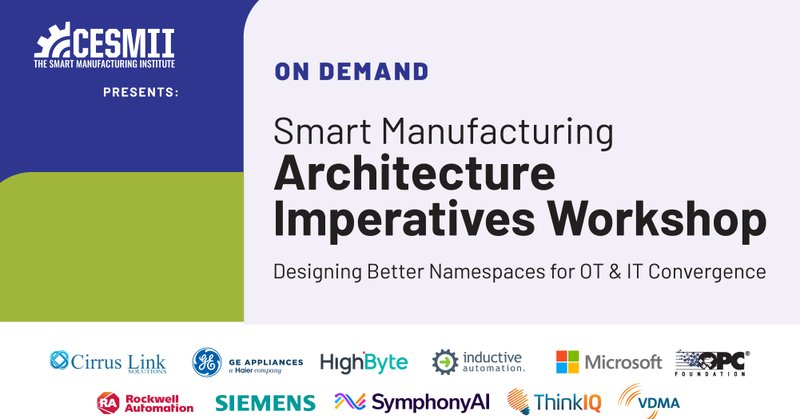
connect.cesmii.org
Unlock the potential of Smart Manufacturing with our on-demand workshop.
0
0
1
I’ve volunteered to contribute to the Linux Foundation’s State of the Edge report, specifically the section on Industrial Edge. The Industrial Edge is where IT meets OT, deploying compute resources close to manufacturing lines, energy systems, and logistics operations. Think
0
0
3
Poorly implemented Semantic Layers result in the "Wild West" The next step in historian evolution at most companies involves poorly conceived semantic layers that over-fit the problem being solved. They are not generalizable enough to be widely reused so they address one problem
0
0
0
Poorly implemented Semantic Layers result in the "Wild West" The next step in historian evolution at most companies involves poorly conceived semantic layers that over-fit the problem being solved. They are not generalizable enough to be widely reused so they address one problem
0
0
0
Why do Historian systems get stuck at a primitive level? Advanced use cases like Condition-Based Maintenance, Fleet Optimization, and AI integration are never realized. Companies leave millions of dollars on the table, shouldering the cost of avoidable waste and downtime. The
0
0
0
There are several ways to deal with the brownfield technical debt associated with a lack of adherence to tag naming conventions or changing control system landscapes, which results in changing standards. Most systems have tags that are decades old and have been collected by a
0
0
1
The Linux Foundation's LF Edge group publishes the most widely read Linux Foundation publication, the State of the Edge report. I contributed to the Industrial sections last year and will again this year. Last year, I discussed the skills gap in the OT world in adopting new
0
0
0
Did you hire a new Data Scientist and expect them to make sense of your OT data mess? Many companies are disappointed with the results. A Semantic Layer translates your OT-centric data models into the data scientist's IT models. It is the key to turning operational data into
0
0
0
"I just need the PI tags for..." Hearing those words means you haven't built a semantic model to group your tags into assets or processes and relate to data in other systems. The person asking you for the tags will have to arrange everything from scratch, probably in a
0
0
0
Today, industrial OT applications are specialized proprietary Windows-based applications often deployed in VMs. This was IT tech from over a decade ago, with each vendor doing things its way. As OT systems adopt more modern IT designs, often based on open source technology, an
0
0
0
Many companies get stuck on the OT data model using ICS tags as the basis for identifying the data streams in their Data Historian. Adopting naming standards seems like an easy way to impose some order, but it always falls short You need a full semantic layer to organize your
0
0
0