NASA Space Alerts
@NASASpaceAlerts
Followers
1M
Following
615
Media
362
Statuses
3K
@NASA official notifications on cosmic activity in near-Earth space including solar events, asteroids, comets, and meteors.
Washington, D.C.
Joined March 2009
New name. New look. Same trusted updates on planetary defense - and more! Welcome to the new @NASASpaceAlerts account – where we’ll share official NASA notifications on cosmic activity in near-Earth space, including: Solar activity💥 Asteroids 🪨 Comets ☄ Meteors 💫
42
81
412
To see how such space weather may affect Earth, check out @NWSSWPC, the U.S. government’s official source for space weather forecasts, watches, warnings, and alerts.
1
8
77
Solar flares are powerful bursts of radiation. Harmful radiation from a flare cannot pass through Earth’s atmosphere to physically affect humans on the ground. However — when intense enough — they can disturb the atmosphere in the layer where GPS & communications signals travel.
9
15
156
The Sun emitted a strong solar flare on Nov. 30, 2025, peaking at 9:49 p.m. ET. NASA’s Solar Dynamics Observatory captured an image of the event, which was classified as X1.9 class: https://t.co/cAJ3UyYL6n
213
972
5K
It’s #SunDay! This week’s (Nov. 21 - 28) space weather report includes: · 2 M-class flare · 2 C-class flares · 52 coronal mass ejections · 0 geomagnetic storms This video from NASA’s Solar Dynamics Observatory (SDO) shows the week’s activity.
37
238
895
#MeteorSighting: A fireball was observed over northern Michigan in the early morning of Nov. 23 – moving northeast at 98,500 mph. After traveling 82 miles, the fireball disintegrated above Lake Huron. Read more about this sighting: https://t.co/KVfkcddEVD Supporting data
8
46
183
The video of the Sun shown above, captured by NASA's Solar Dynamics Observatory (SDO) in its AIA-171 channel (colorized in gold), shows solar material at about 1.1 million ℉. That temperature range is great for visualizing the activity of the “quiet,” non-eruptive Sun. But
4
14
67
It’s #SunDay! This week’s (Nov. 14 - 20) space weather report includes: · 1 X-class flare · 3 M-class flares · 42 coronal mass ejections · 0 geomagnetic storms It’s our first full week back after the government shutdown, and this week's data range caught the tail end of the
36
177
643
Our accounts may have been quiet, but the Sun sure hasn’t! ☀️💥 So far, November has already seen six X-class solar flares and the strongest geomagnetic storm of 2025. All but one of these flares — the X1.1 flare on Nov. 4, shown here at the lower left — erupted from the same
66
320
1K
To see how such space weather may affect Earth, check out @NWSSWPC, the U.S. government’s official source for space weather forecasts, watches, warnings, and alerts.
2
3
40
Solar flares are powerful bursts of radiation. Harmful radiation from a flare cannot pass through Earth’s atmosphere to physically affect humans on the ground. However, when intense enough they can disturb the atmosphere in the layer where GPS & communications signals travel.
4
7
51
The Sun emitted a strong solar flare early this morning, Nov. 14, 2025, peaking at 3:30 a.m. ET. NASA's Solar Dynamics Observatory (right, close-up gif) and NOAA’s GOES-19 satellite (left, full Sun image) captured imagery of the event, which was classified as X4.0 class:
57
261
895
It’s #SunDay! This week’s (Sept. 19 - 25) space weather report includes: · 4 M-class flares · 30 coronal mass ejections · 0 geomagnetic storms This video from NASA’s Solar Dynamics Observatory (SDO) shows the week’s activity. At about 1:25 in the video, another celestial body
21
110
383
It’s #SunDay! This week’s (Sept. 12 - 18) space weather report includes: · 1 C-class flare · 38 coronal mass ejections · 1 geomagnetic storm This video from NASA’s Solar Dynamics Observatory (SDO) shows the week’s activity. There were plenty of coronal mass ejections this
15
132
454
NASA's Planetary Defense Program is charged with finding and tracking near-Earth objects. Here's what we've discovered thus far: https://t.co/6LdFcoymQ4
3
25
111
It’s #SunDay! This week’s (Sept. 5 - 11) space weather report includes: · 2 M-class flares · 4 C-class flares · 26 coronal mass ejections · 1 geomagnetic storm This video from NASA’s Solar Dynamics Observatory (SDO) shows the week’s activity. More on flares & coronal mass
9
111
359
The mid-disk eruption stems from a collapsing filament — a cloud of comparatively cold, dense solar material suspended aloft by the Sun’s magnetic field. As the Sun rotates, that magnetic field twists and contorts, causing the filament to ultimately collapse and erupt into a
1
15
72
It’s #SunDay! This week’s (Aug. 29 - Sept. 4) space weather report includes: · 5 M-class flares · 3 C-class flares · 21 coronal mass ejections · 1 geomagnetic storm This video from NASA’s Solar Dynamics Observatory (SDO) shows the week’s activity. At about 3:01 in the video, a
13
110
346
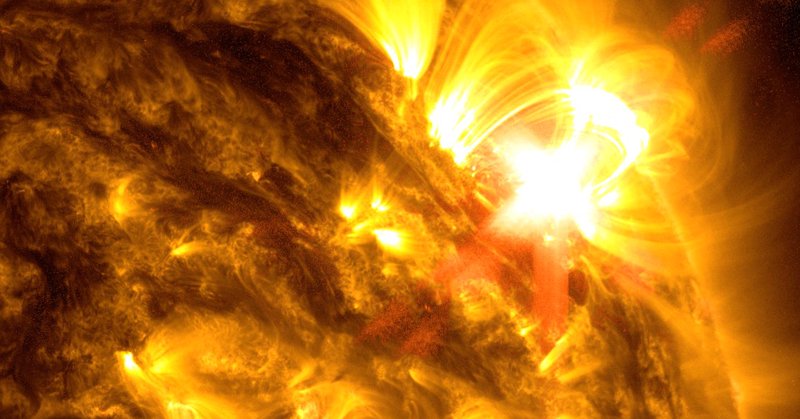
Sunspots and active regions appear on two different layers of the Sun. Both result from an especially intense and complex magnetic field. On the photosphere (solar surface): Areas of intense magnetic activity can prevent some heat and energy from rising to the surface,
science.nasa.gov
Solar storms and flares are eruptions from the Sun that can affect us here on Earth.
1
12
56
It’s #SunDay! This week’s (Aug 22 - 28) space weather report includes: · 15 M-class flares · 58 coronal mass ejections · 0 geomagnetic storms This video from NASA’s Solar Dynamics Observatory (SDO) shows the week’s activity. We currently have some very large active regions
28
238
706
At NASA, our planetary defense teams watch the skies to safeguard our planet. Sometimes, our telescopes find amazing objects like comet 3I/ATLAS. While not a threat to Earth, it’s a fascinating target for scientific study.

At @NASA, we're all about planetary protection. While we have determined interstellar comet 3I/ATLAS poses no threat to Earth, we have discovered it will come within about 130 million miles of our planet. Studying the comet sharpens our ability to detect & track potential
9
17
131