Marion Roullet
@LabSquishyStuff
Followers
195
Following
559
Media
53
Statuses
347
PhD in #yogurt , now post-doc in #biobased plastics| Creator of @YummyPhysics | Tweets in 🇫🇷 🇬🇧
Strasbourg, France
Joined March 2017
Another paper from my PhD is (finally) out: https://t.co/USlvSEP6NP We study what makes set yogurt bouncy or squishy. In physics jargon, we call it the rheology of emulsion gels. 👩🔬🥛🛠️⚗️🔬 What did we do? [a thread] ⬇️
1
1
10
L'outil libre et gratuit GES1 point5, permettant d'évaluer l'empreinte carbone des laboratoires de recherche, est disponible dès aujourd'hui : https://t.co/zqa7iiMXyo Voir notre communiqué ci-dessous⬇️
0
41
58

New video! Let's dive into the pixels of our screens to explore the physics of liquid crystals: fluids that are colourful, beautiful, and ordered! 📱 https://t.co/CMtDgcMkiR
0
4
8
New video! How to use microdroplets and ultrasounds to synthesize drugs directly in the body? 💧🔬💊 For the answer, tune in to our first microfluidic interview, with Marine Bézagu! https://t.co/pd7bv33Mo9
2
4
7

Une poussée d'Archimède... inversée ! les résultats étonnants de chercheurs @PMMH_lab @InstLangevin dans @nature montrent qu'il est possible de faire flotter un objet... sous un liquide en lévitation ! https://t.co/g5gSRL8gIE
https://t.co/lnfdzBIqd2
1
10
18

Hello again, YouTube! La saison 2 du Projet Lutétium commence maintenant 🥳 Voici le programme, à partager largement !
2
14
25
Breaking news: the Lutetium Project is back! We'll release new videos from our Season 2 starting next Tuesday, September 1st. We can't wait to share them with you!
0
9
32
Both the research and the videos were funded by @MSCActions, to which I am very grateful. The research was carried at Unilever and @PhysAstroEd
0
0
1
The clips used to illustrate some concepts are from my #scicomm project @YummyPhysics, check the full episodes on Youtube:
youtube.com
Join Alex the science nerd on the brand new Youtube series “Yummy Physics”, as he investigates why his favorite food has suddenly been deconstructed! On the way, find out about the fascinating...
1
2
4
If you are interested, please check our paper (free for 40 days): 📰 https://t.co/USlvSEP6NP Or the preprint (free forever but less pretty): 🗒️
1
0
1
I was working in an ice cream R&D department when I did this research, but why? Ice cream has a complicated structure, part of which is a milk-like emulsion that forms a yogurt-like network. If you want to make vegan or fat-reduced ice cream, you need to understand how they work
1
1
3
The next step is to use these results to study the mixtures. These results are not published yet, but if you can't wait to find them out, you can check the Chapter 7 of my PhD thesis, available here:
1
0
1
We went on showing that choosing to put big bouncy fat droplets or tiny fluffy proteins in gels does have an influence on some results. But not that much, really!
1
0
1
We could determine this space, that we call volume fraction, using our previous study on the viscosity of milk-like emulsions. The paper is here (free!): https://t.co/Dhl7NYvPvh and I have presented the results here:
Have you ever wondered why #cream is thicker (more viscous) than #milk? Cream contains more fat droplets, so it's difficult to move them all to pour it. But what about the role of milk proteins in these #emulsions? A summary of our new paper ( https://t.co/VweALsHIFz): 1/n
1
0
1
More precisely, what matters is the way you measure the quantity of what you put is important. ⚖️ Traditionally, the weight of the ingredients is used (because it is convenient). But we showed that the space occupied by the stuff, protein or fat droplets, is more important.
1
0
1
This new paper is the first part of the study, with separated ingredients. The main result is that the bounciness (in jargon, the storage modulus G’) depends much more on HOW MUCH stuff you put in your gels than WHAT you put in them.
1
0
1
Our strategy was to separate these two elements. 1⃣First we studied the gels made of only proteins (similar to fat-free yogurt), and those with only fat droplets (similar to the French “crème fraiche”). 2⃣Then we put everything back together.
1
0
1
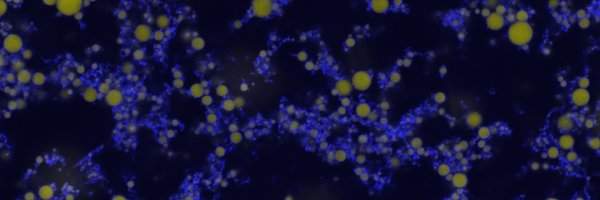
It’s complicated because our emulsions are mixtures made of proteins floating around, and of fat droplets with proteins as a protective cushion around them. (It is easier to make pictures when things stop moving, so here is a gel of a mixture for you 🔬)
1
0
1
Our question for my PhD was simple: what makes yogurt-like gels squishy? What changes with the amounts of fat and proteins we use to make our milk-like emulsions?
1
0
1
To make these squishy materials, other liquids can be used, you only need tiny fat droplets. These liquids are called emulsions. In the food industry, emulsions are often made with vegetable oils and milk proteins: proteins attach around the fat droplets and make them stable.
1
0
2
Let’s start with why yogurt is so interesting. To make yogurt, you take liquid milk, and you turn it into a squishy solid. 🥛🍋🥣 This happens because all the fat and protein in milk stick together and form a network that can hold itself 🪜. We call it a gel.
1
0
1