

George Melios
@GeorgeMelios
Followers
828
Following
683
Media
25
Statuses
170
Academic working on beliefs and subsequent behaviors. Currently at @LSEnews & @RoyalHolloway - ex @UCL, @Yale, @swanecon
London, England
Joined November 2009
Have you seen The Spotlight (@SpotlightMovie) and wondered about the broader implications of these scandals? In our new WP 🚨, @BKleinTeeselink and I study how religiosity affects policy preferences and gender norms. Here's what we find: (a 🧵) #EconTwitter #polsciTwitter
1
3
8
The data can be found here. I've downloaded the data and have already begun to explore it. Super cool! https://t.co/mBNUQAy3Op

Wow. This is wild. Researchers from Columbia, Michigan, and Maryland released VRscores. VRscores is a dataset linking voter registrations to online worker profiles that allow you to measure the partisan leanings of U.S. employers. 24.5M workers. 500k employers. 2012–2024.
0
2
14
Our new book — Greening the International Monetary Fund (Cambridge University Press, 2025) — examines how climate change has become embedded in the IMF’s work and what this means for global economic governance. 📖 Open access:
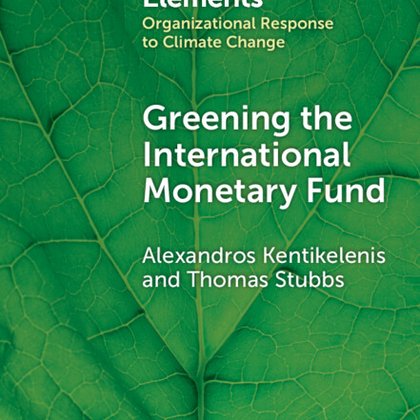
cambridge.org
Cambridge Core - American Studies - Greening the International Monetary Fund
1
3
5
Read the full paper here 👉 https://t.co/8JAhURlXHD And see the coverage by @KingsCollegeLon:
kcl.ac.uk
A new study co-authored by a King’s academic has shown that disability benefits designed to cover extra living costs without restricting employment do not always discourage workforce participation.
0
0
0
Interpretation: Well-designed, work-neutral disability benefits do not reduce labor market participation. The small positive effects under strict assessors likely reflect filtering out strategic claims, not large behavioral responses.
1
0
0
📊 Results: •Expanding access (mental health) → no reduction in employment, if anything small positive effects •Restricting access (minor physical disabilities) → no gains in employment •Stricter assessors → small but significant ↑ in employment
1
0
0
Using the UK panel data (2009–2019) & quasi-experimental variation from the DLA→PIP reform, we estimate employment effects for: •Mental health conditions (gained eligibility) •Minor physical disabilities (lost eligibility) •Regions with stricter vs lenient assessors
1
0
0
PIP is unique. It covers the extra costs of disability but has no earnings tests & no work incapacity requirements. This design lets us isolate pure income effects without substitution distortions.
1
0
0
Most disability benefits combine income support + work restrictions. That makes it hard to know: do people work less because they can, or because policy forces them not to?
1
0
0
🚨 New working paper alert! As part of our Horizon Europe BENEFITS project, @BKleinTeeselink and I study whether disability benefits necessarily discourage work — using the UK’s Personal Independence Payment (PIP) reform as a natural experiment. 🧵 #econtwitter #horizoneu
1
1
3

❤️Does partisanship shape online dating? ➡️ In a conjoint in the UK, @yara_slei @GeorgeMelios & @profpauldolan find politics matter as much as looks, but openness to opposing views matters more. Labour voters show stronger in-group bias https://t.co/0UrhHOxe6O
#FirstView
0
6
19

Takeaway: politics matters in private life—but signaling openness can bridge divides. Surfacing “tolerance” on platforms might reduce partisan sorting
1
0
0
Gender splits: Men penalized “progressive” profiles; women rewarded them. Women also showed a stronger in‑party preference than men
1
0
0
Counter‑stereotypes: Conservatives were more open to out‑partisans who defied stereotypes (e.g., White/Traditional/Non‑veg Labour). Labour respondents tended to prefer stereotypical Tories—except they liked progressive Tories
1
0
0
But tolerance is even stronger. Profiles saying “open to match with anyone” gained +19.9 pp—the largest effect; similar in size to being attractive. It’s not just avoiding “No Tories/No Labour” profiles. Even among co‑partisans, people preferred tolerant over intolerant profiles
1
0
0
Headline: Co‑partisanship is powerful. Co‑partisan profiles were picked +18.2 pp more often than out‑partisans
1
0
0
We ran a visual conjoint with 3,000 UK daters (18–40). Profiles varied party (Labour/Tory), a clear “tolerance” cue, ideology, race, education, diet, height, and facial attractiveness—using real photos to mirror apps
1
0
0
🚨📢 New paper out in @PSRMJournal w. @yara_slei & @profpauldolan : “Sleeping with the enemy: partisanship and tolerance in online dating”. How much do politics shape who we swipe?
1
1
2
#OpenAccess from @psrmjournal - “Sleeping with the enemy”: partisanship and tolerance in online dating - https://t.co/wQ2r5suzyA - @yara_slei, Georgios Melios & @profpauldolan
#FirstView
0
3
6
On a personal note, @yara_slei and I took our “collaboration” to the next level last weekend! 🥳
0
1
7